My insights and writing into Artificial Intelligence and Search

Page 1 | Page 2

Google logo demystifying in a futuristic-library.webp
AI will not replace you. Someone using AI will. These articles explore how modern search systems, including how Google, evaluate websites as structured entities rather than collections of pages. They examine why visibility often stalls despite ongoing SEO activity, how interpretation stabilises over time, and what actually needs to change to shift that position.

Understanding How Structure Shapes Search Visibility

At the centre of this is not optimisation, but structure — how authority is distributed, where it accumulates, where it dissipates, and how intent is reinforced across a site through structural authority flow. These are the underlying dynamics that shape visibility long before rankings appear or decline.

The purpose of this work is not to provide tactical advice, but to support clearer decision-making. Because without understanding the hidden model behind your website’s rankings, further investment often compounds the same outcomes rather than changing them. The future of SEO is still alive and well and even more exciting since the inception of AI.

Foundational & Systems-Level Analysis;

Behind every search query lies a vast mathematical blueprint that determines which pages rise to the top and which remain invisible. While most websites focus solely on surface-level keywords, search engines actually navigate and evaluate your content using network graph theory and probabilistic traversal models—the hidden frameworks that dictate how search crawlers discover your pages, allocate authority, and interpret your site’s true architecture. Understanding how these underlying structural systems view your domain is the key to unlocking consistent, long-term search performance. Explore our structural diagnostic frameworks below to see how search engines truly see your site.
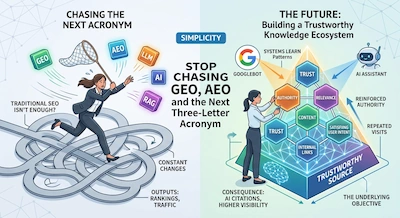
Stop Chasing GEO, AEO and the Next Three-Letter Acronym
Recently, terms such as Generative Engine Optimisation (GEO), Answer Engine Optimisation (AEO) and a growing collection of AI-focused optimisation strategies have become the latest talking points.
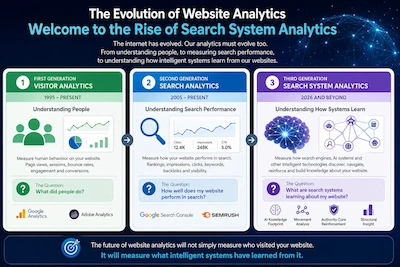
Diagram showing the evolution of website analytics from Visitor Analytics to Search Analytics and finally Search System Analytics, illustrating how intelligent search systems learn from websites.The Rise of Search System Analytics.
The internet has fundamentally changed – For more than two decades, website analytics has revolved around one central objective: understanding people.
An infographic for tgbarker.co.uk titled "Why Your Website Navigation Cannot Scale." On the left, a vintage wooden machine represents a limited "Navigation Menu" overflowing with content. This overflow feeds into a large, glowing digital brain network on the right representing "Google’s Internal Model." Inside the network, individual pages act as nodes connected by flowing light paths of "Internal Links," converging into bright "Authority Hubs" and "Topic Hubs" that ultimately broadcast a signal labeled "Visibility Emerges." Two professionals stand at the bottom right observing the data visualization.Why Your Website Navigation Cannot Scale — And What Google Does Instead

How Google uses internal links, authority flow and structural relationships to determine which pages matter most.
Measuring So how do we measure which pages a website's structure actually makes important?How We Measure Website Structure and Authority
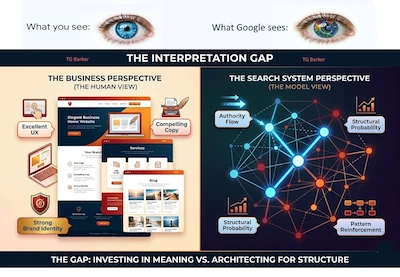
Which pages does your website actually make important? See how graph theory, Markov chains and probability reveal authority flow and structural strength.
Display of a website example with left hand side giving the human eye view of a user sees with a chart or graph of what a search engine seesWe Can Now See How AI Systems Track & Move Through a Website

If you own a website, understanding how AI systems travel through it is becoming increasingly important. Yet this is an area that many SEO and analytics platforms have not yet addressed.
What foundation is the website being built on — and how will you measure whether it is working as intended?How do you measure SEO progress?
When you employ an SEO agency, commission a website redesign or prepare to launch an entirely new website, there is an important question that is often overlooked: What foundation is the website being built on — and how will you measure whether it is working as intended?
Diagram illustrating AI crawlability: Open access allows AI crawlers to process pages and generate citations, while blocked access prevents answer engines from citing contentSearch System Behaviour | how do they move through my website
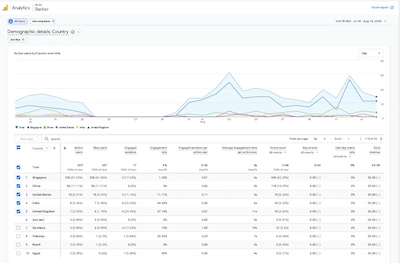
Discover how AI & search systems move through your website, reinforce key pages and build an understanding of your website’s structure over time.
Google Analytics demographic dataGoogle analytics and server-side behavioural analysis

Why Google Analytics alone cannot identify every website visitor. See how server-side analytics reveals AI crawlers, bots and automated traffic.
Architectural blueprint showing a website structure foundation, illustrating how commercial hub pages, pillar content, and supporting blog posts connect to direct PageRank and authority flowYour Website Needs a Foundation
How PageRank, the Random Surfer model, graph theory and Markov chains can help structure a website around the pages you most want to rank.
A technical SEO case study infographic titled 'Pharmacy UK: Markov Chain SEO Analysis'. The left side illustrates 'The Symmetry Problem' with a dense, chaotic web graph of 374 pages and over 30,000 links showing a flat stationary distribution of authority. The right side illustrates the 'Target State' with an optimized, clean hierarchical directed graph flowing from the Homepage down to commercial category hubs and thematic clusters, establishing clear authority signals for search systems.Pharmacy UK Case Study: Markov Chain SEO Analysis

Why a UK Pharmacy Website Remained on Page 2 Despite a Strong Internal Link Network.
A conceptual diagram illustrating the reinforcement model of search visibility. On the left, various digital signals like "Content Depth," "Internal Links," and "User Signals" flow into a large, central glass lens labeled "Search System’s Interpretation." As these signals pass through the lens, they focus into a powerful beam that drives an upward-trending bar chart on the right, representing "Increased Probability" and "Search Visibility Rankings Growth" against a dark, technical background with node-network patterns.The Reinforcement Model Behind Search Visibility

How search systems reinforce existing interpretations of websites. Why rankings stabilise, visibility plateaus, and authority strengthens through repeated signals.
A sleek, stylized digital wireframe or blueprint of a complex structure (like a modern building or an intricate maze) overlaid with faint glowing code or mathematical data streams. The focus is on the "skeleton" of the structure rather than the surface.How Search Engines Decode Your Site
Your website’s internal model is the conceptual map search engines use to judge authority.

A complex, glowing digital network graph on a dark background illustrating website probability and movement structures. The diagram features interconnected blue and gold nodes labeled as "Authority Hub," "Conceptual Centre," "Knowledge Base," "Entry Page," and "Supporting Content." Glowing directional arrows represent transition pathways with mathematical formulas like "P(i → j)" and labels such as "Markov Chain Transition" and "Reinforcement Loop," visually demonstrating how search engine algorithms analyze website architecture and user behaviorSearch Engines and The Origins of Probability Modelling
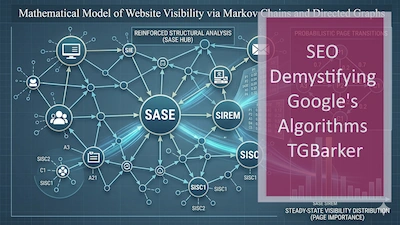
How 20th-century mathematics shapes modern SEO. Learn how search engines use graph theory and Markov chains to interpret your website.

A technical diagram titled "Mathematical Model of Website Visibility via Markov Chains and Directed Graphs" on a dark grid background. The center features a complex network map of web page nodes connected by directional arrows, highlighting central hubs like "SASE," "SIREM," and "SISC." To the right, supplementary panels display data tables of transition matrices, a small directed graph loop with numerical probability values (such as 0.7 and 0.2) labeled "Probabilistic Page Transitions," and a bar chart at the bottom right illustrating a "Steady-State Visibility Distribution (Page Importance).The Markov Model of Website Structure and Search Visibility

Ranking as mathematical outcome of your website. The mathematical foundation behind Google’s original PageRank system is known as the Random Surfer model.
The Hidden Structure Behind Search VisibilityThe Hidden Structure Behind Search Visibility
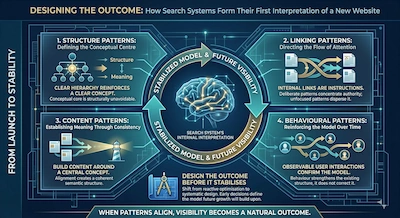
Search visibility is shaped less by SEO activity and more by how search systems interpret the structure of a website.
An infographic titled "Designing the Outcome: How Search Systems Form Their First Interpretation of a New Website," illustrating a cyclical system of SEO patterns."Launching a New Website
Learn how structural, linking, and content patterns at launch define the stable interpretation search systems form of your website
An infographic illustrating the invisible probability model behind search rankings. The top layer shows traditional SEO signals like keywords, backlinks, and content quality. The bottom layer reveals a hidden network graph of interconnected page nodes with flowing authority paths, accompanied by visualizations of a coin toss, an 8-sided die, and a Markov transition matrix.The Invisible Probability Model Behind Search Rankings

The hidden probability model search engines use to analyze your website’s architecture and authority flow.
Signals stable authorityHow Search Systems Decide What to Trust
Authoritative content isn’t just well written—it’s structurally reinforced and trusted to resolve intent. Learn how search systems identify and rank it.
technical overlay of a Markov Chain Transition Matrix showing probabilistic pathways converging on a central Authority Core with a 85.86% self-transition probability.Understanding Website behaviour Through a Transition Matrix

How Internal Models Shape Search Interpretation: Most website owners think in terms of pages, rankings, keywords, and backlinks. Search systems do not.
Visualization of Search Systems Evaluation showing website authority flow and internal link patterns in blue and red.
Search Systems Evaluation: Is Your Website Structurally Invisible?
Search systems do not evaluate websites in the way most businesses assume. They do not simply read content, count keywords, or reward activity.
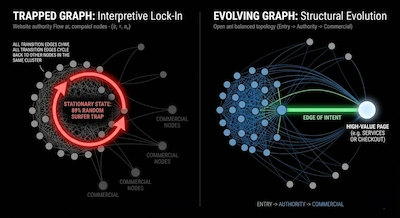
Graph theory diagram comparing two website structures: A 'Trapped Graph' with a red feedback loop showing 89% interpretive lock-in of authority, versus an 'Evolving Graph' where a thick green edge redirects authority to high-value pages like services and checkout.
The Anatomy of a Website Ranking Plateau

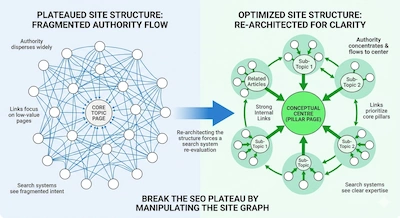
Visualizing Interpretive Lock-In: The Anatomy of a Ranking Plateau. This diagram is a visualization of a website’s internal architecture, viewed through the lens of Directed Graph Theory.

A comparison infographic titled 'Break the SEO Plateau by Manipulating the Site Graph.' The left side shows a 'Plateaued Site Structure' with a chaotic, tangled web of nodes where authority disperses widely and intent is fragmented. An arrow labeled 'Re-architecting the structure forces a search system re-evaluation' points to the right side, which shows an 'Optimized Site Structure.' This model features a clear 'Conceptual Centre' (Pillar Page) surrounded by organized sub-topic clusters and related articles, with green arrows illustrating how internal link equity concentrates and flows toward the center to signal expertise to search systems.
The Architecture of Perception: How Google Evaluates Your Website as a System

In the world of high-stakes SEO, there is a fundamental misunderstanding that visibility is a reward for volume—more content, more technical fixes, and more backlinks.

A technical diagram illustrating structural resistance in search systems, showing new content and optimization signals being absorbed or deflected by a stable internal model and a fixed authority coreHow Search Systems Evaluate Websites
Over many years of working with websites, search engines, and long-term ranking behaviour, one observation became increasingly difficult to ignore. Many websites do not struggle because of poor effort, weak content, or a lack of optimisation.
A technical diagram of a search system's internal model, showing how new content and optimization signals are deflected by a pre-existing stable interpretation flow and structural resistance The Hidden System Behind Search Engine Visibility
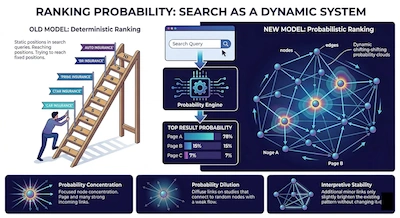
Why more SEO activity stops working. For years, website owners have been told that growth is simply a matter of doing more. Publish more content. Build more backlinks. Add more keywords. Increase activity and rankings will eventually follow. Sometimes this works, particularly for newer websites that are still being explored and interpreted by search systems.
An infographic titled "Ranking Probability: Search as a Dynamic System" comparing the old deterministic SEO model of a linear ladder to a new probabilistic model. The new model illustrates search results as a complex web of nodes and edges, showing "Top Result Probability" percentages and explaining concepts like Probability Concentration, Dilution, and Interpretive Stability.Ranking Probability: Why Search Visibility Is a Probabilistic System, Not a Fixed Position

Search rankings are often discussed as though they are fixed positions waiting to be achieved. Businesses are told to improve keywords, publish more content, gain more backlinks, and eventually “reach number one.”
Why Is My Website Not Ranking?Why Is My Website Not Ranking?
Many website owners reach a point where they ask a simple question: why is my website not ranking?
why your website is not moving or ranking on GoogleWhy Your Website Isn’t Moving Up Google — Even After Months of SEO

You have invested in content. Technical issues have been fixed. Pages are optimised. Backlinks have been acquired.
Why has my website dropped?Why Your Website Rankings Suddenly Dropped?

When website rankings drop, the instinct is immediate reaction. Traffic declines. Leads slow. Internal questions begin.
A conceptual 3D data visualization of AI systems and search crawlers traversing a website structure. Neon blue and orange network nodes map out categories like Authority Core, Supporting Content, and Structural Pages. Tiny stylized robot figures navigate along the path lines, illustrating a Markov system flow matrix and demonstrating how automated bots interpret website hierarchy and data architecture.Understanding How Search Systems Model Your Website

How to monitor search engines, AI models, and autonomous technologies and monitor how they gradually develop a structural understanding of a website.
A futuristic, technical illustration of a website interface with the domain www.tgbarker.co.uk. A glowing, translucent AI figure interacts with the site's layout, extracting concepts like 'Methodologies,' 'Experience,' and 'Knowledge' into a complex neural network.What Is AI Learning From Your Website?
Much of the industry focus is on the companies building massive language models. They deserve immense credit for what they have achieved. But I highly doubt that’s where most organizations will find their ultimate competitive advantage.

Page 1 | Page 2