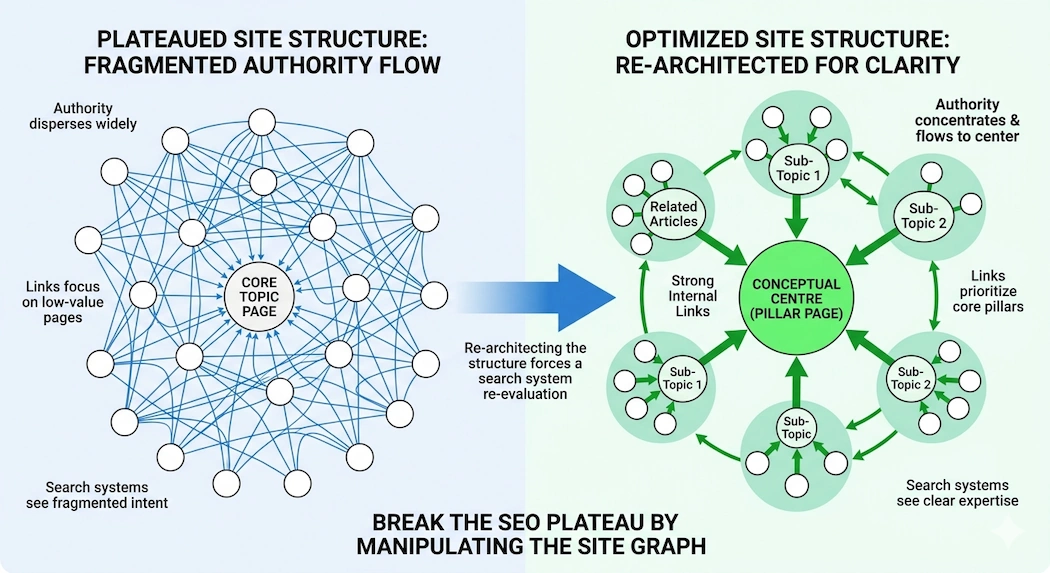
In the world of high-stakes SEO, there is a fundamental misunderstanding that visibility is a reward for volume—more content, more technical fixes, and more backlinks. Yet, many organizations find that after an initial surge, they hit a frustrating wall. Content is published, but the needle doesn’t move.
This occurs because search systems do not evaluate pages in isolation. They interpret your website as a connected graphical system. To move beyond a plateau, you must stop optimizing pages and start managing the hidden model Google builds of your entire domain.
Beyond the Page: The “Hidden Model” of Evaluation
Modern search engines build a structural representation of your organization long before a human visitor arrives. This is not merely a list of keywords; it is a complex map of relationships. Google assesses:
When search systems form a consistent interpretation of your site, your rankings stabilize. At this point, adding more content often just reinforces the existing, limited model rather than expanding it. This is why evaluation must precede optimization.
Authority is Synthesized, Not Assigned
Think of your website as a hydraulic system. Internal linking is the plumbing that dictates how authority flows. If your internal link profile is skewed toward transient blog posts rather than core commercial pillars, you are signaling to Google that your site is primarily informational. This “intent mismatch” can inadvertently suppress the very pages you want to rank.
Internal linking is the primary engine of your site’s architecture. Where a fragmented structure dilutes your power, a coherent hierarchy consolidates it, funneling equity toward the nodes that drive growth.
Why SEO Progress Often Plateaus
Visibility does not plateau because your activity has slowed; it plateaus because evaluation has stabilized. Once Google’s interpretation of your site’s “shape” and “intent” becomes fixed, additional efforts yield diminishing returns.
This is the point where the why SEO progress often plateaus becomes clear. You aren’t fighting a lack of content; you are fighting a structural conclusion that Google has already reached about your domain. To break this cycle, you must shift the evaluation by eliminating authority leaks and reinforcing the hub through deliberate structural signals.
Summary: Activity vs. Evaluation
| Phase |
Tactical Focus (The Plateau) |
Strategic Focus (The Breakthrough) |
| View of Site |
A collection of individual pages. |
A unified graphical system. |
| Internal Links |
Used for user navigation only. |
The primary engine for authority distribution. |
| Goal |
Increase volume of content/links. |
Influence the structural model Google builds. |
| Result |
Stabilization / Diminishing returns. |
Scalable growth and topical authority. |
Ready to shift your evaluation?
Search systems do not respond to activity alone; they respond to how a website is understood. This understanding is shaped by the distribution of authority across the site. When your internal linking is fragmented, authority disperses too widely, and no single page gains sufficient strength to break through competitive rankings. By re-architecting your site to concentrate flow toward your conceptual centre, you transition from a collection of isolated pages to a unified, authoritative system that Google can finally interpret as a market leader.
3 Steps to Re-Architect Your Flow:
- Map the Nodes: Identify the 3–5 pages that actually drive your business. These are your “Conceptual Centres.”
- Prune the Pathing: Look for “Authority Leaks”—pages that have a high number of internal links but provide zero ranking value. Reduce their prominence in your global navigation.
- Strengthen the Spokes: Use contextual internal links within your blog posts to point upward to your pillar pages. This doesn’t just help users; it creates a “semantic gravity” that tells Google exactly which page is the authority on that topic.
Why this breaks the Plateau
By changing the structure, you are effectively forcing a re-evaluation. You are giving Google a new “map” to crawl. When the crawler sees a clear, logical flow toward a central point of expertise, it updates its hidden model of your site. This shift in the internal graph is often the “key” that unlocks the next level of organic visibility.
Conclusion: Evaluation Before Optimisation
Most SEO strategies are tactical—they prioritize doing things over understanding them. But without knowing how your site is currently being interpreted, every “optimization” is a shot in the dark. Addressing the Structural Authority Flow ensures that every new piece of content contributes to a stronger, more visible, and more stable domain.