

Healthcare Website SEO Case Study: When Internal Links Give Authority to the Wrong Pages
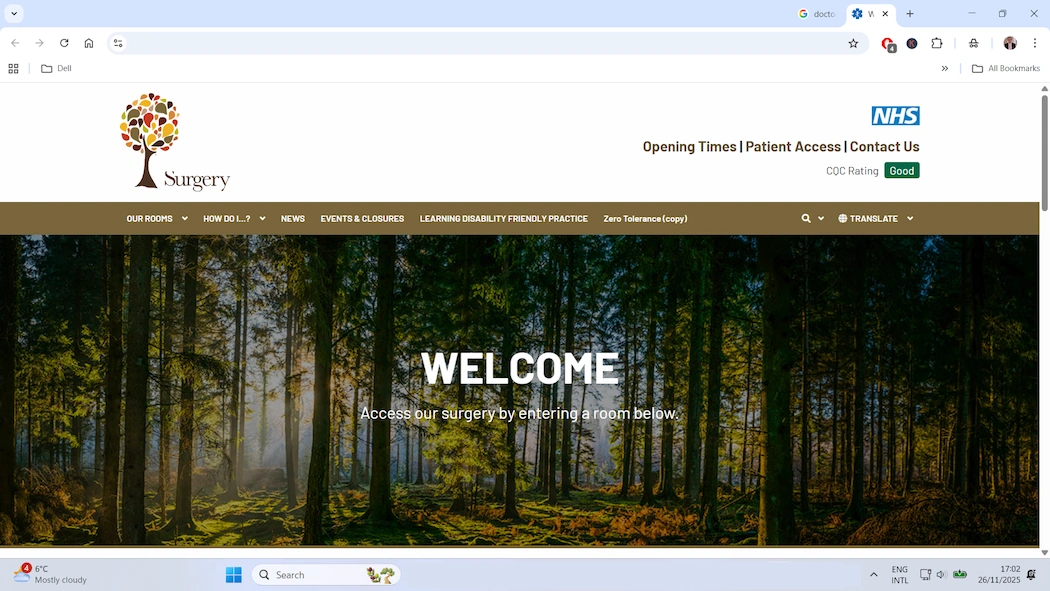 This healthcare website had an unusual structural problem.
The pages patients were most likely to need — including Tests & Results, Travel Clinic, Join the Practice, Referrals, Fit Notes and Reception Enquiries — were among the weakest pages in the website’s internal authority structure.
Meanwhile, pages such as CQC Reports, Friends & Family Test, Patient Access and Opening Hours were absorbing a disproportionate share of the site’s internal link authority.
Nothing was necessarily technically “broken”.
The problem was how authority was flowing through the website.
How We Analysed the Website
We mapped the website’s internal links as a network and analysed that network using a Markov chain.
A Markov model allows us to examine the probability of movement from one page to another through the website’s internal links. This gives us a way of measuring which pages naturally accumulate structural authority and which pages remain relatively weak.
Rather than simply counting links, we wanted to understand the website as a connected system.
The question was:
If a search system followed the website’s internal links repeatedly, which pages would the structure continually reinforce?
What the Existing Structure Revealed
The initial analysis showed that a relatively small group of pages dominated the website’s internal authority structure.
- Homepage
- Friends & Family Test
- CQC Reports
- Patient Access
- Opening Hours
These pages were receiving a substantial share of the site’s internal authority.
But some of the pages representing important patient actions were receiving only around 1% of the site’s internal authority.
These included:
- Join the Practice
- Tests & Results
- Travel Clinic
- Referrals
- Fit Notes
- Reception Enquiries
- Who Do I See?
- Non-NHS Services
This created an important question.
Why were pages representing useful patient services structurally weaker than pages that happened to receive repeated navigation links?
The Website Had the Right Pages — But the Wrong Authority Distribution
This is an important distinction.
The problem was not necessarily missing content.
The website already contained pages covering the services and actions patients needed.
But the internal linking structure was repeatedly reinforcing some pages while leaving other important pages relatively isolated.
In graph terms, the website had created several strong nodes that were absorbing a disproportionate amount of the available internal link flow.
We can think of these strong pages as authority reservoirs.
The opportunity was to use those reservoirs to strengthen the rest of the website.
What Would Happen If We Changed the Internal Links?
Instead of immediately changing the live website, we first changed the mathematical model.
We simulated additional internal links from the strongest pages towards the weaker patient-service pages.
For example, stronger pages such as the homepage, Patient Access and Opening Hours could provide contextual pathways towards relevant service and action pages.
We then ran the Markov calculation again.
This allowed us to compare the existing website structure with a proposed alternative before making the changes to the live website.
Before and After: The Difference Was Substantial
The simulated internal-link changes produced a significant redistribution of structural authority.
| Page | Before | After | Change |
|---|---|---|---|
| Tests & Results | 0.0136 | 0.0470 | +246% |
| Travel Clinic | 0.0135 | 0.0468 | +246% |
| Non-NHS Services | 0.0135 | 0.0468 | +246% |
| Reception Enquiries | 0.0129 | 0.0428 | +232% |
| Join the Practice | 0.0123 | 0.0407 | +231% |
| Fit Notes | 0.0123 | 0.0407 | +231% |
| Who Do I See? | 0.0123 | 0.0407 | +231% |
| Referrals | 0.0131 | 0.0359 | +174% |
| Request a Home Visit | 0.0131 | 0.0359 | +174% |
What Does a 246% Increase Actually Mean?
It is important to understand what these figures represent.
A 246% increase does not mean that Google rankings would automatically improve by 246%.
It means that within the simulated Markov model, the page’s share of structural authority increased substantially after the proposed internal links were introduced.
For example, Tests & Results moved from:
0.0136 to 0.0470
That is a fundamental change in the page’s position within the website’s internal authority network.
The model therefore gives us something extremely useful: a way of testing structural changes mathematically before implementing them.
The Website Began to Tell a Different Story
Before the simulation, the website’s strongest pages were largely determined by its existing navigation structure.
After redistributing the internal links, important patient-service pages began appearing much higher within the authority model.
Tests & Results, Travel Clinic, Non-NHS Services and Reception Enquiries all became substantially stronger nodes within the network.
That produces a website hierarchy that more closely reflects what the website is actually there to provide.
The internal structure begins reinforcing purpose, rather than simply reinforcing navigation.
Why This Matters Beyond a Healthcare Website
This problem is not unique to medical websites.
A website can contain hundreds or thousands of pages, have substantial content and already possess external authority — yet still distribute its internal authority inefficiently.
The strongest page for a business objective is not automatically the page receiving the strongest structural support.
Navigation menus, templates, footers, repeated links and historical site architecture can gradually create an authority pattern that bears little relationship to current commercial priorities.
That is why simply looking at individual pages can miss the larger problem.
Sometimes the problem isn’t the page. The problem is the system surrounding the page.
Why We Use Markov Chains to Analyse Website Structure
Traditional SEO tools can tell us how many internal links point to a page.
That is useful, but it doesn’t tell the whole story.
A link from a structurally important page is not necessarily equivalent to a link from a deeply buried page.
Markov-chain analysis allows us to examine the website as a network of connected states and calculate how authority is likely to settle across that network over repeated transitions.
This helps answer a much more interesting question:
Where does the structure of the website naturally concentrate authority?
Once we can measure that, we can begin modelling what happens when the structure changes.
What This Case Study Demonstrates
The healthcare website did not necessarily need more content.
It did not necessarily need dozens of new pages.
The analysis identified something more fundamental:
The website already had valuable pages. They simply weren’t receiving the structural reinforcement they deserved.
By modelling the website as a network, identifying its strongest and weakest nodes, and then simulating alternative internal links, we could see how dramatically the distribution of authority could change.
That turns internal linking from guesswork into something that can be measured, modelled and tested.
The Bigger Question
Most website owners know which pages they would like Google to consider important.
But there is another question worth asking:
Does the mathematical structure of the website agree with them?
That is what this type of analysis is designed to discover.