

How Search Systems Model New Websites
Author: T.G. Barker | How Google Evaluates Websites | Last reviewed: 10/09/2026
A new website is not interpreted by what you intend it to be, but by the structural and relational patterns present at launch.
Author: T.G. Barker | How Google Evaluates Websites | Last reviewed: 10/09/2026
A new website is not interpreted by what you intend it to be, but by the structural and relational patterns present at launch.
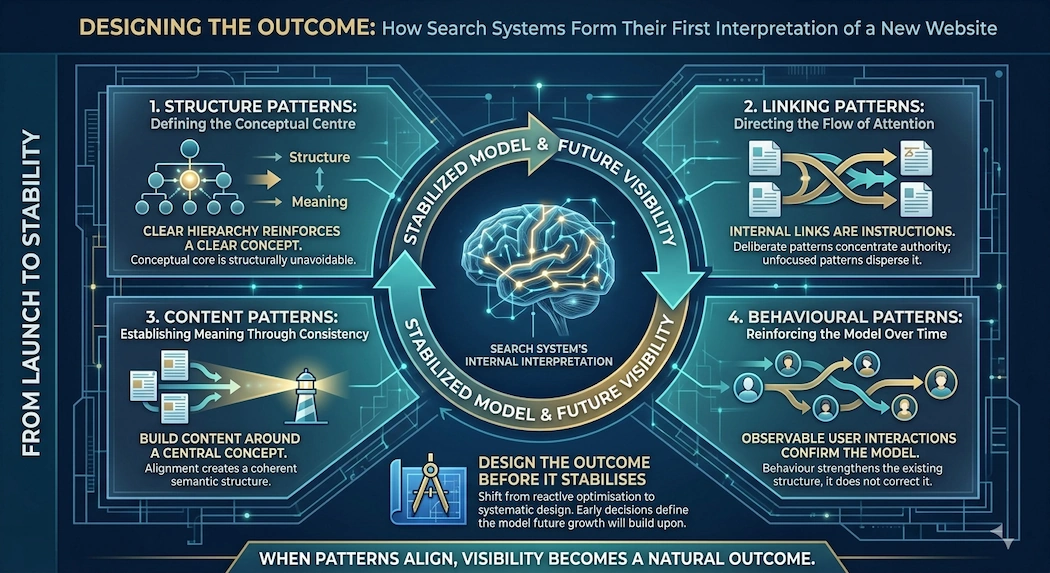
The image features four quadrant boxes—Structure, Linking, Content, and Behavioural Patterns—surrounding a central glowing brain that represents the “Search System’s Internal Interpretation.”
Structure Patterns shows a clear hierarchy vs. scattered meaning.
Linking Patterns depicts arrows flowing between pages to concentrate authority.
Content Patterns shows multiple documents converging on a central “lighthouse” concept.
Behavioural Patterns illustrates user paths reinforcing the site model.
A new website is not interpreted by what you intend it to be, but by the structural and relational patterns present at launch — and those patterns harden into the model that determines future visibility
When launching a new website, most attention is placed on design, branding, and content creation. Pages are written, navigation is built, and the site is prepared for visitors. But long before meaningful traffic arrives, search systems begin forming an internal interpretation of the website — one that will shape its future visibility.
This interpretation is not based on intention. It is based on observable patterns. As explained in how Google evaluates websites, search systems do not read a site in the way a human does. They construct a model from structure, relationships, and behaviour. Rankings are not assigned manually; they emerge as the outcome of that model.
For a new website, this moment is critical. Unlike an established site, where the challenge is to change an existing interpretation, a new site is being understood for the first time. The patterns present at launch often define the direction the model will take.
The structure of a website is the first signal a search system receives. It determines what appears central, what supports it, and what sits on the edge of the domain. This is not simply a matter of organising pages — it is how meaning is inferred at a structural level.
Search systems analyse how pages relate to one another, identifying clusters, hierarchies, and focal points. A clear structure reinforces a clear concept. A scattered structure creates ambiguity. This is why structural authority flow is fundamental to how a website is interpreted.
At launch, the goal is not to create a large site. It is to create a site where the core idea is structurally unavoidable. If the system cannot clearly identify what the website is about from its structure, it will struggle to assign it consistent visibility.
Internal links are often treated as a usability feature, but for search systems they act as instructions. They define how attention moves through the website and which pages reinforce one another.
Each link represents a potential transition. Over time, these transitions form pathways that indicate importance. Pages that are consistently reinforced through internal links become central within the model, while others remain peripheral.
As explored in how this process is applied in practice, linking patterns do not just support structure — they actively shape how authority is distributed across the site. When linking is unfocused, authority disperses. When it is deliberate, authority concentrates.
For a new website, this is one of the most overlooked opportunities. Early linking decisions often become embedded in the model, making them harder to change later.
Content is where meaning is expressed, but meaning is not derived from individual pages in isolation. It emerges from how content relates across the site.
New websites frequently attempt to cover a wide range of topics from the outset. While this may seem comprehensive, it can weaken the overall signal. Without a clear pattern of reinforcement, the system may struggle to identify a dominant theme.
A more effective approach is to build content around a central concept, supported by closely related topics that strengthen and clarify that idea. This creates a coherent semantic structure, where each page contributes to a unified understanding of the website.
The objective is not volume, but alignment. Content should reinforce the same conceptual direction, making it easier for the system to interpret what the site represents.
Once a website is live, search systems begin observing how users interact with it. These interactions form behavioural patterns that reinforce the existing model.
Entry points, navigation paths, and exit points all contribute to how the system understands the role of each page. Over time, repeated patterns of movement indicate which pages satisfy intent and which do not.
These behavioural signals are not independent of structure and linking. They are a reflection of them. If the underlying structure is clear and the linking pathways are coherent, user behaviour tends to reinforce that clarity. If not, the system may receive inconsistent signals, making interpretation more difficult.
This is why behavioural patterns are best understood as reinforcement, not correction. They strengthen what is already present in the structure of the site.
As these patterns accumulate — structural, linking, content, and behavioural — the search system begins to stabilise its interpretation. Certain pages become recognised as central. Others are seen as supporting or peripheral. Entry points become predictable. Authority concentrates.
This process is not instantaneous, but it begins early. Once the model reaches a point of stability, changes to the site are often absorbed into the existing pattern rather than reshaping it. This is the same mechanism behind ranking plateaus, where progress slows because new activity reinforces the current interpretation rather than changing it.
For a new website, this means that early decisions carry disproportionate weight. The initial structure and relationships help define the model that future growth will build upon.
The most effective websites are not those that attempt to optimise after launch, but those that are structured in a way that leads naturally to visibility. Instead of reacting to ranking changes, they are built to produce a clear and consistent interpretation from the beginning.
This requires a shift in thinking. Rather than focusing on individual optimisations, the focus moves to how the website will be understood as a system Structure defines meaning.. Linking directs attention. Content reinforces the concept. Behaviour confirms it.
When these elements are aligned, the model that search systems construct becomes stable in the right direction. Visibility is no longer something that needs to be forced; it becomes a natural outcome of how the site is interpreted.
Understanding this process before launch can prevent the need for significant correction later. Once a model has stabilised, changing it becomes more complex. Designing it correctly from the outset is far more efficient.
Launching a website is not simply the act of publishing pages. It is the moment a search system begins forming an interpretation that will influence future rankings. Structure patterns define what matters. Linking patterns determine how authority flows. Content patterns establish meaning. Behavioural patterns reinforce the result.
Together, these create the internal model from which rankings emerge. The earlier this model is shaped with clarity, the more stable and effective the outcome will be.