

Why your internal linking tells Google more than your content ever will
Search systems have become extraordinarily good at understanding language. Through advances in Natural Language Processing, embeddings, and semantic modelling, they can interpret meaning, nuance, and intent at a level that far exceeds traditional keyword matching. But understanding meaning is not the same as understanding importance, and that distinction is where structure comes in—and where most websites quietly fail, which is explored in how Google evaluates websites.
Content explains. Structure decides.
You can write the most comprehensive, well-optimised page on your site, covering a topic perfectly and matching intent better than competitors. But if your internal structure does not support it, search systems hesitate. Modern engines, rooted in systems like PageRank, do not just read pages—they evaluate relationships, asking which pages are reinforced, where authority concentrates, and which topics are structurally central. They build a model of your website as a system, not a collection of documents, and that model is driven far more by structure than by content alone, which sits at the heart of the hidden structure behind search visibility.
Internal linking is not navigation. It is signalling.
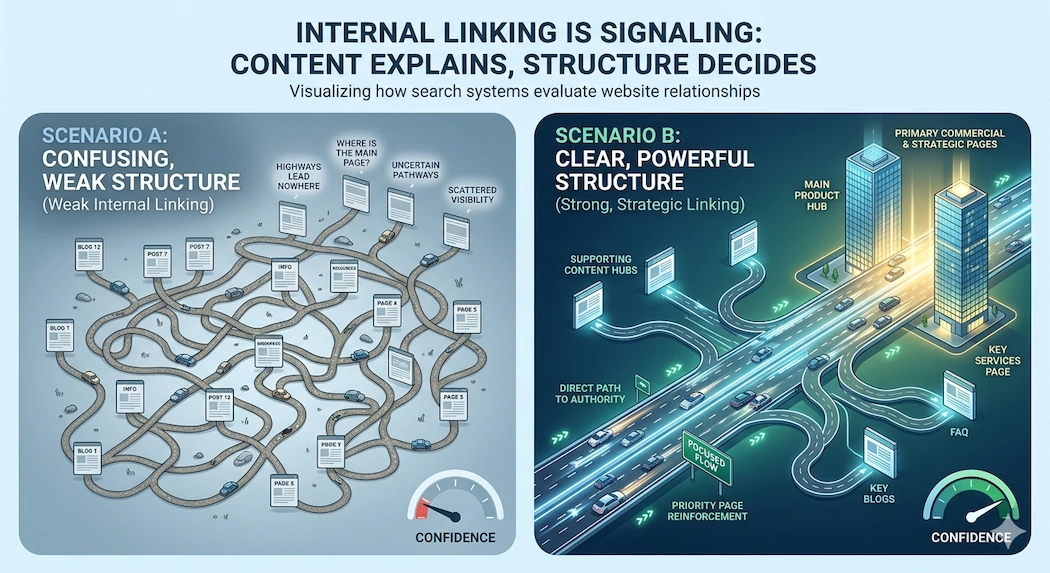
<p>Most websites treat internal links as a usability feature, but search systems treat them as a network of signals. This network behaves like a probability system, similar to a Markov chain, where each link represents a pathway through which attention, authority, and interpretation flow. Over time, this creates patterns: some pages receive repeated reinforcement, some become central hubs, and others drift to the edges and become structurally invisible. If ten pages consistently point to one page, that page becomes important; if none do, it becomes irrelevant, regardless of quality—this is the foundation of structural authority flow in search systems.
Structure reveals belief
Your website’s structure tells search systems what you believe matters. Not what you say matters, not what you optimise for, and not what you want to rank—but what your structure reinforces. If your internal links repeatedly cycle through blog content, that becomes the centre of your site whether you intended it or not. If your commercial or strategic pages sit outside that loop, they are treated as peripheral. Structure is consistent, content is variable, and so structure becomes the more reliable signal.
When structure is inconsistent, interpretation becomes uncertain
Search systems aim to reduce uncertainty. They are constantly evaluating whether they can confidently understand what a website is about and what it should rank for. When structure is clear, key pages are reinforced, hierarchies are visible, relationships are obvious, and authority flows predictably. When structure is inconsistent, important pages are weakly connected, signals conflict, no clear centre emerges, and authority disperses instead of concentrating. The result is not a penalty—it is hesitation, which is explored further in why search systems model structure, not content.
Uncertainty reduces confidence. Confidence affects visibility.
Search systems do not rank purely on relevance; they rank on confidence in their own interpretation. If a system is unsure, it will test pages intermittently, avoid committing to higher positions, and stabilise rankings at a lower level. This is what a plateau really is—not a lack of effort or content, but a lack of structural clarity. Your website has been understood, but not strongly enough to justify movement.
Why more content doesn’t fix this
Most responses to stalled rankings involve publishing more content, adding keywords, building links, or refreshing pages. But if the underlying structure does not change, none of this alters the system’s interpretation. You are adding more signals into a model that has already stabilised, and stable models resist change. To shift rankings, you do not need more input—you need a different structure.
Structural clarity creates interpretive certainty
When structure aligns with intent, search systems begin to recognise clear topic ownership, reinforce central pages more strongly, increase crawl focus on key areas, and assign higher confidence to ranking decisions. This is when movement returns—not because the system has rewarded you, but because it has resolved uncertainty. And once confidence increases, visibility follows.
The quiet advantage most websites miss
Structural optimisation is rarely visible. There are no immediate spikes or obvious signals to celebrate, but over time it changes everything. While content competes, structure compounds, and the sites that win are not always the ones that say the most, but the ones that reinforce the clearest interpretation of themselves.
Final thought
Search systems may understand language, but they trust structure. If your internal linking patterns are inconsistent, your message becomes uncertain, and when interpretation is uncertain, confidence drops—when confidence drops, visibility follows. The question is no longer whether your content is good enough, but whether your structure makes it obvious what matters, because that is what search systems are really modelling, which sits at the core of how search systems evaluate your organisation.