

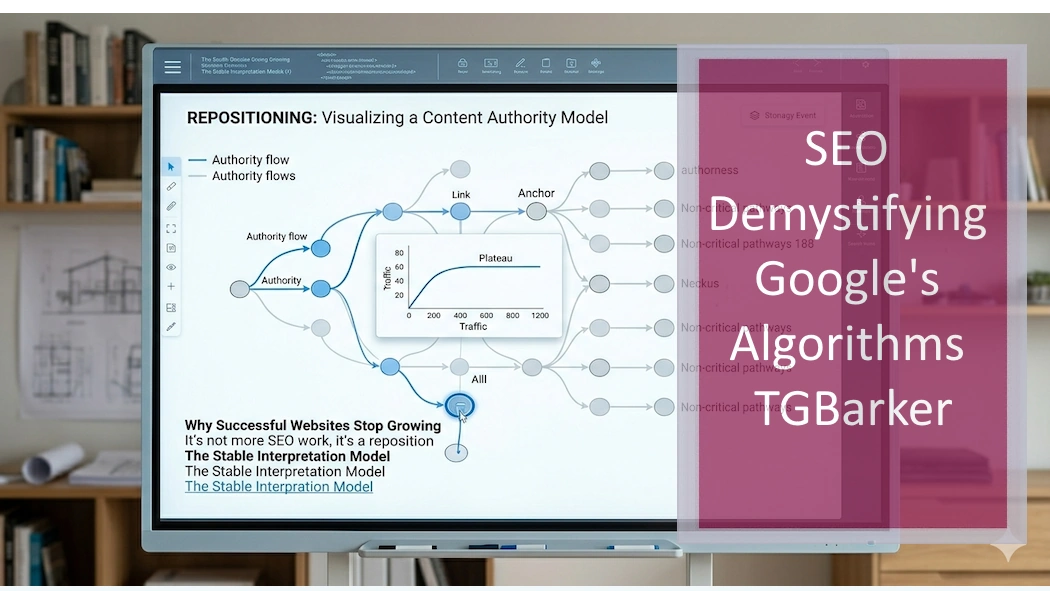
It’s not more SEO work it’s a reposition
Author: T.G. Barker | How Google Evaluates Websites
Some websites decline in visibility. Others reach a point where progress slows, stabilises, or stops entirely. Rankings hold position. Traffic levels off. New content is added, improvements are made, but the overall outcome does not change. This is often described as a lack of momentum. In reality, it is something more precise.
The website has reached a stable interpretation within search systems.
The Point Where Effort Stops Changing Outcomes
Search systems do not simply rank pages. They construct an internal model of your website based on structure, relationships, and observed behaviour. Over time, this model becomes increasingly consistent.
Key pages are reinforced. Entry points stabilise. Authority concentrates around specific areas. The system no longer needs to continuously re-evaluate the site—it recognises it. This is the point where many businesses experience what appears to be a plateau. The issue is not a lack of work. It is that new work conforms to the existing model, reinforcing it rather than changing it.
This situation often presents in familiar ways. A website may appear on the second or third page of results, visible but not prominent. Traffic may have levelled off, despite continued work. Content has been added, improvements made, yet the overall position does not shift in any meaningful way.
It can feel as though the site is close to progressing, but never quite does. The signals appear correct, but the outcome remains the same.
A Common Pattern: Stuck Just Outside Visibility
In many cases, this stability appears in a very specific way. Rankings settle just beyond the most visible positions—often on the second or third page of results. Visibility exists, but it does not convert into meaningful traffic.
This is not a coincidence. It reflects a consistent interpretation within the system. The website is recognised as relevant, but not sufficiently central or authoritative to enter the dominant set of results. At this point, the issue is not visibility alone. It is position within the system’s internal structure. Small improvements or additional activity rarely change this outcome. The site continues to be evaluated in the same way, and the same ranking range is reproduced.
Moving beyond this state does not come from “pushing” harder. It comes from understanding probabilistic patterns and changing the structural signals that define how the site is positioned relative to others.
Why More Content and SEO Activity Often Make No Difference

Your website is like a city. Adding more houses (content) doesn’t help if the roads (links) all lead away from the business district. To grow, you don’t need more houses; you need a new highway system.
When a website reaches this state, additional content, optimisation, or link building often follows existing structural patterns. New pages connect in similar ways. Internal links reinforce the same pathways. The same areas continue to receive authority. From the perspective of the system, nothing fundamentally changes. The interpretation remains stable, and so do the outcomes. To understand how these patterns form, see how authority flows through a website’s structure.
The Hidden Constraint: Structural Reinforcement
Most plateaued websites are not lacking in content or effort. They are constrained by how their structure distributes attention and authority. Certain pages become dominant. Others remain peripheral. Internal linking patterns, navigation, and content relationships create a set of reinforced pathways that define how the site is understood.
Over time, these pathways become self-reinforcing. This is why progress can feel difficult, even when the level of activity is high.
Why Rankings Drop — And Why They Sometimes Don’t Recover
In some cases, a stable model can shift. Rankings may drop, traffic may decline, and visibility may change. This is often interpreted as a need for more activity. However, the underlying issue is rarely the absence of effort. It is that the structure of the site and how authority flows through it no longer supports the previous interpretation—or has been re-evaluated against stronger competing structures. Recovering from this requires more than optimisation. It requires understanding why rankings drop and how the system currently evaluates your website, and where that interpretation has changed.
What Actually Needs to Change
To move beyond a plateau—or recover from a drop—the objective is not to increase activity, but to change the signals that define the system’s model.
This involves:
- Restructuring how authority flows between key pages
- Strengthening connections around a central concept
- Reducing reinforcement of non-critical pathways. Successful sites often stop growing because they are being weighed down by 5-year-old content
- Aligning content more precisely with how the site is interpreted
In practical terms, this means changing how the website is understood—not simply adding to it.
If you want to see how this is analysed in practice, see how this process is applied in a real website review.
When This Matters
This becomes relevant when a business has already invested in its website, produced content, and implemented SEO activity, but results no longer reflect that effort. At this stage, continuing without understanding the underlying model often leads to repetition rather than progress.
A Different Starting Point
Before committing further time or budget, it is often necessary to understand how search systems are currently interpreting your website as a whole. Without that clarity, even well-executed work can reinforce the same outcome.
This is the purpose of a Strategic Search Authority Review—to identify how your site is being modelled, where that model is stable, and what would need to change to move beyond it.
Next Step
If your website has plateaued, or if rankings have declined without a clear explanation, you may already be operating within a stable interpretation.
The question is not what more to do—but what needs to change.
If you are tired of paying for content that doesn’t move the needle, you aren’t facing a content problem—you’re facing a structural limit. Structure & pricing the Strategic Search Authority Review