

How Search Systems Evaluate Websites
By: T.G. Barker | See how the strategic authority review works | Last reviewed: 13/10/2026
Over many years of working with websites, search engines, and long-term ranking behaviour, one observation became increasingly difficult to ignore. Many websites do not struggle because of poor effort, weak content, or a lack of optimisation. In many cases, they struggle because search systems have formed a stable interpretation of what the website represents — and that interpretation becomes increasingly difficult to change over time. This process helps explain the phenomenon of a website ranking plateau, where search visibility stabilises despite continued optimisation efforts, leaving many site owners wondering why progress has slowed or stopped altogether.
This website exists to explore that idea.
Most discussions about SEO focus on activity. More content. More backlinks. More optimisation. More publishing. Yet many websites continue to plateau despite ongoing effort. Rankings stabilise. Growth slows. Visibility fluctuates within narrow ranges. New activity often produces movement without meaningful progress.
One reason for this is that search systems do not evaluate pages in isolation. They evaluate the relationships between pages and how importance is distributed throughout the website. Even strong content can struggle if authority cannot efficiently reach the pages that matter most. This is where structural authority flow becomes important. The way pages connect, reinforce one another, and transfer authority often has a greater impact on long-term visibility than the volume of optimisation activity itself.
The reason may be deeper than optimisation itself.
Search systems such as Google do not simply read pages in isolation. They construct internal models based on structure, relationships, authority signals, semantic connections, and repeated behavioural patterns. Over time, these signals reinforce one another, gradually shaping how a website is interpreted as a complete system rather than as a collection of independent pages. This broader process is explored further within How Google Evaluates Websites.
Search Systems Do Not See Websites Like Humans
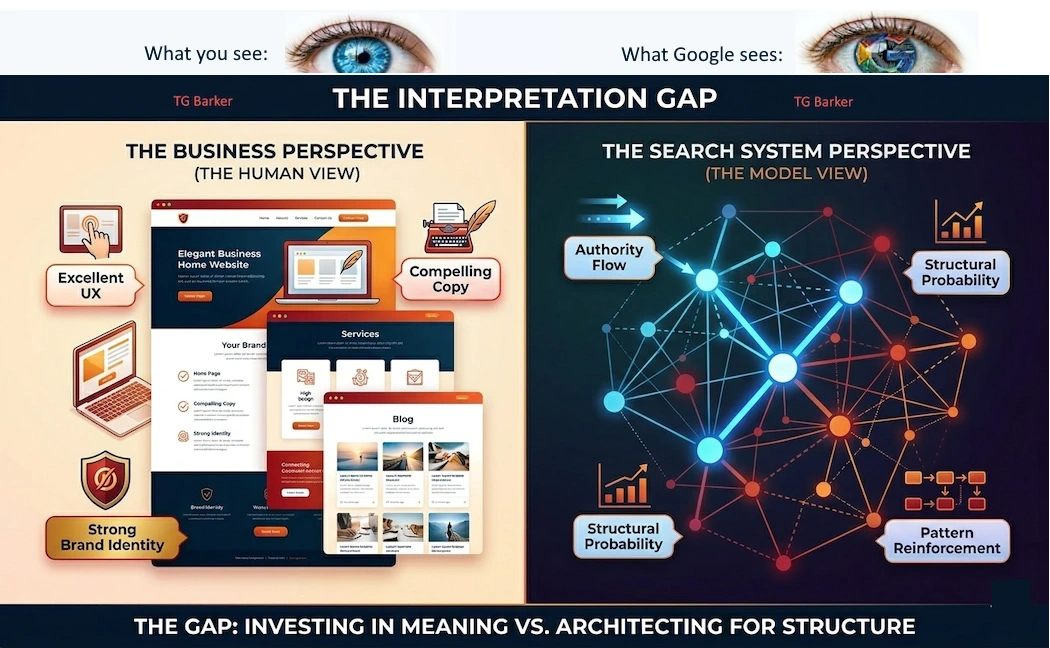 Humans experience websites visually. They see branding, colours, messaging, products, photography, and design. Search systems experience websites differently. They observe pathways, linking structures, semantic relationships, repeated transitions, hierarchy, authority concentration, and behavioural reinforcement.
In many ways, a website behaves less like a digital brochure and more like a connected graph of relationships. Pages become nodes. Internal links become pathways. Repeated user movement reinforces patterns. Some pages emerge as hubs of authority while others become weak peripheral endpoints with little structural influence.
This is closely related to concepts found within Graph Theory, where systems are understood through relationships and connections rather than isolated components. Search engines have used similar concepts for decades, particularly through systems related to PageRank, where authority flows through links and interconnected structures. The idea of authority moving through a website is explored further in Structural Authority Flow in Search Systems.
Rankings Are Outcomes of Systems
One of the central ideas explored throughout this website is that rankings are not fixed positions manually assigned by search engines. Rankings emerge from the interaction of many signals operating simultaneously across a website and the wider web.
These systems observe:
- Structure patterns
- Linking patterns
- Content relationships
- Behavioural pathways
- Semantic reinforcement
- Authority concentration
- User interaction signals
Over time, these signals combine to form stable probabilistic outcomes.
In practical terms, this means that visibility is not simply attached to a single page. Visibility emerges from how the system interprets the relationships between pages, the consistency of signals, and the repeated reinforcement of structural patterns across the entire website.
This is one reason why isolated SEO actions often produce inconsistent results. A page can be improved individually while the wider structural interpretation of the site remains unchanged. Some of these concepts are discussed further within Mathematical Model Behind Website Ranking.
Why Websites Plateau
Many websites eventually reach a point where rankings appear to stabilise. Growth slows. Certain pages repeatedly occupy the same positions. Competitors become difficult to displace despite ongoing activity.
This website explores the possibility that these plateaus are not random.
As search systems gather more data, they gradually reinforce their interpretation of a website. Core pages become central pathways. Certain sections attract authority repeatedly. User transitions become predictable. Entry points stabilise. The system no longer needs to constantly reassess the structure because the model has already formed.
At that stage, additional optimisation may simply reinforce the existing interpretation instead of changing it.
This explains why many websites continue publishing content yet experience little meaningful movement. The issue is often not the absence of activity, but the persistence of an already-established structural model. This broader idea is explored further in Why Successful Websites Stop Growing.
New Websites Are Interpreted From The Beginning
This framework does not apply only to declining or plateaued websites. New websites are also interpreted from the very beginning.
Before rankings even exist, search systems begin observing:
- How pages connect together
- Which topics are repeatedly reinforced
- Where authority accumulates
- How users move through the site
- Whether structural signals remain consistent
In other words, the model begins forming long before stable rankings appear.
This is why website foundations matter. The structural patterns established early in a website’s development may heavily influence how search systems understand the site later on. Over time, those early signals can become deeply reinforced through content growth, linking behaviour, and user interaction. The process behind this is discussed further within How Google Interprets Your New Website.
A Connected Research Framework
The articles throughout this website are connected by a common idea. Topics such as structural authority flow, probabilistic ranking behaviour, behavioural reinforcement, graph relationships, semantic interpretation, and search system evaluation are not separate subjects. They are different perspectives on the same underlying phenomenon.
The purpose of this website is therefore not simply to discuss rankings or optimisation tactics. It is to explore how search systems construct internal representations of websites — and how those representations influence visibility over time.
Many of the concepts explored throughout the site attempt to move beyond traditional SEO discussions and instead examine websites as evolving systems of relationships, probabilities, reinforcement, and interpretation. A wider overview of these themes can also be found within Insights into Artificial Intelligence and Search.
Why Understanding The Model Matters
Without understanding how systems currently interpret a website, additional activity may unintentionally strengthen the very patterns limiting growth.
This is one reason why some websites continue investing heavily in SEO while remaining structurally trapped within the same visibility range. The effort itself may not be ineffective. It may simply be reinforcing an interpretation that has already stabilised.
Understanding the model changes the objective. Instead of endlessly adding activity, the focus shifts toward understanding how authority flows, how pathways reinforce meaning, and how structural relationships shape the system’s interpretation over time.
For organisations wanting to explore how their own website is currently being interpreted, further information can be found within the Search Strategy Consultant contact page.
Final Thoughts
This website represents an ongoing exploration into how modern search systems evaluate websites as connected environments rather than isolated pages.
Its purpose is not to chase trends or produce generic optimisation advice. Instead, it seeks to understand the deeper structural mechanisms that influence how search systems form trust, authority, relevance, and visibility.
As artificial intelligence and search continue evolving together, understanding how systems interpret websites may become increasingly important — not only for recovering lost visibility, but for shaping how new websites are understood from the very beginning.
Frequently Asked Questions
Should You Start Over With a New Domain if Search Systems Have Formed a Stable Interpretation?
Not necessarily. In many cases, starting again with a new domain removes valuable signals that search systems have already learned about your website, including authority, historical trust, crawl behaviour, topic associations, and user interaction patterns.
When rankings plateau, the issue is often not that the domain has failed, but that search systems have formed a stable interpretation of what the website represents. Over time, systems learn:
which topics the site covers,
which pages are most important,
how authority flows through the structure,
and which search intents the site consistently satisfies.
This creates stability. The problem is that new content and optimisation efforts can sometimes reinforce the same interpretation instead of changing it.
In many situations, it is more effective to reshape how the existing website is interpreted rather than abandoning the domain completely. This can involve:
restructuring internal linking,
redefining core pages,
consolidating overlapping topics,
improving semantic clarity,
strengthening authority pathways,
and reducing conflicting signals.
A new domain may occasionally make sense where there is a severe spam history, a complete change of business direction, or long-term structural problems that cannot realistically be separated from the existing site. However, a new domain also starts without trust, behavioural history, or established topical understanding.
Search systems do not simply rank pages individually. They construct internal models of websites over time. In many cases, the objective is not to start again, but to deliberately change the interpretation the system has already formed.