

The Rise of Search System Analytics
For more than two decades, website analytics has revolved around one central objective: understanding people.
Traditional Analytics Only Tell Half the Story
We measure visitors, sessions, page views, bounce rates, engagement and conversions because these metrics help us understand how human users interact with a website. Google Analytics has become the industry standard for answering questions such as:
- How many visitors arrived today?
- Which pages attracted the most traffic?
- Where did visitors come from?
- Which pages generated enquiries or sales?
These measurements remain valuable, but they no longer tell the whole story.
The internet has fundamentally changed.
Today, every website is continuously visited by search engines, artificial intelligence systems, language models, SEO platforms, security scanners, cloud infrastructure and countless automated technologies. Many of these systems influence how a website is discovered, interpreted and represented within search results, yet they are almost entirely invisible within traditional analytics.
Google Analytics measures people.
It tells us almost nothing about what intelligent search systems are doing.
I believe this has created an entirely new discipline.
I call it Search System Analytics.
What Is Search System Analytics?
Search System Analytics is the measurement and analysis of how search engines, AI systems and other automated technologies discover, navigate, interpret and reinforce a website’s knowledge structure over time.
Unlike traditional analytics, which focuses on human behaviour, Search System Analytics measures the behaviour of the intelligent systems that increasingly determine online visibility.
Its purpose is not simply to count automated requests.
Its purpose is to understand what those systems are learning.
As artificial intelligence becomes an increasingly important part of search, measuring how search systems build an understanding of a website may become just as important as measuring human visitors.
The Hidden Audience
Most website owners believe their audience consists of customers and potential customers.
In reality, every website has another audience that operates entirely behind the scenes.
This hidden audience includes:
- Search engine crawlers
- AI training crawlers
- AI retrieval systems
- AI-assisted browsers
- SEO auditing platforms
- Automated vulnerability scanners
- Cloud infrastructure services
- Monitoring systems
- Unknown automated agents
Collectively, these systems often generate more requests than genuine human visitors.
Yet most analytics software either ignores them completely or simply labels them as “bots.”
Grouping every automated request together tells us very little.
Understanding the behaviour of these systems is far more valuable than simply counting them.
Not Every AI Visit Means the Same Thing
One of the biggest misconceptions surrounding artificial intelligence is the assumption that every AI request serves the same purpose.
It does not.
Some systems are collecting information for future model training.
Others retrieve information in real time to answer user questions.
Some requests originate from AI-assisted web browsing, while others come directly from large language model infrastructure.
Each performs a different role.
Recognising these systems individually allows us to understand which AI ecosystems are repeatedly interacting with a website and how frequently they return.
That provides considerably more insight than simply reporting that “AI visited.”
From Page Views to Knowledge Reinforcement
Traditional analytics treats every page request as an isolated event.
Search systems do not.
Every visit contributes to an evolving understanding of the website.
More importantly, repeated observations strengthen confidence.
A page visited once may simply have been discovered.
A page visited repeatedly over weeks or months is likely becoming an established part of a search system’s knowledge model.
This is why Search System Analytics focuses on reinforcement rather than simple visit counts.
Instead of asking:
Has AI visited this page?
It asks:
Which pages are consistently being reinforced over time?
That distinction changes how website activity is interpreted.
Measuring a Website’s AI Knowledge Footprint
Repeated AI observations gradually create what can be described as a website’s AI Knowledge Footprint.
Rather than simply counting crawler requests, this measures the breadth and consistency of AI interaction.
Questions include:
- How many recognised AI requests have been observed?
- How many pages have AI systems discovered?
- Which pages continue to receive repeated observations?
- Is the footprint expanding or contracting over time?
Like footprints left in fresh snow, individual impressions reveal very little.
Over time, however, they expose clear patterns of movement and behaviour.
Knowledge Stability
Search systems do not build knowledge in a single visit.
Understanding develops gradually through repeated observation.
Some pages experience a brief burst of activity before disappearing from view.
Others continue attracting attention month after month.
Search System Analytics therefore measures Knowledge Stability—the consistency with which pages continue to be revisited over time.
Long-term reinforcement often provides a far more reliable indicator of importance than short-lived spikes in activity.
Websites Are Networks, Not Collections of Pages
Perhaps the greatest misunderstanding in SEO is the belief that search engines evaluate individual pages independently.
They do not.
A website is a connected network of information.
Every internal link forms another relationship.
Every movement between pages provides another piece of evidence about how the website is organised.
Search systems gradually learn this structure by repeatedly travelling through those connections.
The website itself becomes a knowledge graph.
Understanding that graph is considerably more valuable than simply counting page views.
Following Search System Movement
Every crawler request creates another movement from one page to another.
Thousands of these movements gradually reveal behavioural patterns.
Rather than asking:
Which pages were visited?
Search System Analytics asks:
How do intelligent systems naturally move through this website?
This shift transforms website analysis from static reporting into behavioural measurement.
Movement patterns often reveal structural strengths and weaknesses that remain invisible within conventional analytics.
Why Markov Chains Matter
One of the most effective ways of modelling search system behaviour is through Markov Chains.
Each observed transition contributes to a probability.
As more observations accumulate, those probabilities become increasingly stable.
Eventually they describe how search systems naturally explore the website.
Instead of guessing how search engines interpret a site’s structure, we can begin measuring their observed movement behaviour directly.
The result is a probabilistic model of website understanding.
Equilibrium: Where Search Systems Naturally Concentrate
One of the most powerful outcomes of probabilistic modelling is the ability to estimate equilibrium.
This represents the long-run distribution of search system attention.
Some parts of a website naturally retain attention.
Others are visited only occasionally.
Equilibrium identifies where intelligent systems are most likely to concentrate after repeated exploration.
It provides insight into how the website’s knowledge structure is stabilising over time.
Measuring the Authority Core
Most websites contain a relatively small collection of pages that define their principal expertise.
These pages form the website’s Authority Core.
Repeated movement between Authority Core pages provides evidence that search systems are reinforcing relationships within the website’s primary knowledge.
Monitoring these reinforcement patterns offers insight into how expertise itself is being interpreted.
This is fundamentally different from measuring popularity or traffic.
It measures structural understanding.
Detecting Structural Change
Websites evolve continuously.
New content is published.
Internal links are updated.
Knowledge expands.
Search System Analytics measures how these structural changes influence search system behaviour.
Questions become:
- Is the Authority Core becoming stronger?
- Have new knowledge communities emerged?
- Has reinforcement shifted towards different topics?
- Are search systems exploring new pathways?
Instead of producing isolated daily reports, Search System Analytics observes how intelligent systems adapt to a website as it evolves.
A New Discipline for an AI-Driven Internet
For many years, visitor analytics was sufficient because people represented almost every meaningful interaction with a website.
That is no longer true.
Today’s websites exist within an ecosystem populated by search engines, AI systems and countless forms of intelligent automation.
These systems are not simply reading pages.
They are building probabilistic knowledge models.
They are identifying relationships.
They are reinforcing concepts.
They are gradually constructing an understanding of every website they encounter.
If we wish to understand modern search, we must begin measuring those processes directly.
Google Analytics transformed how we understand people.
Search System Analytics seeks to transform how we understand the intelligent systems that increasingly determine online visibility.
As search continues its evolution towards artificial intelligence, measuring what search systems learn may prove just as important as measuring who visits.
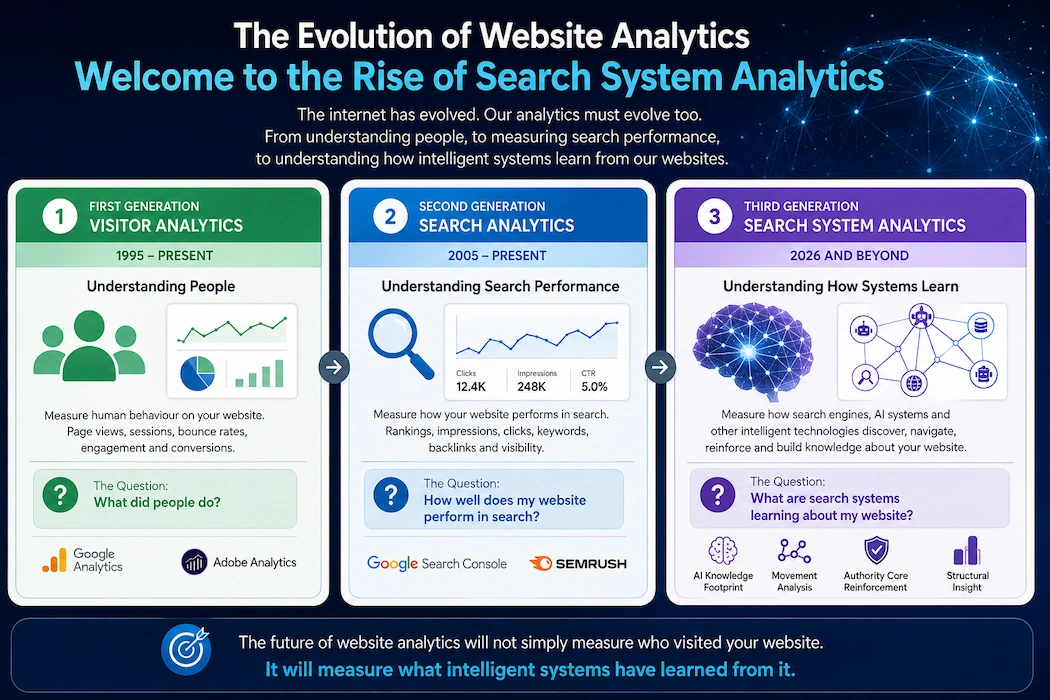
The Three Generations of Website Analytics
Website analytics has continually evolved alongside the internet itself.
As the web has changed, so too have the questions we need to answer.
I believe there have now been three distinct generations of website analytics.
First Generation: Visitor Analytics
The first generation focused entirely on people.
Its objective was to understand how visitors interacted with a website by measuring page views, sessions, bounce rates, engagement and conversions.
Platforms such as Google Analytics transformed how businesses measured human behaviour online, and they remain indispensable for understanding customers.
However, visitor analytics answers only one question:
What did people do?
Second Generation: Search Analytics
The second generation shifted attention towards search performance.
Website owners began measuring rankings, impressions, clicks, keywords, backlinks and search visibility using platforms such as Google Search Console and professional SEO software.
This generation helped explain how websites performed within search engines.
Its central question became:
How well does my website perform in search?
Although this represented a major advance, it still concentrated primarily on outcomes rather than understanding how search systems themselves interpret a website.
Third Generation: Search System Analytics
Artificial intelligence has fundamentally changed the nature of search.
Modern search systems no longer simply index pages.
They build knowledge.
They identify relationships between topics.
They reinforce concepts through repeated observation.
They construct probabilistic models that gradually develop an understanding of an entire website.
This creates an entirely new challenge.
Instead of asking only how many visitors arrived or how well pages ranked, we must also begin asking:
What are search systems learning about my website?
This is the purpose of Search System Analytics.
It measures how search engines, AI systems and other intelligent technologies discover, navigate, reinforce and build an understanding of a website over time.
It combines behavioural analysis, graph theory, probability modelling, reinforcement measurement and structural interpretation to provide insights that traditional analytics were never designed to deliver.
Search System Analytics does not replace Google Analytics or Google Search Console.
Instead, it complements them by measuring something they were never intended to measure: the behaviour of the intelligent systems that increasingly determine online visibility.
Conclusion
The internet is entering a new era.
For decades, understanding people was enough.
Today, websites are observed continuously by search engines, AI models and countless automated systems that influence how information is discovered, interpreted and presented.
These systems are no longer passive crawlers.
They are active learners.
If we want to understand how websites perform in modern search, we must begin measuring how these intelligent systems build knowledge, reinforce authority and interpret website structure.
I believe this marks the beginning of a new discipline.
Just as Google Analytics transformed our understanding of visitors, Search System Analytics seeks to transform our understanding of the search systems themselves.
The future of website analytics will not simply measure who visited your website.
It will measure what intelligent systems have learned from it.