Pharmacy UK Case Study Analysis
Case Study: Why a UK Pharmacy Website Remained on Page 2 Despite a Strong Internal Link Network
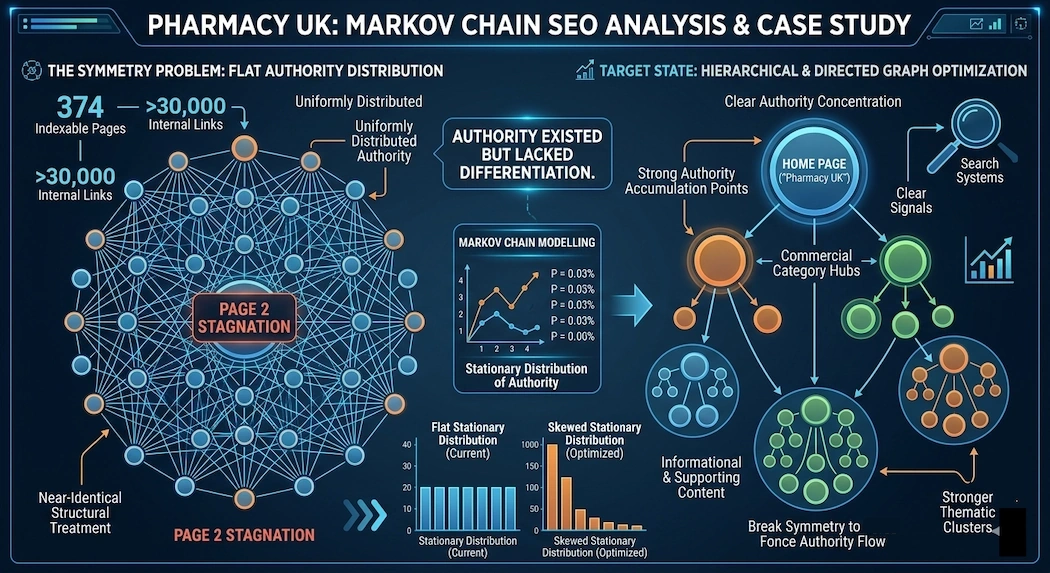 Target Search Phrase: Pharmacy UK
Pharmacy Website Case Study: When Every Page Looks Equally Important
This UK pharmacy website looked strong on paper. It had 374 indexable pages, more than 30,000 internal links and plenty of content. Yet for the search it cared about most, “Pharmacy UK”, it sat on page 2 of Google.
The usual explanation would be that it needs more content, more links or more authority. The analysis pointed somewhere else. The site wasn’t short of authority. Its structure just didn’t make clear which pages should lead.
How I looked at it
I exported the site’s internal links and mapped them as a graph, with every page a point and every link a connection between two points. Then I ran a random-walk model over it (a Markov chain, the same idea behind Google’s original PageRank). It asks a simple question: if you kept clicking links at random, where would you end up most often?
The answer gives each page a share of the site’s structural weight. On most websites, that weight gathers around a small number of important pages, such as the homepage, the main categories and the key services. The question here was whether it gathered around the pages most likely to rank for “Pharmacy UK”.
What it showed
It didn’t gather anywhere much.
- 374 indexable pages
- more than 30,000 internal links, an average of around 80 per page
- roughly 80% of pages sitting in very similar positions in the network
That average of 80 links per page is the clue. Most of those links come from menus, headers and footers repeated on every page. When nearly every page links to nearly every other page, the weight gets spread evenly across the whole site. Nothing stands out, including the pages that should.
The problem with a flat structure
Think of a company where hundreds of people all have the same job title. The work might still get done, but from the outside it’s hard to tell who’s in charge.
This site had the same problem. Its links gave Google very little to go on about which pages should represent the business for a broad search like “Pharmacy UK”. Adding more pages or more links wouldn’t help, because it would just make the same flat network bigger.
Backlinks, competition and brand all play their part in rankings too, so I wouldn’t say the structure explains page 2 on its own. But it’s a likely contributing factor, and unlike most of the others, it’s entirely within the business’s control.
What I’d change
The fix isn’t more links. It’s giving the site a hierarchy again:
- Trim the sitewide menus, so not every page links to every other page.
- Make the main category pages the hubs, linked to clearly from the homepage and from the pages beneath them.
- Link supporting content upwards, so health advice and product pages pass weight to the categories they belong to, rather than just to each other.
- Re-run the model to check the weight is actually gathering where it should before anything goes live.
Want to know what your site is favouring?
The site structure review runs the same analysis on your website. It’s a fixed £1,970, and you get a written report and a call to walk you through it. Send me your web address and a line about what’s bothering you.