Car Industry Case Study
Analysis of the internal linking structure revealed a clear imbalance in how authority was distributed across the website.
The strongest internal “hubs” were not commercial pages.
Instead, authority was concentrated in:
– Help & Support pages
– Claims-related content
– Policy and upgrade pages
– Sitemap and utility pages
Meanwhile, key commercial pages — including the core “Used Cars” section and vehicle listings — were comparatively underweighted.
Agriculture Supplies Case Study
What We Found
The wrong pages had the most authority.
The top PageRank page was /country-clothing-and-footwear, meaning Google sees the site as mainly about clothing, not farming supplies.
System pages were also too strong, such as basket/signin/wishlist — these were absorbing authority because they appear in the navigation or template.
Farming-related categories were not central in the internal graph and received very little authority.
The homepage was unexpectedly weak, meaning it wasn’t distributing PageRank properly.
No Farming Hub existed, so Google had no single page representing your main topic (“Farming Suppliers”).
Car Insurance Case Study
A website already on the 1st page of Google can improve their position on the page
The internal linking analysis of this car insurance website shows that most of the site’s authority is currently being absorbed by Help & Support pages, claims content, and policy upgrade pages, while the core commercial insurance pages receive far less internal PageRank than they should. This misalignment weakens the site’s ability to rank for high-value car insurance keywords.
Ecommerce website cosmetics industry – Case Study
This case study took a cosmetics website to view problems for keywords: “cosmetics London” holding it back from page 3 to what could be done to move the website to page 1 on Google. Missing keyword structure crucially, the site had no dedicated “Cosmetics London” landing page, meaning it had no focused authority channel for that keyword. This explained why Liberty London did not feature prominently for the search term despite having strong brand power and a wide range of beauty products.
Travel & Tourism Case Study
Case study for inbound links for travel/holiday website using system flow analysis.
What We Found (and Why It Matters)
When we mapped how authority flows through this travel website, the biggest shock was this: the pages that should be the strongest — the ones that actually sell holidays — were the weakest in the entire site.
Medical Website Page-Flow Case Study
The website had the right pages — but the wrong authority distribution healthcare surgery case study report. The pages patients were most likely to need — including Tests & Results, Travel Clinic, Join the Practice, Referrals, Fit Notes and Reception Enquiries were among the weakest pages in the website’s internal authority structure. We simulated additional internal links from the strongest pages towards the weaker patient-service pages. The model gave us something extremely useful: a way of testing structural changes mathematically before implementing them. This is something we would apply when researching and launching a new website.
Case Study Audit for “Builders Near Me”
Local search for the term – builders near me.
Importance of SEO in the Construction Industry – Slough. In the construction industry, from local builders to national contractors, SEO helps you win tenders. SEO Audit for search terms, “builders near me”
SolentBuilders was ranking around page 3 of Google for searches related to “builders near me.” The purpose of this audit was to understand whether the structure of the website itself could be limiting its ability to compete more strongly. Using PageRank, graph analysis and Markov chain modelling, we mapped the website as a network and measured how its internal links distributed authority between its pages in order to establish where authority flows through it’s pages.


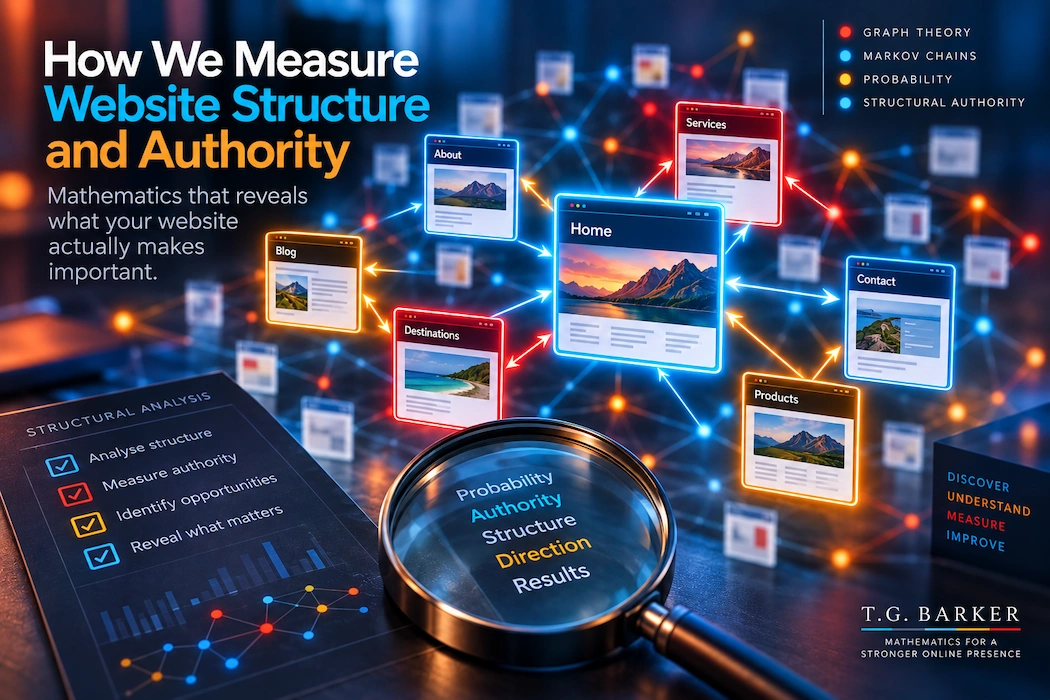 Each example focuses on how pages relate to one another, how authority flows internally, and how small structural differences can produce very different visibility outcomes — even when content quality appears similar. This becomes clearer when viewed through structural authority flow and internal linking relationships.