Actual Website What We Found (and Why It Matters)
When we mapped how authority flows through this travel website, the biggest shock was this: the pages that should be the strongest — the ones that actually sell holidays — were the weakest in the entire site.
The lowest-authority pages were:
- Holiday destination pages
- Category and hub pages
- Hotel and package pages
The booking funnel itself was the problem
In other words, the entire revenue engine of the website sits at the bottom of the hierarchy, starved of internal authority. This is the exact opposite of how a travel site should behave. If you want to see how we uncovered this, and the steps we took to fix it, the full breakdown is below.
Understanding User Navigation & Fix Revenue LeaksThe travel sector relies on emotional triggers and practical planning, and Google understands this deeply. Your pages perform best when they combine inspiration with clear details about destinations, local culture, transportation, and lodging. When visitors stay longer to explore itineraries or click through related guides, that engagement tells Google your content genuinely helps travellers make decisions — which boosts your visibility for competitive tourism queries.
Overview
This analysis examines how users and internal links move through a travel website. The focus is not on SEO activity, but on how the site structure directs attention, authority, and user flow — and whether that flow supports revenue. To understand this properly, it helps to first see how Google evaluates websites at a structural level.
Key Findings
1. Authority is being diverted to non-commercial pages
A large proportion of internal links point to Privacy Policy and Terms & Conditions pages. These links appear across the site, primarily in the footer and header, meaning they receive consistent internal link weight.
As a result, non-commercial pages act as central hubs in the site structure, despite having no role in conversion. This is a clear example of distorted structural authority flow, where link equity is concentrated in areas that do not support business outcomes.
2. Commercial pages are underlinked
There are very few internal links directing users toward destination pages, holiday categories, package or hotel pages, and booking-related pages. Without understanding the hidden model behind your website’s rankings, high-value pages receive limited internal authority and are less likely to be reached through normal navigation paths.
3. User flow is fragmented
Instead of following a clear path such as Homepage → Destination → Package → Booking, users are frequently routed through Homepage → Footer → Legal pages → Back → Exit. This is largely driven by template-level linking rather than intentional navigation design.
As a result, users do not consistently move toward conversion pages.
4. Internal linking creates circular loops
Repeated patterns such as Privacy → Homepage and Homepage → Privacy create closed loops within the site structure.
With no knowledge or understanding the structure behind search performance and as a result, authority circulates within low-value areas instead of progressing toward commercial pages.
5. Low probability of reaching revenue pages
Based on the observed link structure, only a small proportion of internal flow reaches product or booking pages, while a large proportion remains within navigation and compliance areas.
As a result, the site structurally limits the likelihood of conversion. This kind of pattern is often behind why SEO progress often plateaus, even when activity continues.
Structural Outcome
If the current linking patterns are followed repeatedly, the most reinforced pages are Privacy Policy, Terms & Conditions, and the Homepage. The least reinforced pages are destination pages, product or package pages, and booking funnel pages.
This is the inverse of what a travel website requires.
Graph Interpretation
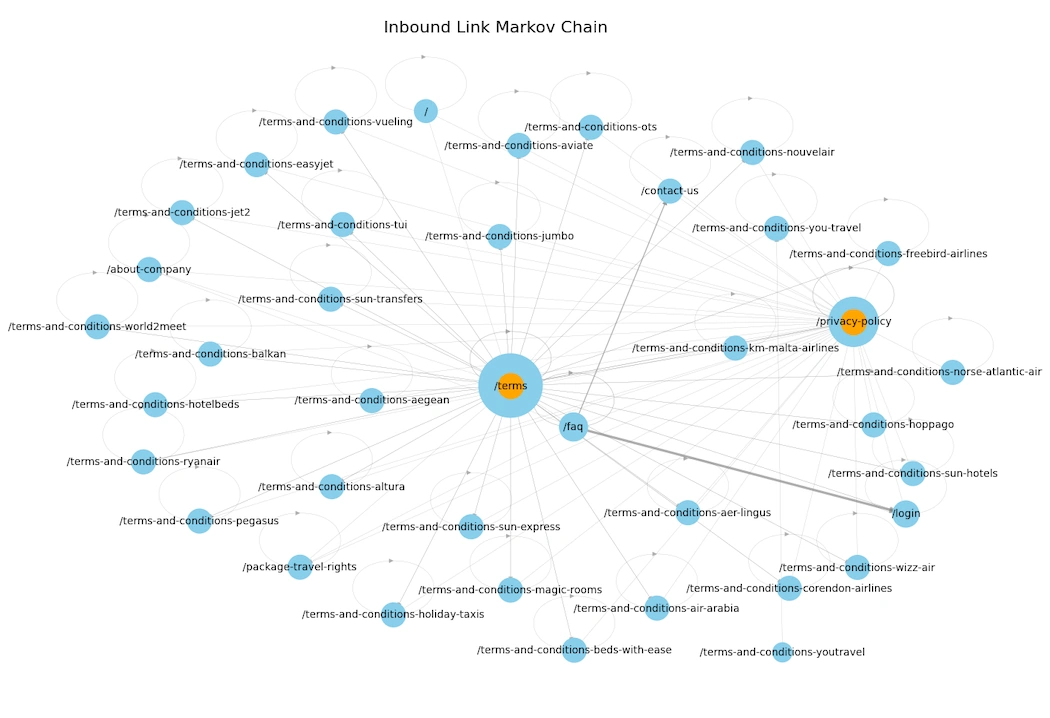
 The internal link structure shows that legal and compliance pages act as central hubs, supporting pages connect back to these hubs, and commercial pages sit at the edges of the graph with relatively weak connectivity.
As a result, authority concentrates in structurally convenient areas, not commercially important ones. This reflects how the model behaves in practice — something explored in more detail in how this is applied in practice.
Graph Summary
- Central hubs: Privacy Policy and Terms & Conditions pages dominate the network. Nearly every page links to them via footer navigation. These hubs absorb most of the authority flow in the Markov model.
- Satellite nodes: Dozens of airline/supplier-specific terms pages orbit around the Terms hub. They link outward but always funnel back to Privacy/Terms. These nodes are structurally important but don’t contribute to conversions.
- Peripheral nodes: Pages like Home, About, Contact, FAQ, Package Travel Rights are present but weakly connected compared to compliance hubs. They sit at the edges of the graph, meaning less authority flow reaches them.
Results & Conclusion
The issue is not content quality or lack of activity. The structure of the site directs both users and authority away from revenue-generating pages. As a result, conversion paths are weakened, commercial pages receive limited reinforcement, and overall visibility for high-value search terms is reduced. The site is not underperforming because of a lack of SEO activity. It is underperforming because its structure reinforces the wrong pages.
The next step is understanding how search systems currently interpret the structure of the website and identifying which areas of the site are reinforcing visibility and which are diluting it. This requires stepping back from individual SEO tasks and examining how authority flows through the website as a connected system. The process used to analyse these structural patterns, ranking pathways, and interpretation signals is outlined on the How the Strategic Search Authority Review Works page.


 The internal link structure shows that legal and compliance pages act as central hubs, supporting pages connect back to these hubs, and commercial pages sit at the edges of the graph with relatively weak connectivity.