Local SEO Audit: What We Found About SolentBuilders for “Builders Near Me”
SEO Audit for “Builders Near Me”
Executive Summary
SolentBuilders was ranking around page 3 of Google for searches related to “builders near me.” The purpose of this audit was to understand whether the structure of the website itself could be limiting its ability to compete more strongly.
Using PageRank, graph analysis and Markov chain modelling, we mapped the website as a network and measured how its internal links distributed authority between its pages. The analysis found that approximately 0.42 of the calculated PageRank was concentrated on the homepage, while the Services, About and Contact pages each received approximately 0.19.
When alternative internal relationships were modelled, PageRank to the Services and Contact pages increased to approximately 0.21 each. The audit therefore identified an opportunity to build a stronger website foundation by expanding important service subjects and creating clearer internal relationships around the pages the business needs search systems to understand.The central finding was simple: the website did not merely need more content. It needed a structure that more clearly reinforced its services, locations and commercially important pages.
The Question Behind the Audit
SolentBuilders was appearing around page 3 of Google for searches related to “builders near me.”
For a small local building company, that creates a straightforward question:
What is preventing the website from competing more strongly for the searches that matter to the business?
Rather than beginning with more content, more keywords or more backlinks, we started underneath the visible website — with its structure.
A website is a network of connected pages. Those connections help search systems determine which pages appear important, how subjects relate to one another and where authority is being concentrated.
This case study shows how we used PageRank, graph analysis and Markov chain modelling to examine that network and identify practical changes that could create a stronger foundation for search visibility.
Local SEO Audit: How SolentBuilders Performs for “Builders Near Me”
The Starting Point
SolentBuilders was a very small website consisting primarily of four important pages:
Homepage
Services
About Us
Contact
There was nothing unusual about this. Many small business websites begin with a similar structure.
The problem was not simply the number of pages.
The more interesting question was:
How was the existing website reinforcing those pages?
Search systems do not necessarily interpret a website in the same way that a visitor or business owner does. The relationships created by navigation, internal links and page structure can cause some pages to receive considerably more structural support than others.
Instead of looking at the four pages as separate documents, we mapped them as nodes in a network, with the internal links forming the connections between them.
This allowed us to examine the site’s structural authority flow and ask a much more useful question:
Where does the website itself suggest that importance should accumulate?
The initial PageRank calculation revealed a significant imbalance.
The homepage held approximately 0.42 of the calculated PageRank, while Services, About and Contact each received approximately 0.19.
In other words, the structure was strongly reinforcing the homepage.
That is not automatically wrong. A homepage will normally be an important page.
But if the business wants its Services pages to compete for commercially valuable searches, the structure should also help search systems understand the importance of those services.
Step 2: Finding Why Authority Was Concentrated
We then examined the actual links responsible for the distribution.
The analysis showed repeated links back to the homepage, including redundant “Home” and brand-based anchors.
Every individual link may appear insignificant when viewed on a page.
Across the network, however, those links create a pattern.
That is why examining a website mathematically can reveal something that is difficult to see by simply looking at pages individually.
Rather than asking only whether a page contains the right keywords, we can examine the probability of movement through the network and see which pages the structure repeatedly reinforces.
Step 3: Testing a Different Structure
The next stage was not simply to recommend more internal links.
We modelled what could happen if the existing relationships were changed.
Contextual links were introduced into the model to give greater structural support to commercially important destinations such as Services and Contact.
The result was measurable.
The homepage PageRank reduced from approximately 0.42 to 0.39, while Services and Contact increased to approximately 0.21 each.
Nothing had been done to Google.
No backlinks had been acquired.
No new pages had yet been published.
We had simply changed the relationships within the website.
This demonstrated that some of the authority already available within the site could be redistributed towards pages that were more closely connected with the objectives of the business.
That is an example of how the methodology works: measure the existing structure, identify what it reinforces, model potential changes and then use the evidence to guide decisions.
What Was Holding the Website Back?
The structural analysis also highlighted a wider problem.
The website was simply too shallow to communicate the full range of subjects associated with a building company competing for local searches.
It had a Services page, but very little supporting information explaining those services.
For example, a prospective customer might be looking for:
Loft conversions
Kitchen extensions
Garage conversions
Renovations and refurbishments
New builds
Home extensions
Those are different customer requirements and different search subjects.
Trying to represent all of them through one general Services page gives the website relatively few opportunities to establish strong relationships between individual services, locations and useful supporting information.
This helps explain why SEO progress often plateaus. A website can contain perfectly reasonable content while its underlying structure limits how strongly its important subjects are reinforced.
Building a Stronger Website Foundation
The audit therefore moved beyond the original four-page structure.
Instead of treating the solution as simply “write more content,” we designed a structure in which new pages would have a specific purpose within the network.
The proposed foundation contained four main areas.
Services
The Services section would become the principal commercial cluster, supported by individual pages such as:
Loft Conversions in Southampton
Kitchen Extensions in Hampshire
Garage Conversions in Portsmouth
Renovations and Refurbishments
New Builds
Home Extensions
These pages would not exist merely to target keywords.
Together, they would establish clearer relationships around the building services the company actually provides.
About and Trust
The About section could be expanded with information that helps visitors — and search systems — understand the business behind the website:
The team
Qualifications and experience
The building process
Testimonials and reviews
Accreditations and certifications
This provides evidence of the real organisation behind the services being offered.
Contact and Service Areas
The Contact section could support the commercial journey through:
Request a Quote
Areas Covered
Frequently Asked Questions
Payment or financing information
Service pages could then link naturally towards the appropriate conversion pages.
Building Advice and Guides
A supporting knowledge section could answer questions potential customers are already asking:
How to Plan a Loft Conversion
Kitchen Extension Ideas
Building Regulations in Hampshire
Cost of a Home Extension
How to Choose a Builder in Southampton
These articles would support the commercial pages rather than exist as an isolated blog.
A guide about planning a loft conversion, for example, has a natural relationship with the Loft Conversion service page.
That relationship can be expressed through an internal link.
Multiply those meaningful relationships across the website and the network begins to reinforce the subjects and pages that matter to the business.
From Four Pages to a Connected Website
The proposed structure can be represented simply:
Homepage
├── Services
│   ├── Loft Conversions
│   ├── Kitchen Extensions
│   ├── Garage Conversions
│   ├── Renovations
│   └── New Builds
│
├── About
│   ├── Team
│   ├── Process
│   ├── Testimonials
│   └── Accreditations
│
├── Contact
│   ├── Request a Quote
│   ├── Service Areas
│   ├── FAQs
│   └── Financing
│
└── Building Advice
    ├── Loft Conversion Guide
    ├── Kitchen Extension Ideas
    ├── Building Regulations
    ├── Cost Guides
    └── Choosing a Builder
The important difference is not simply that the website becomes larger.
It becomes more connected around clearly defined subjects.
Why Internal Relationships Matter
This is where the audit moves beyond a conventional SEO checklist.
Keywords, backlinks, technical performance, structured data and local signals all remain important.
But they operate within a website whose pages have relationships with one another.
By analysing those relationships, we can examine how search systems interpret your website and whether its structure supports the pages the business actually needs to perform.
For SolentBuilders, the original network concentrated a disproportionate amount of PageRank on the homepage.
The simulation demonstrated that changing internal relationships could redistribute some of that structural authority towards commercial pages.
Adding carefully designed service and supporting pages would then create a much richer network in which those relationships could be developed further.
The SEO Roadmap
The structural findings gave us a practical sequence of improvements.
Strengthen the service structure.
Create dedicated pages for important building services rather than relying on one general Services page.
Improve internal linking.
Use relevant contextual links between supporting information and commercial pages.
Develop local relevance.
Make the company’s genuine service areas and geographical relationships clearer throughout the site.
Build supporting knowledge.
Create useful guides answering the questions customers ask before choosing a builder.
Strengthen external evidence.
Develop appropriate local citations, backlinks, reviews and Google Business Profile signals.
Improve technical signals.
Review structured data, mobile performance, Core Web Vitals and other technical factors that could restrict search performance.
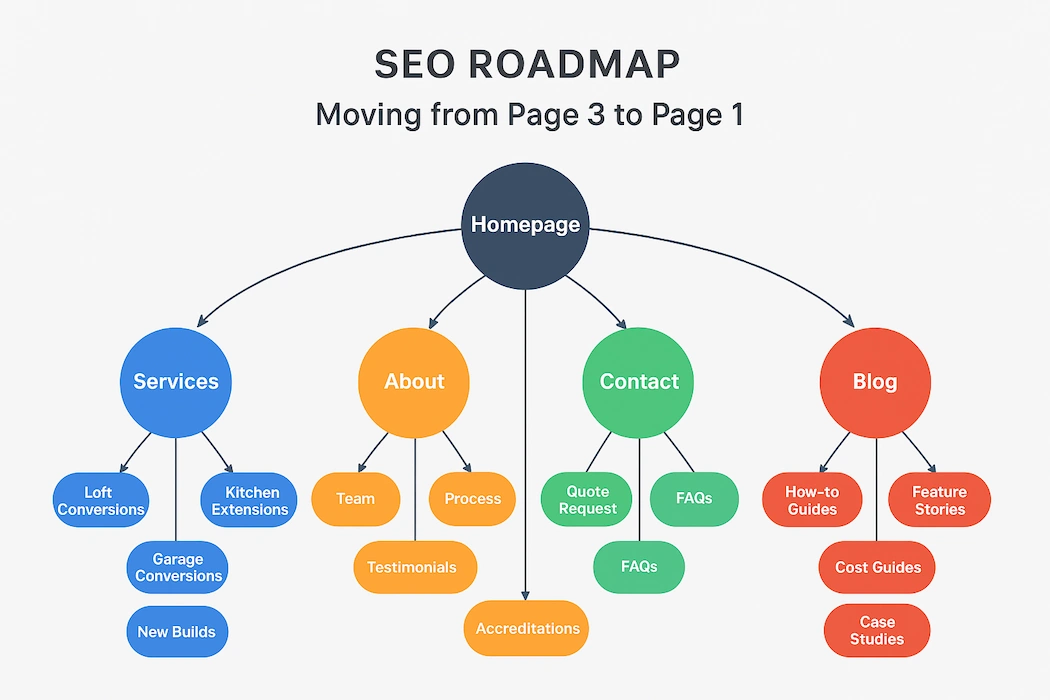
Proposed SEO roadmap and structural cluster map.
The graph illustrates the proposed structure, with the homepage connected to the main Services, About, Contact and Knowledge areas and each of those supported by more specific pages.
What Did the Audit Actually Tell Us?
The most important finding was not simply that SolentBuilders needed more content.
It showed why the existing website had structural limitations.
The original PageRank model concentrated approximately 0.42 on the homepage, with the other principal pages at approximately 0.19 each.
When we changed the internal relationships in the model, the distribution changed.
Services and Contact increased to approximately 0.21, while the homepage reduced to approximately 0.39.
That may appear to be a small numerical movement.
Structurally, however, it demonstrates something important:
The website itself can influence which pages receive the greatest reinforcement.
The next stage is therefore not to chase a particular PageRank number. It is to build a website whose structure, content and internal relationships consistently support the subjects and commercial pages that matter.
That is the real value of applying graph theory and Markov chain analysis to SEO.
We are no longer simply asking:
“Why aren’t we on page one?”
We can ask a much more useful question:
“What is the website currently reinforcing — and is that what the business actually wants search systems to understand?”
That question can be measured.
Visual Map (Textual Layout)
Homepage (/)
├── Services (/services)
│ ├── Loft Conversions
│ ├── Kitchen Extensions
│ ├── Garage Conversions
│ ├── Renovations
│ └── New Builds
├── About (/about)
│ ├── Team
│ ├── Process
│ ├── Testimonials
│ └── Accreditations
├── Contact (/contact)
│ ├── Quote Request
│ ├── Service Area
│ ├── FAQs
│ └── Financing
└── Blog (/blog)
├── Loft Conversion Guide
├── Kitchen Extension Ideas
├── Building Regulations
├── Cost Guides
└── Choosing a Builder
Why this works
Topical authority: Each cluster reinforces a core pillar, signaling expertise.
SERP features: FAQ schema, service area pages, and guides increase visibility.
Local SEO: Service area + case studies target geo-modified queries.
SEO Roadmap move from page 3 to page 1 on Google
With our PageRank modeling skills, we can simulate authority flow after adding new service pages and contextual links. That will show exactly how much ranking power shifts toward the website’s money pages.
Cluster map graph diagram you can see the Homepage at the center, with arrows flowing into the four main clusters (Services, About, Contact, Blog), and each cluster branching into its supporting subpages. This visualization makes the authority funnel and topical structure clear at a glance.
So to sum-up
Taken together, the data makes the trajectory unmistakable. With PageRank currently concentrated at 0.42 on the homepage and the remaining pages sitting around 0.19, the site’s authority distribution is mathematically capped until new cluster pages and contextual anchors are introduced. Our simulations showed that even modest restructuring increased PageRank to the Services and Contact pages by more than 10 percent — a shift that directly correlates with higher conversion-page visibility in competitive SERPs. Combined with structured content expansion, targeted backlink acquisition, and the addition of geo-specific landing pages, SolentBuilders could realistically progress from page 3 to page 2 within 90 days, with page 1 viability in the 6–12-month range. The metrics are clear, the movement is predictable, and the opportunity is entirely within reach.