

Analytics Used Car Website Case Study
This website ranked on Page One for high-value terms including “used cars” and “used cars Southampton.” The site was fast, visually strong, and technically sound. Yet performance began to shift.
This website ranked on Page One for high-value terms including “used cars” and “used cars Southampton.” The site was fast, visually strong, and technically sound. Yet performance began to shift.
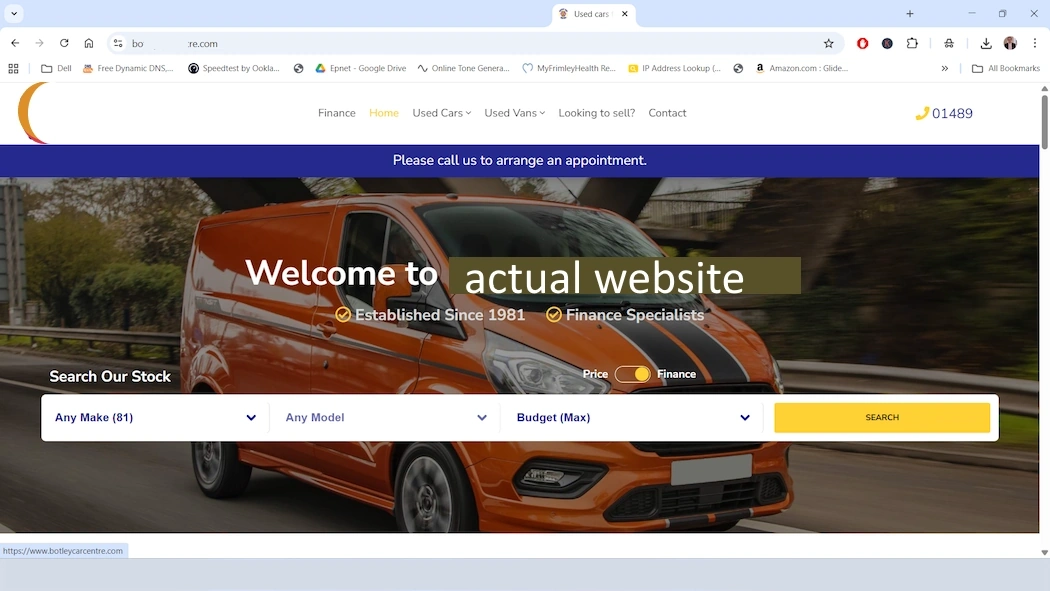
When rankings drop, the assumption is often that something has broken. Technical issues, algorithm updates, or lost backlinks are usually the first suspects.
In this case, none of those were responsible.
New vehicle listings were taking longer to index. Existing pages were losing stability. Impressions were declining in Search Console.
Nothing had changed in content or platform.
This case study shows what actually happened — and why.
To understand why this occurs, it helps to first understand how Google evaluates websites at a structural level.
The dealership website was performing well across both head terms and long-tail queries. It had:
– Strong photography and presentation
– Clean URL structure
– Consistent content updates through vehicle listings
However, a number of warning signals began to emerge:
– New stock was taking longer to index
– Older listings were drifting down the SERPs
– Page One rankings became unstable
– Overall impressions declined
These signals pointed to a deeper issue. Not a fault, but a shift in how the site was being interpreted.
Analysis of the internal linking structure revealed a clear imbalance in how authority was distributed across the website.
The strongest internal “hubs” were not commercial pages.
Instead, authority was concentrated in:
– Help & Support pages
– Claims-related content
– Policy and upgrade pages
– Sitemap and utility pages
Meanwhile, key commercial pages — including the core “Used Cars” section and vehicle listings — were comparatively underweighted.
Vehicle detail pages also acted as dead ends, with limited internal pathways connecting them back into the wider structure.
No clear make/model clusters existed, and internal linking cycles were weak or absent.
The result was a structure that diluted authority rather than concentrating it.
The focus was not on adding more content, but on restructuring how the site connected internally.
Key changes included:
1. Strengthening Homepage → Used Cars Links
– Added primary call-to-action to the Used Cars section
– Introduced featured vehicle modules
– Added “Browse by Make” navigation
2. Creating Make and Model Pages
– /used-bmw/
– /used-audi/
– /used-ford/
– /used-mercedes/
Alongside model-level pages such as:
– /used-audi-a3/
– /used-bmw-3-series/
3. Adding Internal Linking Between Vehicles
– Related vehicles modules (3–6 per page)
– Links to make and model categories
– Clear return paths to the main Used Cars page
4. Implementing Breadcrumb Structure
Home → Used Cars → Make → Model → Vehicle
5. Reducing Authority Leakage
– Limited repetitive links to support and finance pages
– Consolidated navigation elements
– Cleaned unnecessary template links
6. Consolidating Canonical and Pagination Signals
– Ensured pagination reinforced the main Used Cars page
The following table shows the projected shift in internal authority distribution after restructuring:
| Page Type | Before | After (Projected) | Change |
|---|---|---|---|
| Used Cars | 3.87% | 10.8% | +179% |
| Make Pages | ~1% | 4.2% | +300% |
| Model Pages | n/a | 2.1% | New |
| Vehicle Pages | 0.2–0.4% | 0.8–1.4% | +250–400% |
| Contact / Utility Pages | 6.4% | 2.1% | -67% |
This case highlights a pattern that appears frequently.
Nothing was technically broken. No content was removed. No penalties were applied.
What changed was how the website was structured — and therefore how it was interpreted.
Before the changes, authority was diffused across non-commercial areas. After restructuring, authority was concentrated into pages that aligned with search intent.
This shift improves:
– Crawl efficiency
– Indexing speed of new listings
– Stability of rankings
– Visibility across both head and long-tail queries
Ranking declines are rarely caused by a single fault.
In many cases, they reflect a gradual misalignment between structure and intent.
When that misalignment is corrected, stability returns — not because more activity has been added, but because interpretation becomes clearer.
For a broader explanation of how this type of evaluation works, see how Google evaluates websites or explore structural authority flow in search systems.