How SEO Varies by Industry
Every industry behaves differently in search because each market has distinct users, intent patterns, and quality expectations. This page examines the technical, semantic, and behavioural factors that shape visibility across sectors, helping to identify where genuine opportunities exist. By replacing assumptions with data-led analysis, it becomes possible to understand why certain strategies work in one market and fail in another. Whether an industry depends on trust, speed, expertise, or location, the underlying patterns that influence search performance can be mapped and evaluated.
To explore practical examples, visit my car insurance and dealer SEO case study or my tourism sector analysis.
Businesses across every sector struggle with the same challenge: visibility. The examples below demonstrate how data-driven SEO, customer behaviour modelling, AI insights, and Markov chain analysis consistently improve rankings and conversions — whether in finance, tourism, e-commerce, medical industries, or professional services.
Discover how TGBarker used a Markov-chain analysis to reveal hidden SEO opportunities for London speaker agencies and boost high-value speaker visibility.
The automotive sector is competitive, from dealerships to local garages.
We help you:
From farming suppliers to agri-tech innovators, visibility matters.
Our strategies include:
-
Seasonal keyword planning to align with harvests and product cycles.
-
Connecting B2B buyers with suppliers through targeted search campaigns.
-
Optimising for both local and export markets.
- Farming supplies using PageRank simulations and link-flow mapping,
Insurance buyers start with Google — trust is key.
We deliver: Internal link structure audit for car insurance website
-
Content marketing that builds authority in a regulated field.
-
Technical SEO that meets compliance standards.
-
Ranking for long-tail searches like “best car insurance for young drivers.”
Ecommerce website cosmetics industry
This case study took a cosmetics website to view problems for keywords: “cosmetics London” holding it back from page 3 to what could be done to move the website to page 1 on Google.
Travel thrives on being discovered online.
We focus on:
-
Destination-based keyword optimisation.
-
Using structured data to surface offers in Google results.
-
Multilingual SEO for international visitors.
- Case study for inbound links for travel/holiday website using Markov chain findings
Healthcare requires credibility and compliance.
Our approach includes:
-
Meeting Google’s YMYL (Your Money, Your Life) quality standards.
-
Optimising for “doctor near me” and location-based queries.
-
Building authority with medically reviewed and trustworthy content.
- Case study healthcare surgery
Importance of SEO in the Construction Industry – Slough. In the construction industry, from local builders to national contractors, SEO helps you win tenders. SEO Audit for search terms, “builders near me”
The financial services industry demands authority and security.
We help with:
-
SEO strategies that align with regulations.
-
Targeting intent-driven searches such as “small business loans” or “mortgage advisor.”
-
Enhancing trust signals to rise above competitors.
- SEO Markov analysis for Financial Services website
Why Choose TG Barker SEO?
No two industries are the same — and neither are our SEO campaigns. We combine technical expertise with industry insight to deliver measurable growth across sectors in London’s highly competitive market places. By creating a transition matrix based on user data, these models show the likelihood of a user moving from one page to another, providing data-driven insights for SEO strategy. This allows for strategic adjustments to guide users more effectively toward conversions.
Search behaviour differs by industry because user expectations, competitive pressure, and quality thresholds are not the same in every market. This page looks at how those differences affect visibility, authority, and performance across sectors, focusing on the structural and behavioural factors that shape search outcomes rather than generic tactics.
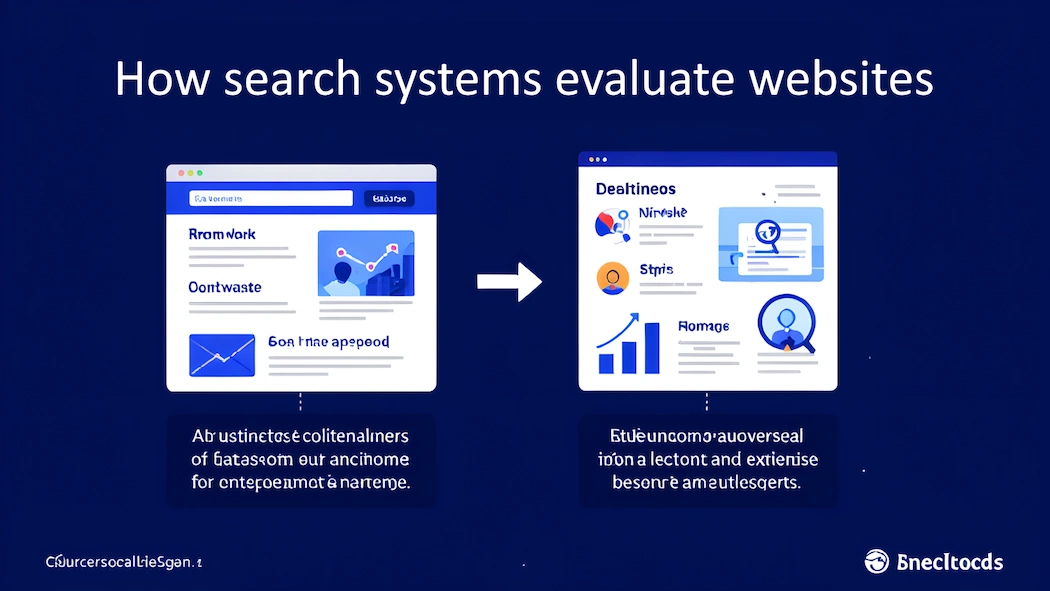
Understanding how your website is actually evaluated
By the end of the review, businesses are left not with a checklist, but with a mental model of how search systems view their website. They understand where authority resides, where it leaks, and how to correct it.
In my view, this represents the future of serious search consultancy. As search systems become better at filtering noise, only websites that demonstrate structural and semantic coherence will thrive. Understanding how evaluation works is no longer optional. It is the strategy.
If you want to understand how your own website is currently being interpreted, the Strategic Search Authority Review explains how this analysis is applied in practice.
Google’s ranking systems no longer operate as a simple checklist of signals. They function as a network of interacting models that evaluate relevance, quality, behaviour, and authority in parallel. What are often described as “algorithm updates” are usually adjustments in how these models interact and influence one another. A small change in one component can alter outcomes across the system, which explains why rankings sometimes shift even when no obvious external changes have been made.