

Internal Link Authority Review (Markov Model Analysis)
Executive Summary
A Markov Model analysis was conducted to understand how internal authority flows through a website and whether that authority supports the organisation’s commercial objectives. This approach is closely aligned with the principles explained in Structural Authority Flow and how modern search systems evaluate connected websites.
The analysis found that the website’s strongest internal authority is concentrated on non-commercial pages rather than revenue-generating product and advice pages. As a result, key financial services areas such as investments, pensions, ISAs, and adviser acquisition receive less internal support than they require to compete effectively in search.
Key Findings
1. Authority Is Concentrated in the Wrong Areas
The highest-authority pages are currently a campaign page and the documents directory. These pages attract more internal authority than many commercially important sections of the website.
2. Commercial Pages Are Under-Supported
Investment, advice, and adviser acquisition pages sit lower in the authority distribution than expected. The internal linking structure does not consistently direct authority towards these priority areas, a common issue discussed in Why Website Rankings Plateau.
3. Authority Circulation Is Restricted
Several pages act as authority sinks, receiving internal authority but passing little of it back into the wider website. This reduces the efficiency of authority distribution across the site and affects how search systems interpret overall importance.
4. Navigation Dilutes Authority
The primary navigation spreads authority across too many sections equally, limiting the ability to strengthen strategically important pages.
Business Impact
The current structure creates several challenges:
- Reduced ability to compete for high-value financial services keywords.
- Lower visibility for adviser acquisition pages.
- Dilution of authority as content grows.
- Internal structure does not reflect commercial priorities.
These effects often emerge when the website’s structure and authority distribution no longer align with how search systems build an internal representation of the site, as explained in How Google Evaluates Websites.
Recommended Actions
Redirect Authority Towards Commercial Hubs
Reduce internal emphasis on non-commercial areas such as campaign pages and document repositories.
Increase internal links to:
- Investment products
- Financial advice services
- Pension and ISA sections
- Adviser acquisition pages
Strengthen Internal Linking
Add contextual links from high-authority pages to commercial hubs using descriptive anchor text.
Remove Authority Sinks
Ensure informational pages, tools, and resources link back into key commercial sections.
Simplify Navigation
Reduce prominence of low-value sections and strengthen pathways towards revenue-generating content.
Rebuild the Authority Hierarchy
Homepage → Category Hub → Product Hub → Product Page → Supporting Content
This type of hierarchy helps reinforce the structural signals discussed in How Search Systems Evaluate Websites.
Expected Outcomes
- Increased authority for financial advice pages.
- Improved visibility for investment and adviser-related content.
- Better distribution of internal authority.
- Stronger alignment between website structure and business objectives.
Conclusion
The website is structurally misaligned with its commercial goals. Too much internal authority flows into non-commercial content, while key revenue-generating pages receive insufficient support.
A targeted internal linking restructure would allow authority to flow more efficiently towards commercial hubs, improving visibility and creating a stronger foundation for long-term organic growth.
For organisations experiencing similar issues, a Strategic Search Authority Review can identify where authority is being accumulated, where it is being wasted, and how search systems are likely interpreting the website’s structure.
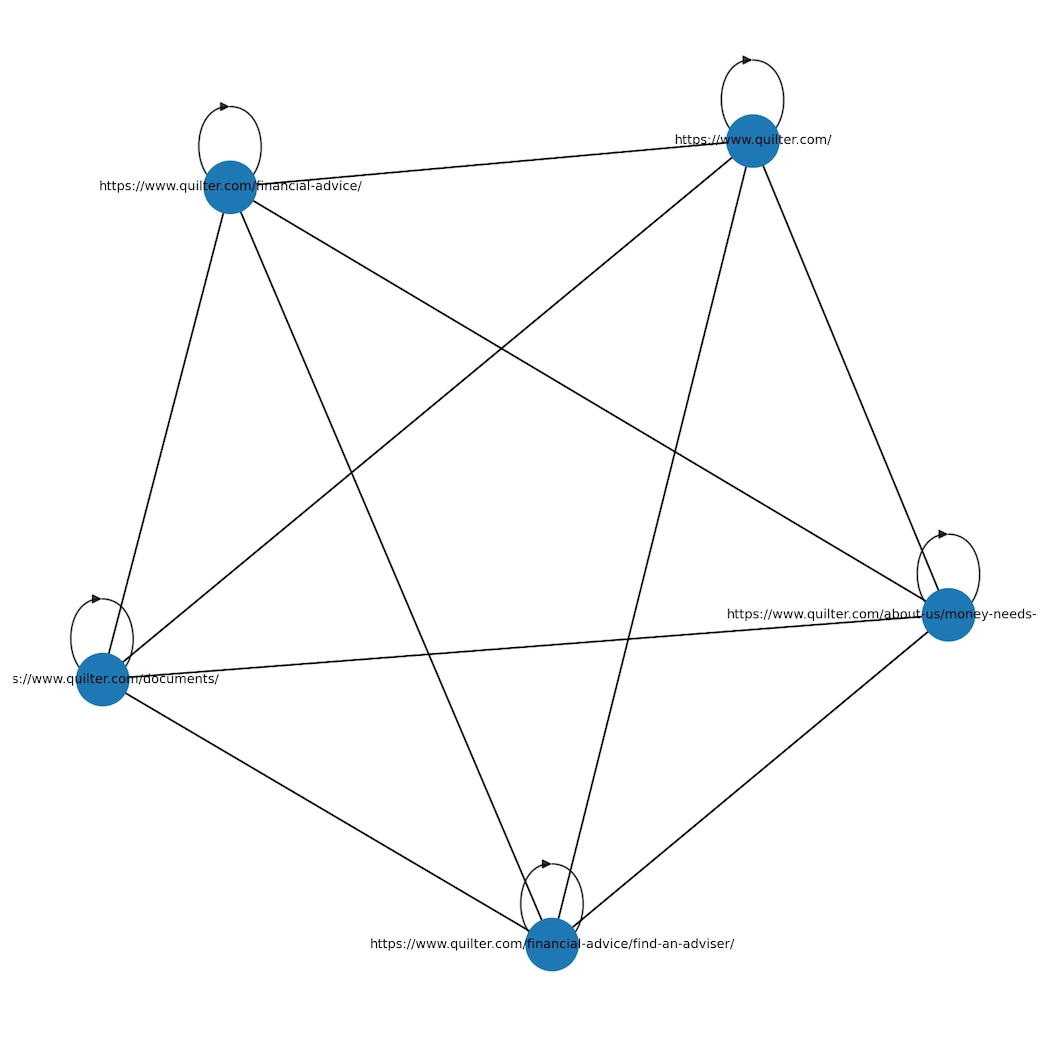
A website network graph diagram from an SEO or web crawl audit of quilter.com. The diagram consists of five large blue circular nodes arranged in a pentagon-like layout against a white background. Each node is labeled with a specific website URL, including the homepage, a financial advice page, a “find an adviser” page, a documents page, and an about-us page. Straight black lines (edges) connect nearly every node to every other node, illustrating a highly interconnected internal linking structure. Additionally, each node features a looped black arrow pointing back to itself, indicating the presence of self-referencing hyperlinks on each page.