

Stop Chasing GEO, AEO and the Next Three-Letter Acronym
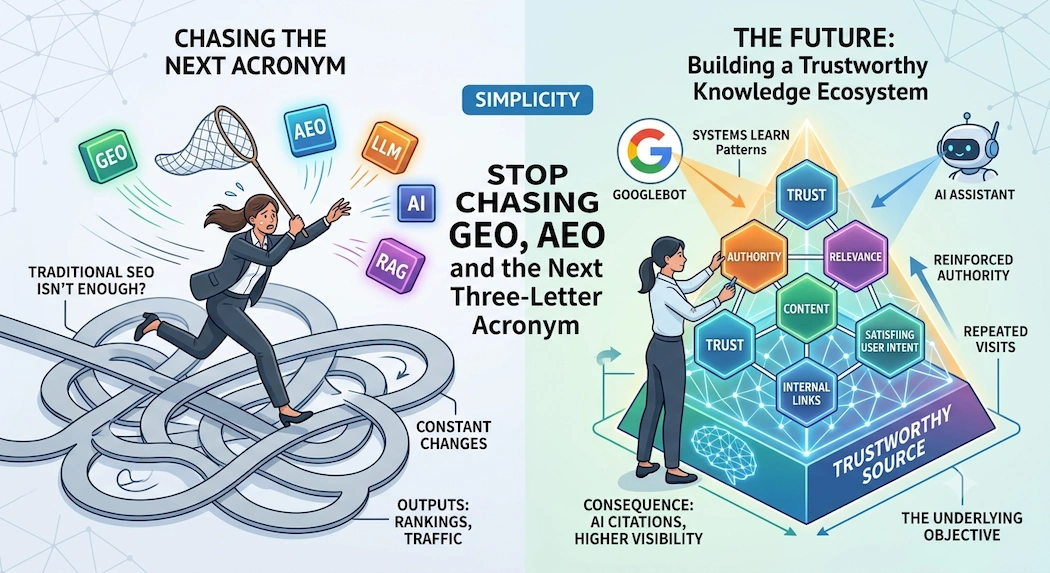
The SEO industry has always been fond of creating new terminology.
Every few months a new acronym appears, promising to redefine how websites should be optimised. Recently, terms such as Generative Engine Optimisation (GEO), Answer Engine Optimisation (AEO) and a growing collection of AI-focused optimisation strategies have become the latest talking points.
The implication is that traditional SEO is somehow no longer enough.
I believe this is the wrong way to think about the future of search.
The reality is much simpler. Modern search engines and AI systems are all attempting to solve exactly the same problem: identifying the most trustworthy and relevant sources of information for a particular question. Although the technologies differ, the underlying objective remains remarkably consistent.
Key Takeaway: The challenge has never been to optimise for another acronym. The challenge has always been to help intelligent systems understand your website.
Search Systems Do Not Simply Read Pages
One of the biggest misconceptions in SEO is the belief that search engines rank individual pages in isolation.
They do not.
Modern search systems construct an internal representation of an entire website. Every page becomes part of a larger network. Internal links establish relationships, authority flows between connected pages, topics reinforce one another, and over time the system develops an increasingly sophisticated understanding of the website as a whole.
This is no longer true only for traditional search engines.
Today’s AI assistants—including ChatGPT, Claude, Gemini, Perplexity and other retrieval-based systems—also need to determine which sources deserve confidence. While foundational AI models draw on static training data, any real-time system performing live retrieval or search grounding faces the exact same fundamental challenge: deciding which information across the web is sufficiently reliable to present as an answer or cite as evidence.
In other words, modern search and AI systems do not simply retrieve pages; they progressively learn and refine an internal representation of entire websites.
Rankings and AI Citations Are Consequences
Much of today’s discussion centres around questions such as:
- “How do I optimise for AI?”
- “How do I increase AI citations?”
These questions assume that AI visibility is a separate optimisation problem. I do not believe it is.
If a website already demonstrates expertise, structural consistency, topical depth and clear authority, AI systems naturally become more willing to reference it.
An AI citation is not the objective. It is the consequence of trust.
Exactly the same principle applies to traditional search rankings. Higher visibility emerges because search systems develop increasing confidence in what your website represents and how consistently it satisfies user intent.
Stop Chasing Outcomes
Many SEO strategies continue to focus almost entirely on outcomes:
- Rankings
- Clicks
- Traffic
- Impressions
- AI citations
These metrics are undoubtedly valuable. However, they describe what has already happened. They rarely explain why it happened.
If we want to understand future visibility, we should begin observing the behaviour of the systems making those decisions.
Questions such as these become far more interesting:
- Which search engines and AI systems are actually visiting my website?
- How frequently do they return?
- Which pathways do they follow?
- Which pages consistently reinforce authority?
- Which knowledge communities attract repeated attention?
- Which areas of the website receive little or no exploration?
- Which systems regularly revisit the website, and which rarely return?
These observations provide insight into how search systems are progressively learning the structure and purpose of a website.
SEO Is Becoming the Study of Learning Systems
Search engines no longer rely on isolated ranking signals. Instead, they evaluate patterns.
They observe how pages relate to one another, how authority flows through the network, whether intent is consistently reinforced, how content evolves over time, and how users interact with the information presented.
From these interconnected observations, search systems gradually construct a probabilistic understanding of the website.
Visibility is not manually assigned. It emerges naturally from the confidence that the system develops in its internal model.
Whether the visitor is Googlebot, Bingbot or an AI retrieval system, the underlying objective remains the same:
Objective: To determine whether your website has become a trustworthy source of knowledge.
The Problem with Chasing New Acronyms
Many of today’s AI-focused optimisation strategies attempt to solve symptoms rather than causes.
Adding another piece of structured data, changing headings to suit an AI model or inventing new terminology does little if the underlying website lacks coherence, authority or structural reinforcement.
Search systems do not become confident because a page has been labelled for AI. They become confident because repeated observations consistently reinforce the same understanding.
That understanding develops over time. It is learned.
Looking Beyond SEO
For many years, SEO has largely focused on changing websites. An equally important question is now emerging:
How are search and AI systems actually learning websites?
This is where we believe the conversation needs to move.
At T.G. Barker, our current research is focused on observing how search engines and AI systems behave after they arrive on a website. We are investigating how frequently different systems revisit content, the pathways they follow through a site’s knowledge structure, how authority is reinforced through repeated exploration, and how these behavioural patterns relate to indexing, visibility and AI citation over time.
If visibility is driven by how systems learn, then the metric that matters most isn’t ranking—it’s crawler behavior. Rather than treating search engines and AI systems as black boxes, our objective is to better understand their observable behaviour and the probabilistic models they construct as they learn websites.
We believe this represents an important shift in perspective.
For many years, SEO has measured the outputs of search systems. The next stage may be to measure the behaviour of the search systems themselves.
Instead of asking: “How do I optimise for AI?”
Perhaps the more important question is:
“How are search systems learning my website?”
Because whether the outcome is a higher search ranking, stronger authority or an AI citation, they all emerge from the same underlying process: A search system developing an increasingly rich understanding of your website as an interconnected system of knowledge.