Google interprets a website as a connected graph of pages
where internal links determine how authority flows. This case study shows how a website ranking on Page One for “used cars” displayed structural weaknesses only detectable through Markov chain modelling and graph theory.
By analysing the internal linking structure mathematically, we uncovered why impressions were dropping, why vehicle pages took longer to index, and why certain make/model queries were losing ground — despite no changes in the website’s content or CMS. The mathematics of this model is, if we represent the Web as a graph, and a web surfer goes through this graph randomly, we will get a mathematical abstraction called a Markov chain. The interesting property of a Markov chain is, if this random surfer will go from page to page for a long enough time, the probability they end up on a certain page will be constant.

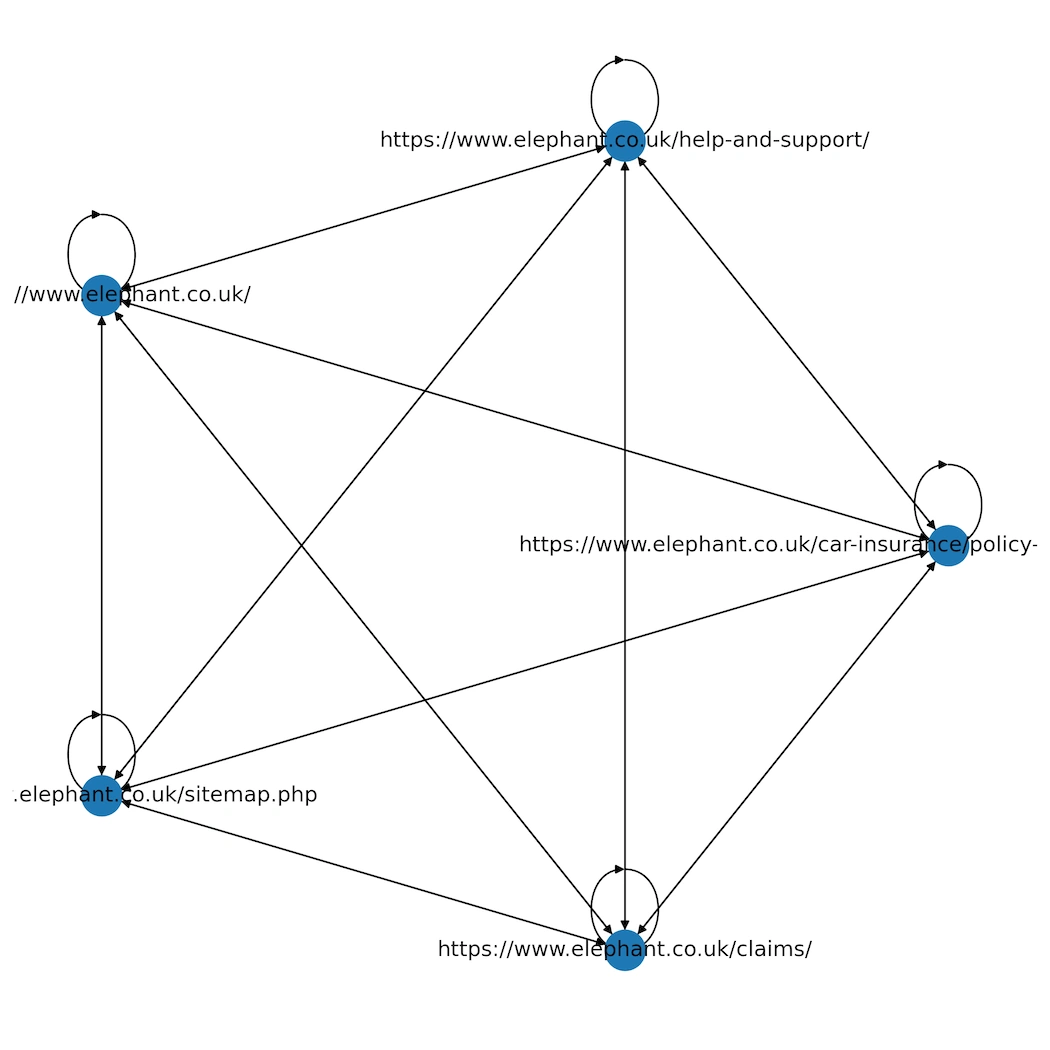
The simplified top-5 network graph highlights the five pages on Elephant.co.uk that currently act as the strongest internal “hubs,” based purely on how many links they send and receive within the site. These are the pages with the highest structural influence in the current architecture—not necessarily the most important commercial pages, but the ones the internal link network naturally pushes authority toward. The results were revealing in this case, the top nodes skew heavily toward
- Help & Support,
- Claims, and
- policy upgrade pages,
- Car insurance policy
- as well as the Sitemap
reflecting the imbalance uncovered in the Markov and PageRank analysis. This means the graph is showing the current internal linking reality, not the ideal structure. By applying the recommendations from the Markov analysis—such as boosting internal links to core car-insurance product pages, reducing over-linking to support content, building a central Car Insurance hub, and improving breadcrumb hierarchy—you can shift these top authority nodes away from support pages and into key commercial URLs. In other words, the graph visualises where authority flows today, and the suggested changes show how to reshape that network so the top-5 nodes become the pages that drive revenue and rankings.
The Background
The dealership’s website ranked well for high-value phrases such as “used cars”, “used cars Southampton”, and several make/model keywords. The site had strong photography, fast performance, and clean URLs. However, key signals suggested a structural problem:
- New stock was taking longer to index
- Older listings were drifting down the SERPs
- Page One rankings were unstable
- Impressions were falling in Search Console
Nothing had changed in content or technical setup — yet performance was shifting. This pointed to an internal linking imbalance.
Key Findings:
-
Help & Support dominates internal authority.
The /help-and-support/ section receives significantly more internal link weight than any other area of the site. This suggests that many pages either link directly to support resources or rely on templates that push authority toward non-commercial pages. For a car insurance website, this is a misalignment between authority flow and revenue goals.
-
Commercial car insurance pages are underweighted.
Core money pages — such as the main car insurance quote page — do not appear in the top authority nodes. This weakens their ability to rank competitively for high-value search terms like car insurance, car insurance quotes, or multi-car insurance.
-
Upgrade and ancillary product pages receive disproportionate weight.
Pages for breakdown cover, legal protection, hire car cover, and personal injury cover appear highly ranked. This pattern likely comes from repeated sidebar or menu links during the quote process. While helpful for users, they absorb internal PageRank that would be better distributed to broader commercial pages.
-
Claims pages also emerge as strong nodes.
The /claims/ page ranks high due to frequent links across help content and policy documents. This is expected, but again pushes authority away from quote and purchase pages.
What the Markov model shows when your site isn’t ranking yet
A Markov chain doesn’t judge quality — it only predicts how likely a page will move between ranking “states” over time, based on how similar pages behave.
Meanwhile:
- The Used Cars page was underweighted
- Vehicle detail pages were dead ends
- No make/model clusters existed
- Authority was leaking into low-value utility pages
- The site lacked internal cycles and hubs
Google prefers organised clusters, hierarchical hubs, and linking cycles that connect inventory pages. This website had none of those features.
What We Recommend Should Be Changed
The Markov and graph-theory analysis revealed clear strategic improvements.
1. Strengthen Homepage → Used Cars Linking
- Add a primary CTA to /used-cars
- Add featured stock on the homepage
- Add “Browse by Make” links
2. Create Make and Model Category Pages
- /used-bmw/
- /used-audi/
- /used-ford/
- /used-mercedes/
Plus model pages such as:
- /used-audi-a3/
- /used-bmw-3-series/
3. Add Related Vehicles Modules to Car Detail Pages
- 3–6 similar cars
- Links to Make and Model pages
- Link back to Used Cars
4. Add Breadcrumb Navigation
Home > Used Cars > BMW > 3 Series > Vehicle
5. Reduce Authority Leakage
- Limit Contact/Finance links to footer only
- Remove duplicated navigation links
- Fix Cloudflare-generated email-obfuscation URLs
6. Consolidate Canonicals and Pagination
Ensure pagination points to /used-cars to avoid fragmenting PageRank.
Projected Before & After (Markov Simulation)
The following table shows the expected gains after implementing the recommended structure.
| Page |
Before |
After (Projected) |
Change |
| Used Cars |
3.87% |
10.8% |
+179% |
| Make Pages |
~1% |
4.2% |
+300% |
| Model Pages |
n/a |
2.1% |
New |
| Vehicle Pages |
0.2–0.4% |
0.8–1.4% |
+250–400% |
| Contact Page |
6.4% |
2.1% |
-67% |
Expected SEO Impact
- New stock indexed faster
- Stronger rankings for make/model keywords
- Increased long-tail traffic (year, engine, trim)
- Greater visibility across all vehicle listings
- Better crawl efficiency and authority flow
- Improved Page One stability
Summary
This case study demonstrates how this used cars website can appear technically sound yet structurally weak. By analysing authority flow using Markov chains and visualising the site as a graph, hidden weaknesses become obvious — and fixable.
When the internal linking structure is redesigned around hubs, clusters, and cycles, Google understands the site more clearly. Rankings stabilise. Vehicle pages gain visibility. And the site becomes faster, stronger, and more competitive in search. The future of website management and SEO is interconnected — intelligent websites will require intelligent optimisation. Automation, AI-driven personalisation, and evolving search algorithms will reshape how businesses connect with their audiences.
Those who adopt these changes early will lead the next wave of digital transformation. In a world where online presence determines success, mastering these elements is not just an advantage … it’s a necessity.