

How Search Systems Decide Your Ranking Position
By: T.G. Barker | See how the strategic authority review works | Last reviewed: 13/10/2026.
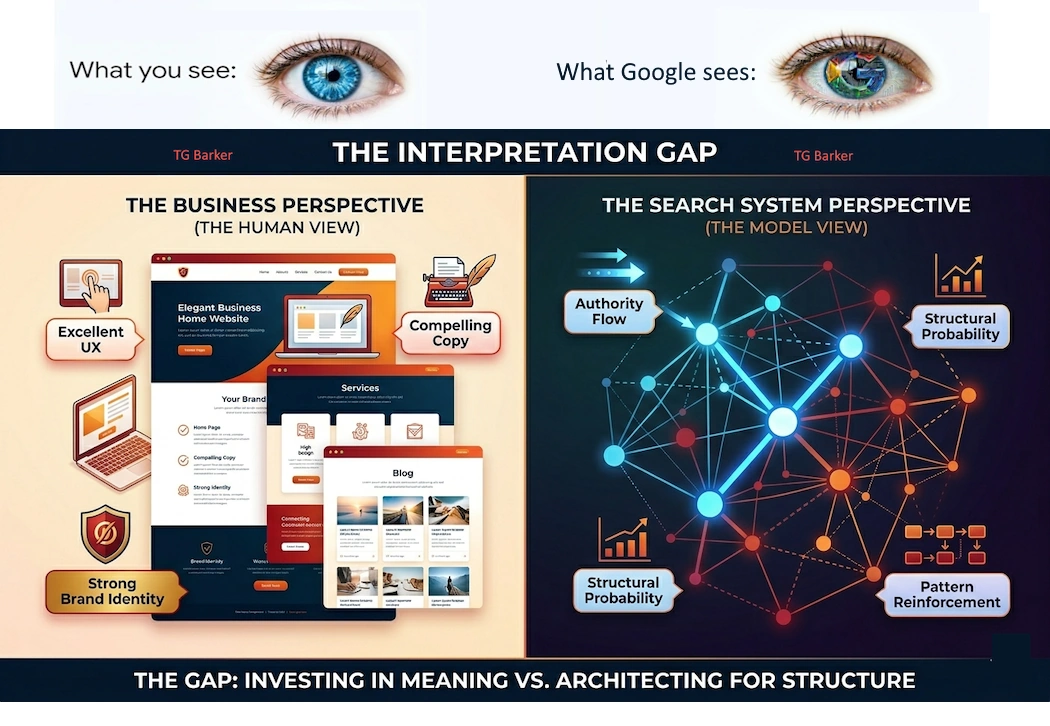
A website may look clear and well designed to people, yet search systems see something very different. They interpret structure, relationships, pathways, topic consistency, and patterns of reinforcement across the site. What users experience visually is only one layer of how a website is understood.
Search systems do not evaluate websites in the way many people assume. They do not simply reward activity, content volume, or optimisation in isolation. Instead, they attempt to form an overall understanding of what a website represents, how different sections relate to one another, and which pages appear most central over time.
Without that foundation, even well-written content and ongoing optimisation can struggle to produce consistent visibility. In many cases, websites do not fail because of a lack of effort, but because the underlying structure does not clearly support the interpretation the business is trying to achieve.
This website explores how modern search and AI-driven systems evaluate websites, how structural patterns influence visibility, and why understanding those systems has become increasingly important for businesses that want greater control over their online presence.
Website Foundations
Before building a house, architectural plans are created to define the structure, the flow, and how everything connects together. Websites are not very different.
A website foundation is the underlying structure that allows search systems to interpret what a website represents, how authority flows through it, and how different sections support one another over time.
This foundation influences:
- how pages connect together
- how content reinforces topics
- how authority flows through the site
- how users navigate information
- how search systems form stable interpretations
Without that foundation, even well-written content and ongoing optimisation can struggle to produce consistent visibility.
This applies equally to:
- new websites being launched for the first time
- growing websites expanding into new topics
- established websites that have plateaued
- websites that have lost visibility after structural changes
In each case, the underlying issue is often not the amount of activity taking place, but how the website itself is being interpreted.
Search Systems Build Models
Search systems do not simply rank individual pages. They build internal models of websites based on structure, relationships, authority flow, and repeated patterns across the site. This process is part of what can be described as
Search systems do not simply rank individual pages. They build internal models of websites based on structure, relationships, authority flow, and repeated patterns across the site. This process is part of what can be described as search systems evaluation — the way search platforms interpret a website as a connected system rather than isolated pages.
These models are formed through:
- linking patterns
- topic relationships
- structural pathways
- authority reinforcement
- behavioural patterns
- repeated user journeys through the site
Over time, the system begins to understand which pages act as hubs, which pages reinforce authority, and which pages appear central to a topic.
Visibility emerges from this interpretation.
Understanding how Google evaluates websites therefore becomes less about isolated SEO tactics and more about understanding how the wider structure of a website is being interpreted as a connected system.
Why Some Websites Plateau
Many websites continue producing content, adding pages, and making adjustments, yet see little movement in visibility.
This often happens because the system has already formed a stable interpretation of the site.
Once enough structural and behavioural signals accumulate, rankings begin reflecting that established model. Additional activity frequently reinforces the existing interpretation rather than changing it.
This is why website rankings plateau even when ongoing work continues.
The same principles also apply to new websites. Early structural decisions can heavily influence how search systems interpret a site from launch, sometimes reinforcing patterns that become difficult to change later.
Understanding Authority Flow
Authority does not move randomly through a website.
Search systems observe:
- which pages attract links
- which sections reinforce topic relevance
- how internal links distribute importance
- how users repeatedly move between pages
- which pages consistently satisfy intent
Over time, these repeated pathways create stable patterns that influence visibility.
This is part of how authority flows through a website structure and why some pages naturally become dominant within a search system’s interpretation of the site.
Behavioural Patterns and Reinforcement
Search systems also observe behavioural patterns.
They monitor:
- which pages users enter first
- where users move next
- which pages repeatedly act as endpoints
- which pathways are reinforced most often
These interactions form observable patterns across the site.
Over time, those patterns contribute to a probabilistic understanding of the website — reinforcing which pages appear important, which topics are central, and how the site functions as a connected entity rather than a collection of isolated pages.
This is why websites can gradually settle into stable visibility patterns over time.
Designing the Website Foundation
Before building a house, architectural plans are created to define the structure, the flow, and how everything connects together. Websites are not very different.
Many website owners begin creating pages, publishing content, and investing in SEO before first establishing the underlying structure that search systems will use to interpret the site.
A website foundation provides that structure.
It defines how topics connect together, how authority flows between pages, how content reinforces central themes, and how search systems gradually form an understanding of what the website represents.
Without a clear foundation, SEO activity can easily become fragmented. New pages are added without reinforcing a wider structure, authority becomes diluted across unrelated areas, and search systems struggle to form a confident interpretation of the site.
This is why website foundations matter. They give direction to the entire website.
Content creation, internal linking, authority building, navigation, and SEO strategy all become easier when the underlying structure has been designed deliberately from the beginning.
The objective is not simply to rank individual pages, but to shape a website model that search systems can understand, reinforce, and trust over time.
It is to design a website foundation that creates:
- clear topic relationships
- understandable authority pathways
- reinforced intent structures
- scalable content organisation
- long-term structural clarity
When the underlying structure is coherent, both users and search systems can understand the site more easily.
This creates a website that is easier to grow, easier to expand, and easier for search systems to interpret consistently over time.
Understanding the Existing Model
For established websites, the first step is usually understanding how the current model has formed.
This involves examining:
- authority concentration
- internal linking structures
- topic reinforcement
- crawl pathways
- structural inconsistencies
- behavioural flow patterns
The goal is not simply more optimisation, but clarity.
To understand how this process is approached in practice, see how the review process works and how structural interpretation is analysed across a website.