Builders need visibility in searches that depend on clarity, proximity and trust. My audit reveals the technical gaps that hold construction businesses back, such as weak location signals, missing schema, poor internal linking, or diluted content relevance. I turn these findings into a structured improvement plan you can act on immediately. This is practical, straightforward and backed by real ranking behaviour.
You can also review how Google evaluates similar signals in my SEO Website Audit page.
Construction firms rank well when their websites reflect real-world expertise, transparent processes, and clear service boundaries. Google’s models analyse whether your pages help homeowners or developers understand timelines, compliance, materials, and costs. When your construction content blends practical explanations with local relevance and project examples, it signals authority — making Google far more likely to prioritise your business in competitive regional searches. Why auditing using Google’s own PageRank is critical to any website and this is an example of a very small one but how important it is by using Markov chain analysis we can audit and recommend steps to improve a site.
The Journey
- Data Gathering
- Uploaded an inlinks file, which gave us the raw internal link structure of the site.
- We identified four key pages: homepage, services, about us and contact us
-
- Graph & PageRank Analysis
- We mapped the site as a small, tightly connected graph.
- Initial PageRank showed the homepage dominating (~0.42), with the other three pages evenly balanced (~0.19 each).
- We then computed the exact weighted transition matrix from the link counts, confirming the homepage’s overweighting due to redundant “Home” and brand anchors.
- 3. Simulation & Redistribution
- We simulated contextual anchors (e.g., → , → ).
- This redistributed PageRank: homepage dropped slightly (~0.39), while Services and Contact rose (~0.21 each), showing how authority can be sculpted toward conversion pages.
-
- 4. Strategic Diagnosis
- We noted why the site is stuck on page 3: thin content, shallow structure, homepage overweighting, lack of topical clusters, and limited local SEO signals.
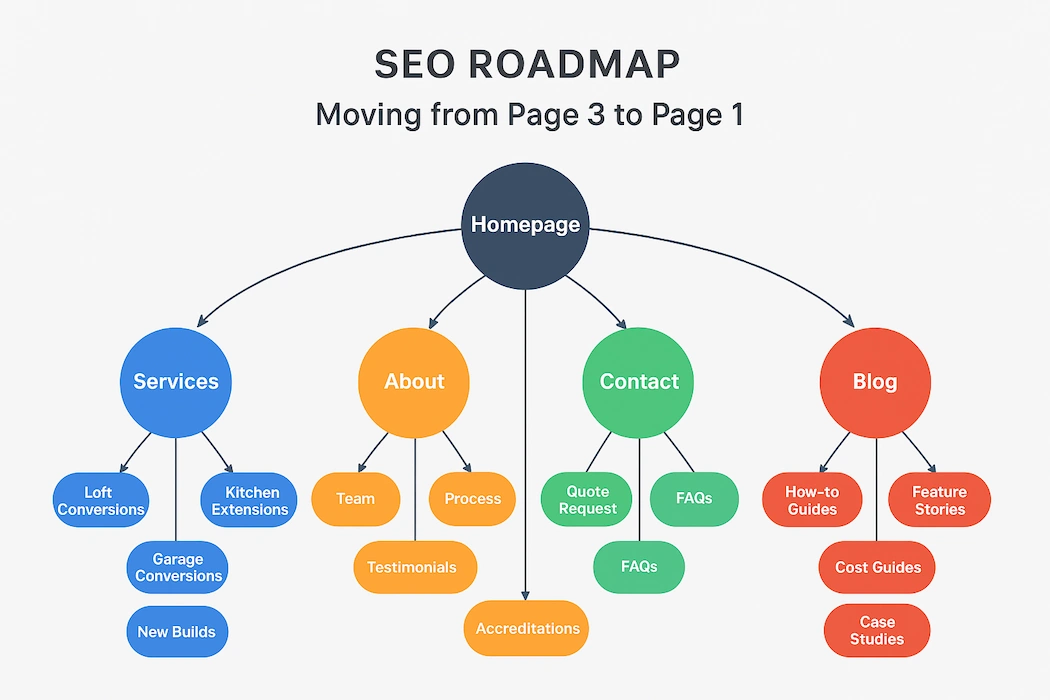
- We designed a topical cluster map: Services, About, Contact, and a Knowledge Hub (blog/resources) to expand topical authority and funnel PageRank strategically.
- The Results & Path to Page 1
If implemented, the following changes can move the site forward:
- Content Expansion: Service-specific landing pages, FAQs, case studies, and a blog hub.
- Internal Linking: Contextual anchors to sculpt PageRank into Services and Contact.
- Authority Building: Local backlinks, citations, Google Business Profile optimization.
- Technical SEO: Structured data (LocalBusiness, FAQ), Core Web Vitals, mobile optimization.
- Local SEO: Geo-modified keywords and service area pages to capture regional queries.
This is all measurable and our Expected trajectory is as follows:
- Short term (1–3 months): Long-tail visibility improves, CTR rises.
- Medium term (3–6 months): Movement from page 3 → page 2 as topical clusters and backlinks grow.
- Long term (6–12 months): Page 1 potential if clusters, authority, and local signals are consistently reinforced.
In short: we moved from raw link analysis → PageRank modeling → simulations → cluster design → a roadmap. The result is a clear strategy: sculpt authority flow, expand topical depth, and build local trust signals to move solentbuilder.com from page 3 toward page 1.
Topical cluster map for solentbuilder.com
That will help push the website off page 3 and into page 1 by building topical authority.
Core Pillar Page
-
- Homepage () → Broad positioning: “Solent Builders – Trusted Building Services in Hampshire”
- Acts as the pillar hub, linking into all clusters with contextual anchors.
- Should emphasize brand + geographic coverage.
Cluster 1: Services (Conversion-Focused)
Pillar: → “Our Building Services”
Supporting cluster pages:
-
-
- Loft Conversions in Southampton
- Kitchen Extensions Hampshire
- Garage Conversions Portsmouth
- Renovations & Refurbishments Hampshire
- New Builds & Home Extensions
Each service page links back to and cross-links to relevant case studies.
Cluster 2: About & Trust Signals
Pillar: → “About Solent Builders”
Supporting cluster pages:
- Meet the Team (bios, qualifications)
- Our Process (step-by-step building journey)
- Testimonials & Reviews
- Accreditations & Certifications
These reinforce E-E-A-T (Experience, Expertise, Authoritativeness, Trustworthiness).
Cluster 3: Contact & Conversion Funnel
Pillar: → “Contact Solent Builders”
Supporting cluster pages:
- Request a Quote (form optimized for conversions)
- Service Area Coverage (map + local towns)
- FAQs (structured with FAQ schema)
- Financing & Payment Options
Internal links from service pages should funnel into .
Cluster 4: Knowledge Hub (SEO Growth Engine)
Pillar: or → “Building Advice & Guides”
Supporting cluster pages:
- “How to Plan a Loft Conversion”
- “Top 10 Kitchen Extension Ideas”
- “Building Regulations in Hampshire Explained”
- “Cost Guide: Home Extensions in 2025”
- “Choosing the Right Builder in Southampton”
Each article links contextually to relevant service pages, boosting topical authority.