

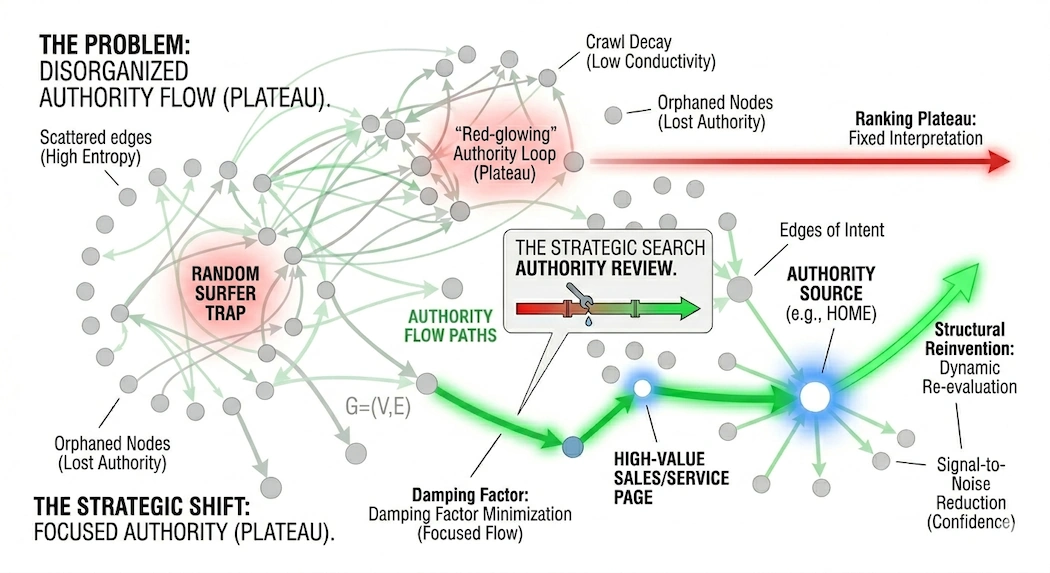
How Your Website Is Being Interpreted
Search systems do not evaluate websites in the way humans do. They construct internal models based on structure, relationships, and authority distribution. This process defines how Google evaluates websites to determine their relevance and reliability.
This means your website is assessed as a whole. It is interpreted based on how pages connect, where authority concentrates, and whether the structure appears coherent. If the structure does not align with recognised patterns, the system does not treat the site as incorrect — it treats it as uncertain.
Website Structure as a Network
Your website functions as a network of interconnected pages. This analysis identifies core pages (central nodes), supporting pages, orphan or disconnected content, and structural gaps. By revealing the hidden model behind website rankings, we can pinpoint exactly where your structural foundation is failing.
A well-structured site forms clear pathways of reinforcement. A fragmented site disperses authority and weakens visibility.
Authority Flow Analysis
Internal links create pathways through which authority flows. By modelling this as a probability system, we can identify pages that receive repeated reinforcement, pages that are rarely reached, and points where authority dissipates.
Pages that are frequently encountered become important. Pages that are not become structurally invisible.
Structural Authority Core
Search systems prioritise pages that are repeatedly reinforced. This analysis highlights pages acting as central hubs, pages incorrectly positioned as important, and pages that should be central but are not.
Importance is not declared. It is inferred through structure, forming a probabilistic model that dictates how Google ranks search results.
Authority Distribution
Authority within your site is not evenly distributed. This analysis identifies overweight pages receiving excessive internal focus, under-supported pages with high strategic value, and wasted internal pathways.
Correcting this distribution is essential for shifting visibility and explains why SEO progress often plateaus despite continued investment in content.
Intent Alignment
Structure reinforces meaning. This section evaluates whether related topics are connected, whether commercial and informational pages support each other, and whether the site expresses a clear, unified intent.
Misalignment weakens the system’s confidence in your site.
Structural Weaknesses
The following issues reduce your visibility: orphan or near-orphan pages, broken or inefficient link pathways, competing pages diluting intent, and pages receiving traffic but not redistributing authority.
Why Growth Has Stalled
Your current performance reflects a stable system state. Search systems have formed a consistent interpretation of your website, and this interpretation is reinforced through repeated internal pathways.
As a result, additional SEO activity produces minimal change, new content reinforces existing patterns, and rankings remain stable. The issue is not effort. It is structural stability.
Strategic Recommendations
Authority Reallocation: Increase internal links to priority pages and reduce emphasis on low-value pages.
Core Hub Reinforcement: Establish clear central nodes and strengthen internal pathways.
Structural Simplification: Remove duplication and reduce fragmentation.
Intent Consolidation: Align related content and eliminate competing signals.
Expected Outcome
If these changes are implemented, authority will concentrate more effectively, key pages will gain structural importance, and search systems will begin to reassess your website. This creates the conditions for improved visibility.
Implementation Priorities
Immediate: Internal linking adjustments and orphan page fixes.
Medium-Term: Structural reorganisation and content alignment.
Long-Term: Strategic positioning refinement.
Final Statement
Without changing how search systems interpret your website, further investment will reinforce existing outcomes.