

Understanding How Search Systems Model Your Website
An observational framework for modelling how autonomous computational systems progressively construct, reinforce and refine an internal representation of a website through repeated interaction.
An observational framework for modelling how autonomous computational systems progressively construct, reinforce and refine an internal representation of a website through repeated interaction.

Why Our Daily Search System Behaviour Analysis Exists:
It is asking “What does observed computational behaviour tell us about how search and AI systems are modelling this website?”
Traditional web analytics have spent decades answering variations of the exact same question: What are humans doing on my website? We track pageviews, monitor bounce rates, map conversion funnels, and celebrate when user engagement ticks upward. This data remains highly valuable for measuring human behavior, visits, and conversions.
However, standard analytics tools were never intended to explain a completely different, increasingly critical function of the modern web: how search engines, AI models, and autonomous technologies gradually develop a structural understanding of a website. A human visitor browses via user interfaces to find a specific answer or product. An AI crawler or search bot traverses a site to ingest, categorize, and map an entire knowledge structure. They do not build this understanding by reading isolated pages in a vacuum; they construct a probabilistic model by repeatedly moving between connected pages. Every single movement reinforces some parts of your website while completely ignoring others.
Keypoints:
 This is why the Daily Search System Behaviour Analysis exists. It shifts the operational focus from recording human events to interpreting computational behavior, revealing exactly how autonomous entities construct an internal representation of your digital footprint.
To understand why this analysis is necessary, we must view websites as evolving knowledge structures rather than simple collections of independent landing pages. When an AI crawler or search bot arrives, its behavior leaves behind an observable trail within your server logs. Every request represents another observation.
Collectively over time, these requests expose remarkably consistent behavioral patterns. Search systems return to important knowledge areas, reinforce relationships between pages, and continually refine their interpretation as the website evolves.
By mapping these patterns, the daily report answers fundamental, non-traditional analytics questions:
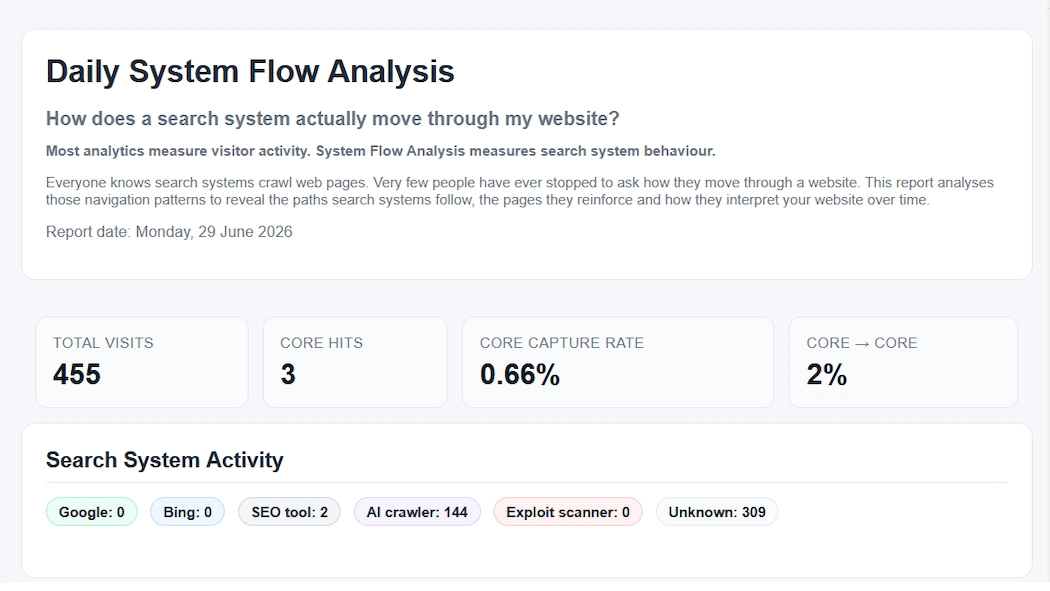
To see how this works in practice, we can analyze actual data collected from a live daily report. The reporting interface isolates non-human interactions precisely, exposing background automation that standard analytics platforms routinely mask or ignore.
While the visual dashboard serves as a framework for tracking total visits and core capture rates, a deep dive into the raw daily report data reveals a stark reality of modern web traffic:
The presence of heavy “Unknown” visits highlights why server-level observation is mandatory. This background Internet automation reflects automated infrastructure activity rather than real user behavior, comprising:
A primary component of the report is tracking the AI Knowledge Footprint. This measures exactly how much attention AI systems are giving to the website, and whether they are reinforcing existing knowledge or expanding into brand-new content tiers.
According to daily metrics, AI models actively build a foundation on specific thematic layers:
When AI systems repeatedly visit specific pages, they use them as primary reference sources to interpret the wider context of your entire business. The report maps these out by structural priority, separating general homepage ingestion from deep informational guides, technical cornerstones, and structural directory endpoints.
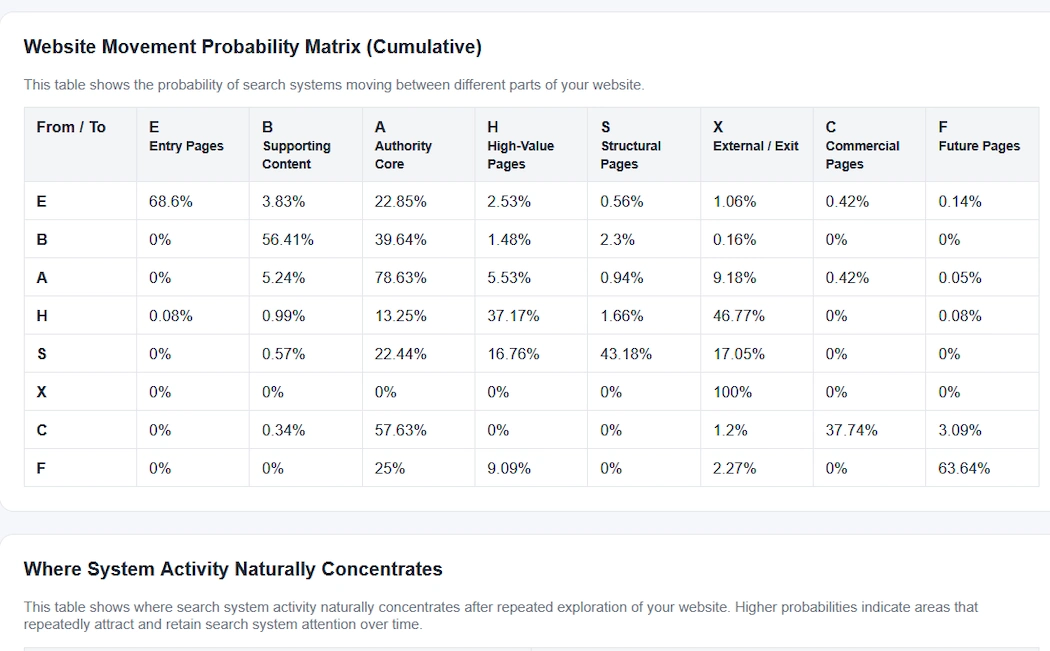 Bots do not move randomly through a website; their behavioral transitions follow a mathematical framework known as a Markov Chain. The report maps these movements into a cumulative Website Movement Probability Matrix.
Looking closely at the observed cumulative probabilities from structural data models, we can map out the precise mechanics of bot traversal:
By combining these Markov transition probabilities with the physical map of the site, the daily analysis generates a clear System Flow Assessment. Instead of guessing where technical equity is leaking, the report provides concrete observations:
The report flags when search systems continue to circulate deeply within a designated Authority Core, proving these pages are successfully being treated as a tightly connected knowledge cluster.
The informational and supporting content tiers are monitored to ensure they function perfectly as traffic funnels, successfully passing algorithmic authority over to the Core.
The system identifies exactly where high-value pages are acting as architectural dead-ends, causing bots to leave the ecosystem entirely before redistributing authority to other commercial zones. This alerts you to add contextual, internal links on those specific pages to encourage deeper crawling loops.
The absolute core of the traversal engine can be viewed by looking at performance within the Authority Core. The report tracks A → A Loops—the specific structural pages where crawlers repeatedly bounce from one core authority asset to another.
A high loop count means a page has become an anchor for the website’s structural knowledge model. This tracking reveals a fascinating paradox: standard structural utility pages (such as a primary contact node or global privacy policy) might hold very little SEO keyword value for human search queries, yet mathematically, they often act as massive operational hubs where search engine bots continually pass through to redistribute crawling energy across the rest of the domain.
As search ecosystems continue to evolve, understanding how computational systems acquire knowledge is no longer optional. Search engines and AI models are no longer simply matching text keywords to pull up isolated articles; they are organizing entire sites into structured representations to determine real-world context, topical authority, and trust.
For years, webmasters have focused entirely on making blind changes to frontend elements in the hope of shifting search engine rankings. But sustainable improvement must begin with observation. Before attempting to change how an AI system evaluates a brand, you must first understand how it already moves through the architecture.
The Daily Search System Behaviour Analysis brings this hidden backend layer to light. It doesn’t rely on assumptions, algorithmic theories, or third-party keyword indexes. It looks directly at the structural footprints left on a server every day.
Because at the end of the day, a website is what is chosen to be published—but a search system’s traversal graph is what it actually understands.
Understanding rarely develops from a single observation. Whether we consider scientific research, medical diagnosis or everyday experience, confidence grows as evidence accumulates. Individual observations begin to support one another, relationships become clearer and isolated pieces of information gradually form a coherent picture. Search systems appear to develop an understanding of websites in much the same way. Every page discovered contributes another observation. Every internal link provides further evidence that two subjects are related. Every return visit either reinforces or refines previous understanding. Over time these countless observations begin to organise themselves into something far more meaningful than a collection of independent pages. They become an interconnected representation of how the website is structured and what knowledge it appears to contain.
Observing behaviour alone is rarely enough to draw meaningful conclusions. Every scientific observation requires context, otherwise it becomes little more than a collection of measurements. The same principle applies when studying how search systems interact with a website. Watching autonomous systems move from page to page tells us very little unless we first understand what the website was intended to communicate. Before any behavioural analysis begins, it is therefore necessary to establish a reference model against which observed behaviour can be interpreted. This reference model is known as the Website Blueprint.
The Website Blueprint describes the intended structure of the website rather than its visual appearance. It identifies the pages that represent the primary knowledge of the website, the supporting pages that reinforce those subjects, the structural pages that assist navigation and the commercial pages that represent business objectives. It also considers how authority should naturally accumulate, which pathways should strengthen the website’s central themes and how different sections are expected to support one another. In effect, the Blueprint records how the website is intended to function as an organised body of knowledge before any observations of search system behaviour take place.
Once we begin to view websites as evolving knowledge structures rather than collections of independent pages, a different approach to measurement naturally follows. Traditional website reporting remains valuable because it tells us how people interact with a website. It measures visits, engagement, conversions and many other aspects of human behaviour. Those measurements continue to answer important business questions. They were never intended, however, to explain how search engines, AI systems and other autonomous technologies gradually develop an understanding of a website. That is a different process requiring a different form of observation.
The Daily Search System Behaviour Analysis was developed to observe that process. It does not attempt to replace Google Analytics, nor does it compete with traditional SEO reporting. Instead, it examines the observable behaviour left behind as computational systems repeatedly explore a website. Every request recorded within a server log represents another observation. Individually those requests reveal very little, but when collected over time they begin to expose remarkably consistent behavioural patterns. Search systems return to important knowledge areas, reinforce relationships between pages, revisit established authority and continually refine their interpretation as the website evolves. Although the internal representation itself remains hidden, the behaviour contributing towards its construction can be observed, measured and interpreted.
The report therefore focuses less on individual crawler requests and more on the behaviour that emerges from repeated exploration. It examines where computational attention naturally concentrates, how frequently important pages are reinforced, how supporting content contributes towards broader knowledge areas and how movement develops across the website over time. These observations reflect how search systems evaluate websites, where understanding develops through repeated structural exploration rather than isolated page requests. Rather than asking simply whether a page has been visited, it asks what repeated visits reveal about the computational understanding that is gradually being constructed. This shift from recording events to interpreting behaviour forms the central purpose of the analysis.
To make those observations meaningful, the report combines behavioural evidence with the Website Blueprint. The Blueprint describes the intended organisation of the website and the structural relationships it is designed to communicate. Daily observations reveal how search systems actually behave when exploring it. By comparing the two, it becomes possible to determine whether the website is being interpreted in the way its structure was designed to communicate or whether search systems are gradually constructing a different understanding. This comparison reflects the principles explored in the Website Blueprint, where the emphasis shifts from individual pages towards the overall structure from which search systems construct meaning. The objective is not to judge whether that interpretation is right or wrong, but to observe how it develops and how it changes as the website continues to evolve.
Several of the measurements within the report have been developed specifically for this purpose. Rather than concentrating on conventional traffic metrics, the analysis examines areas such as knowledge reinforcement, repeated pathways, authority concentration, structural transitions and AI Knowledge Footprint. Each contributes another perspective on how computational systems repeatedly interact with the website. Individually they provide useful observations. Together they begin to reveal how search systems are reinforcing knowledge, refining relationships and strengthening particular areas of the website over time.
Perhaps the most important distinction is that the report does not attempt to explain what search systems are thinking. No external observer can know the internal processes operating within modern search engines or AI systems. Instead, the report studies behaviour in much the same way that scientists observe natural phenomena. Behaviour leaves evidence. Repeated observations reveal patterns. Consistent patterns allow carefully reasoned conclusions to be drawn. This evidence-based approach reflects how search systems evaluate websites, where conclusions are drawn from observable behaviour rather than assumptions about proprietary algorithms. The Daily Search System Behaviour Analysis is therefore best understood as an observational study of computational behaviour rather than an attempt to reverse engineer search algorithms.
As search continues to evolve, understanding how computational systems acquire knowledge of websites is becoming increasingly important. Search systems are no longer simply retrieving documents that contain particular words. They are continually organising information into structured representations that help them interpret subjects, relationships and context across entire websites. This process is closely related to Structural Authority Flow, where repeated exploration reinforces the relationships that shape a website’s computational representation. The Daily Search System Behaviour Analysis was developed to observe part of that process. It seeks to make visible some of the evidence left behind as search engines, AI systems and other autonomous technologies repeatedly explore, reinforce and refine their understanding of a website.
Ultimately, this represents a subtle shift in perspective. For many years the emphasis has been placed on changing websites in the hope of improving search performance. While optimisation will always remain important, meaningful improvement begins with understanding. Before attempting to influence how search systems evaluate a website, it is helpful to understand how they are already interpreting it. That is the purpose of the Daily Search System Behaviour Analysis. It begins not with recommendations or assumptions, but with observation. Because your website is what you publish. A search system’s representation is what it understands.