

Pharmacy UK Case Study: Markov Chain SEO Analysis
Case Study: Why a UK Pharmacy Website Remained on Page 2 Despite a Strong Internal Link Network
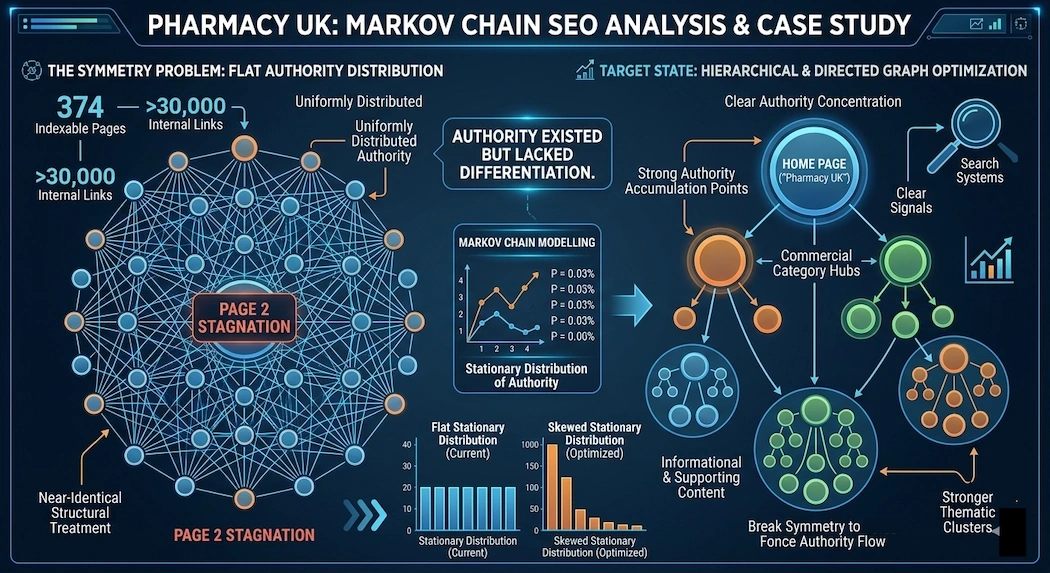 Target Search Phrase: Pharmacy UK
Methodology: Directed Graph Analysis, Markov Chain Modelling and Structural Authority Review
Executive Summary
Many SEO reports focus on content, backlinks and technical optimisation. While these factors remain important, they do not fully explain how modern search systems evaluate a website. This case study examines a large UK pharmacy website ranking on Page 2 of Google for the commercially valuable search phrase “Pharmacy UK”.
Using the same principles discussed in our guide to How Search Systems Interpret Your Website, the website’s internal link structure was modelled as a mathematical graph and analysed using Markov Chain techniques derived from Google’s original PageRank framework.
At first glance the website appeared exceptionally strong. The domain contained hundreds of pages connected by more than 30,000 internal links. Conventional SEO thinking would suggest that such a large authority network should naturally produce strong rankings.
However, the graph analysis revealed something unexpected. The website did not appear to suffer from an authority shortage. Instead, it appeared to suffer from an authority differentiation problem.
Authority was present throughout the website. The challenge was that authority was being distributed so evenly that search systems may struggle to identify which destinations should dominate for the search phrase “Pharmacy UK”.
The Question
If a website contains hundreds of pages, tens of thousands of internal links and significant authority, why would it still struggle to reach Page 1 for an important commercial search phrase? To answer that question we applied the same methodology used within a Structural Authority Flow Review.
Methodology
The website’s internal link structure was exported and modelled as a directed graph. Within graph theory, pages become nodes and hyperlinks become edges connecting those nodes. This allows authority flow to be measured mathematically rather than estimated through conventional SEO metrics.
A Markov Chain model was then applied to calculate the stationary distribution of authority throughout the network. This process is closely related to the probabilistic concepts discussed within our article on Ranking Probability.
How Probability Models See Your Site:
Think of a search engine crawler as a random surfer clicking links on your website. If a page has dozens of internal links pointing to it from highly traveled areas, the probability of the surfer landing there is high. In mathematical terms, this is a Markov chain—a model where your next step depends entirely on your current location. Search systems use these probability models to calculate a page’s “stationary distribution” (its ultimate structural weight). If your internal links are a chaotic maze, the probability model flattens, and your core pages lose their mathematical advantage.
The objective was simple:
Determine whether authority naturally accumulated around the pages most likely to rank for the phrase “Pharmacy UK”.
Network Findings
- 374 indexable pages were identified.
- More than 30,000 internal links connected the network.
- Approximately 80% of pages occupied very similar positions within the graph structure.
- Large numbers of pages displayed remarkably similar authority characteristics.
This finding was significant.
Most websites develop a natural hierarchy where authority accumulates around a relatively small number of strategic destinations. In this case the analysis suggested an unusually flat authority distribution.
The Symmetry Problem
The most important finding was not that the website lacked authority. The most important finding was that authority lacked differentiation.
Imagine a company with a CEO, directors, managers and staff. The hierarchy makes it obvious where responsibility accumulates. Now imagine a company where hundreds of employees all hold similar titles and responsibilities. The organisation may still function effectively, but it becomes harder to identify who is leading.
The graph structure displayed similar characteristics.
Approximately 80% of the pages occupied very similar structural positions. As a result, search systems may receive weaker signals regarding which pages should represent the organisation for broad commercial searches.
This is an example of how Google evaluates websites as connected systems rather than simply evaluating individual pages in isolation.
The Strategic Insight
The analysis suggested that the ranking limitation was not primarily caused by content quality, backlinks or technical SEO.
Instead, the website appeared to have developed an unusually symmetrical authority structure. Authority existed throughout the network, but search systems may have found it difficult to determine where that authority should accumulate.
This insight helps explain why SEO progress often reaches a plateau. As discussed in Why SEO Progress Often Plateaus, additional activity does not always change how a website is interpreted.
Sometimes the limiting factor is the structure itself.
Analytics & Conclusion
This case study demonstrates why website evaluation extends beyond content, backlinks and technical optimisation.
Using graph theory and Markov Chain modelling, it was possible to identify a structural characteristic that conventional SEO reporting would likely miss. The pharmaceutical website examined possessed substantial authority, extensive internal linking and hundreds of pages. However, the analysis suggested that authority was being distributed unusually evenly throughout the network. The key insight was not that the website needed more authority. The key insight was that authority needed clearer differentiation.
Understanding how search systems interpret structure often reveals opportunities that remain invisible when analysis is limited to traditional SEO metrics alone. To understand the mathematical principles behind this approach, explore our PageRank case study using Markov modelling, which examines how probability and link relationships can be used to visualise the flow of importance across a website.