

Why Websites Plateau: The Hidden System Behind Search Engine Visibility
By: T.G. Barker | See how the strategic authority review works | Last reviewed: 13/10/2026
Why More SEO Activity Stops Working
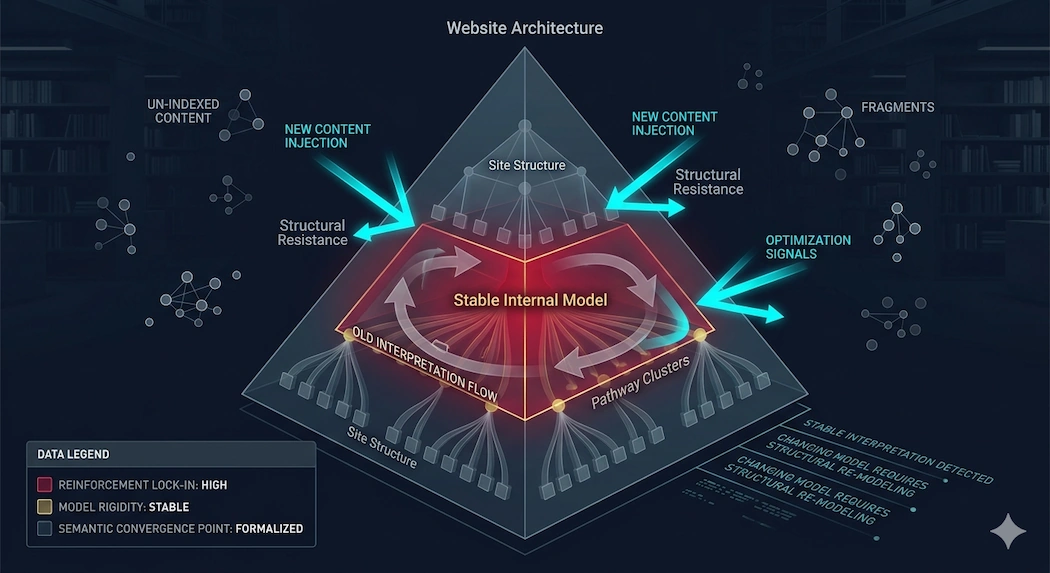
For years, website owners have been told that growth is simply a matter of doing more. Publish more content. Build more backlinks. Add more keywords. Increase activity and rankings will eventually follow. Sometimes this works, particularly for newer websites that are still being explored and interpreted by search systems. But for many established websites, something very different happens. The website continues publishing content, updating pages, and investing in SEO, yet rankings barely move. Traffic stabilises. Growth slows. Visibility reaches a plateau. In many cases, this is not because the website lacks quality. It is because modern search systems have already formed a stable interpretation of what the website represents. Search systems no longer evaluate websites simply as collections of pages. They evaluate them as connected systems. Over time, Google and other search platforms observe structural patterns, semantic consistency, behavioural pathways, and authority signals across the entire website. From this, they construct an internal model. Once that model stabilises, additional activity often reinforces the existing interpretation instead of changing it.
Search Systems Are Trying to Reduce Uncertainty
Modern search systems are fundamentally designed to reduce uncertainty. When someone searches for information, the system is not simply looking for matching keywords. It is attempting to predict which destination has the highest probability of resolving the user’s intent successfully. This is a major change from earlier search systems. Years ago, rankings relied heavily on direct signals such as exact-match keywords and backlink volume. Today, systems evaluate much broader patterns, including how content relates together semantically, how authority flows through the website, which pages appear central to the structure, how users move through the site, and whether the website consistently reinforces a clear topic identity. This reflects the way search systems evaluate websites as connected probabilistic structures rather than isolated pages. In other words, the system is not only evaluating relevance. It is evaluating predictability and clarity.
How a Search System Forms an Internal Model
When a website is first discovered, the search system has very little certainty about it. The site is effectively unexplored territory. Over time, however, the system begins constructing an internal model by observing patterns across the website. It analyses how pages connect together, which sections repeatedly receive structural reinforcement, and whether internal linking creates clear authority pathways or diluted confusion. This is one reason why structural authority flow matters so much. Search systems learn from repeated pathways. The system also evaluates semantic consistency. A website about financial advice that suddenly publishes celebrity gossip, AI news, recipes, and travel content creates semantic instability. Even within the same industry, fragmentation can weaken interpretation. Search systems are constantly trying to answer a simple question: What does this website fundamentally represent? User behaviour strengthens the model further by reinforcing where users enter, which pages they continue toward, where journeys stop, and which pages repeatedly resolve intent successfully.
The Moment a Website Becomes “Solved”
One of the most important moments in a website’s lifecycle occurs when the search system becomes highly confident in its internal model. At this point, something subtle changes. The system stops actively evaluating the website and starts verifying its existing assumptions. This is often where ranking plateaus begin. If the system has concluded that a website is a moderate-authority source within a particular topic area, future content may continue to be interpreted through that same lens. This explains why some websites can publish genuinely excellent content and still struggle to move beyond positions they seem permanently associated with. The issue is not necessarily the quality of the new content. The issue is that the broader interpretation of the website has already stabilised.
Why More Content Sometimes Makes Things Worse
When rankings plateau, many businesses respond by increasing activity. More blog posts. More landing pages. More updates. But if the underlying structure is unclear, additional content may simply reinforce the same problems. An ecommerce website with thousands of thin category pages may continuously expand while unintentionally diluting authority signals further. A business blog publishing large volumes of loosely related content may create semantic fragmentation rather than topical reinforcement. In these situations, the system does not necessarily see growth. It sees repeated patterns of inconsistency. This creates what could be described as a reinforcement trap.
Understanding Website Behaviour Through Pathways
One useful way to understand a website is by examining movement patterns through the structure. This is where probabilistic modelling becomes useful. A transition matrix measures the probability of movement between different areas of a website. Rather than simply recording traffic numbers, it helps reveal structural behaviour: do visitors consistently move toward authority pages, does the homepage reinforce important sections, are high-value pages isolated, and do journeys terminate too early? This type of analysis is closely related to probabilistic systems such as PageRank and Markov modelling, where pathways and reinforcement patterns shape long-term visibility. Strong websites usually exhibit clear directional reinforcement. Weak or plateaued websites often show fragmented pathways, circular movement, or isolated authority sinks.
Breaking a Stable Interpretation
If a website has become trapped inside an underperforming interpretation, incremental optimisation is rarely enough. The system itself often needs to be remodelled. This does not necessarily mean rebuilding the website entirely. It means changing the patterns that the search system repeatedly observes. Removing low-value or duplicative pages can improve interpretational clarity. Consolidating multiple weak pages into stronger authority pages can create clearer resolution points. Changing internal linking structures can alter the probability flows through the website and gradually shift how the system interprets importance over time. This is why understanding how search systems evaluate websites has become increasingly important for businesses trying to break long-term visibility plateaus.
Visibility Is an Outcome of Clarity
Search visibility is no longer simply the reward for activity. Modern search systems evaluate websites as probabilistic structures made up of relationships, reinforcement pathways, semantic consistency, and behavioural validation. Rankings are not fixed positions manually assigned by a search engine. They emerge from the system’s interpretation of the website itself. The clearer and more consistent that interpretation becomes, the easier visibility is to sustain. In many ways, the future of SEO is no longer about optimisation alone. It is about reducing ambiguity. When a search system can clearly understand what a website represents, where authority exists, and how users successfully resolve intent within that structure, growth becomes far more achievable.