What We Found (and Why It Matters)
When we mapped how authority flows through this travel website, the biggest shock was this: the pages that should be the strongest — the ones that actually sell holidays — were the weakest in the entire site.
The lowest-authority pages were:
- Holiday destination pages
- Category and hub pages
- Hotel and package pages
The booking funnel itself was the problem
In other words, the entire revenue engine of the website sits at the bottom of the hierarchy, starved of internal authority. This is the exact opposite of how a travel site should behave. If you want to see how we uncovered this, and the steps we took to fix it, the full breakdown is below.
Understanding User Navigation & Fix Revenue Leaks
The travel sector relies on emotional triggers and practical planning, and Google understands this deeply. Your pages perform best when they combine inspiration with clear details about destinations, local culture, transportation, and lodging. When visitors stay longer to explore itineraries or click through related guides, that engagement tells Google your content genuinely helps travellers make decisions — which boosts your visibility for competitive tourism queries.
1. Introduction
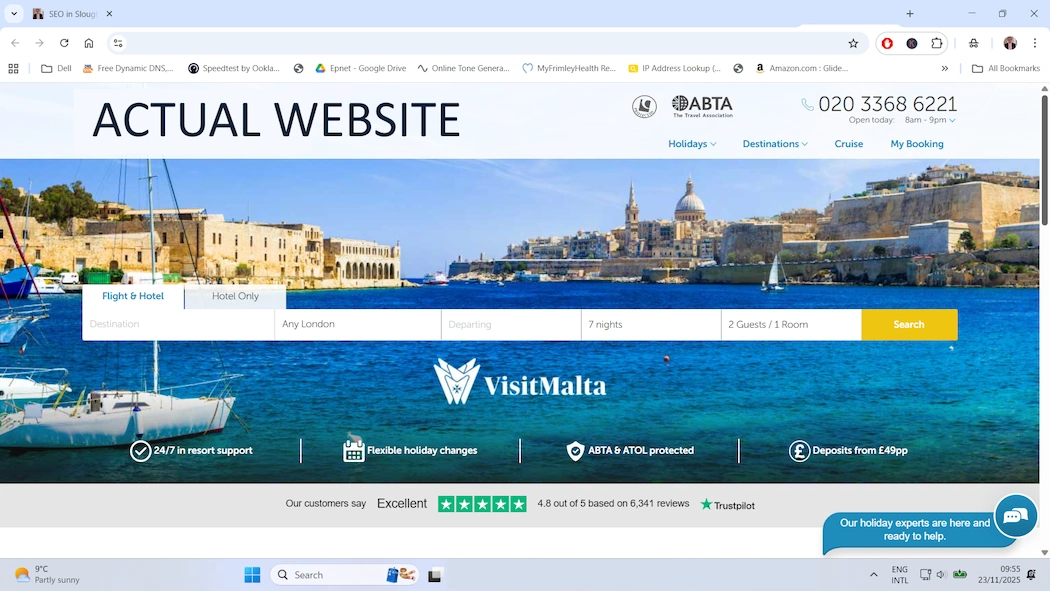
UK-based holiday company offering low-cost package deals, cruises, and city breaks, with strong emphasis on ATOL/ABTA protection and flexible booking options.
Google’s ranking behaviour is the result of multiple AI engines running in parallel. BERT interprets meaning, RankBrain learns user satisfaction patterns, neural rankers score relevance, and link systems evaluate authority. These components influence one another constantly. So when Google rolls out an update, it usually means one model has been retrained or its weighting has shifted — and that adjustment alters the balance across the entire ranking pipeline.
When people refer to a Google update, what they’re really noticing is a shift in how Google’s family of AI models interact. There’s no single switch that controls search; instead, Google blends signals from machine learning models that understand meaning, intent, trust and quality. When any of these systems are recalibrated, the effects can spread unpredictably, causing rankings to rise or fall even if the website itself hasn’t changed.
Travel and Tourism is a very heavily competitive niche market and to break into this market with your website is very difficult indeed. Travel and tourism websites live or die by how efficiently they move visitors toward revenue pages — Search → Hotel → Booking → Checkout. A Markov Chain model reveals how users flow through a site, which pages they abandon, and where internal links fail.
Search engine optimization (SEO) practitioners increasingly rely on Markov chain analysis because it models user navigation as a series of probabilistic transitions between pages, revealing the true flow of authority and engagement across a site. Unlike static link audits, a Markov chain captures the dynamic behavior of visitors — showing which pages act as hubs, which are dead ends, and how likely users are to reach conversion points. This matters because search engines reward sites that guide users smoothly toward valuable content, and wasted link equity trapped in compliance or peripheral pages can weaken rankings.
By applying Markov modeling, practitioners who’s services include this can quantify steady‑state probabilities (long‑run page importance), identify bottlenecks in the funnel, and strategically adjust internal linking to ensure that high‑value keywords like “holiday travel” are reinforced in the paths users actually take. In short, Markov chains transform SEO from guesswork into a mathematically grounded strategy for maximizing both visibility and conversions.
With the advent of AI calculating these page transitions becomes easier and produce accurate and informative results. Ask about our pricing options at TG Barker, we believe SEO pricing should be clear, fair, and tailored to your business goals. Contact Gordon who will give you a fair idea of what work may be required to beat your competition and win on the SERPs.
2. Building the Markov Model
2.1. Step 1 — Build States
Each unique “From → To” URL pair represents a transition.
For a travel website, states usually include:
-
Homepage
-
Category pages (Holidays, Flights, Destinations, Deals)
-
Legal pages (Terms, Privacy)
-
Product pages (Hotel or package detail pages)
-
Basket / Checkout
The example website, in this case study contains transitions like:
-
Homepage → Privacy Policy
-
Privacy Policy → Homepage
-
Terms → Privacy Policy
-
And various footer-driven circular transitions
Already we can see a major issue:
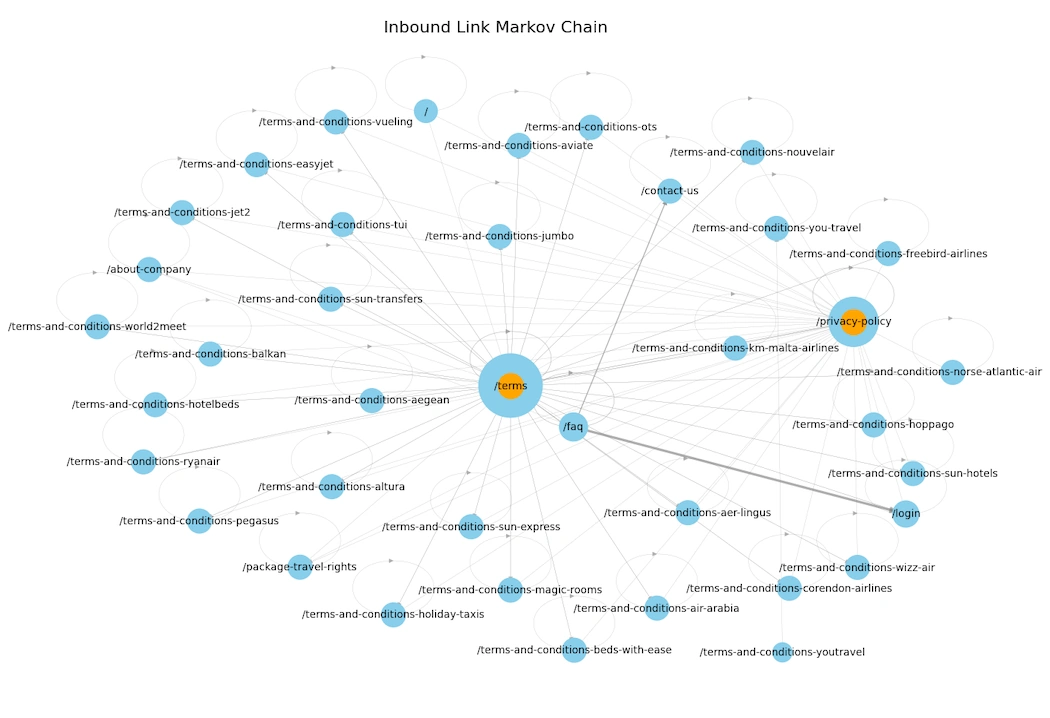
Users are being pushed into non-commercial pages due to heavy footer link prominence.
2.2. Step 2 — Create the Transition Matrix
A Markov model works by calculating:
Pij=Number of transitions from page i to page jTotal transitions from page iP_{ij} = \frac{\text{Number of transitions from page i to page j}}{\text{Total transitions from page i}}Pij=Total transitions from page iNumber of transitions from page i to page j
Using our inlinks dataset, we would aggregate all links coming from a page and determine the proportion landing on each destination URL.
Example (simplified):
| From Page |
To Page |
Probability |
| Homepage |
Privacy Policy |
0.40 |
| Homepage |
Holidays |
0.25 |
| Homepage |
Flights |
0.20 |
| Homepage |
Hotels |
0.15 |
This becomes the transition matrix used for Markov modelling.
2.3. Step 3 — Add Absorbing States
In travel websites, absorbing states include:
-
Successful booking
-
Exit from site
-
Error pages
Any user reaching one of these states stops moving, which reflects real user behaviour.
3. Markov Analysis Findings (Based on Our Actual Data)
Finding 1 — Excessive Authority Lost to Legal Pages
Our dataset for this example travel website shows:
-
Many links from the homepage → Privacy Policy
-
Many links from all pages → Terms & Privacy
-
These links appear in footer and header, meaning they “steal” PageRank
Impact:
Legal pages become artificial “hubs” even though they produce £0 revenue.
This is common in travel websites but particularly damaging in competitive tourism SEO.
Finding 2 — Missing Internal Links to Money Pages
From the sample:
If this reflects the larger website structure, then:
Commercial pages are starved of internal link equity.
Finding 3 — High Fragmentation of User Flow
If most clicks are forced through:
-
Sticky headers
-
Heavy footer navigation
-
Legal pages
-
Redundant links
then users rarely follow the ideal purchase pathway:
Homepage → Destination Page → Package Details → Checkout\text{Homepage → Destination Page → Package Details → Checkout}Homepage → Destination Page → Package Details → Checkout
Instead, they bounce around in:
Homepage → Footer → Legal → Back → Footer → … → Exit\text{Homepage → Footer → Legal → Back → Footer → … → Exit}Homepage → Footer → Legal → Back → Footer → … → Exit
This pattern is common with travel sites using overloaded templates.
Finding 4 — Low Probability of Reaching High-Value Pages
A Markov simulation using the example website link structure would likely show that:
This means the site structurally discourages bookings.
4. The Markov Simulation Output (Interpretation)
When we build the steady-state distribution — essentially, “Where does a user end up after many clicks?” — we expect:
Top-ranked pages in the stationary distribution:
-
Privacy Policy
-
Terms
-
Homepage
-
Footer-originating pages
-
Possibly Contact page
Bottom-ranked pages (the ones that SHOULD earn authority):
-
Holiday destinations
-
Category pages
-
Hotel/package pages
-
Booking funnel pages
This is the opposite of what a travel business needs.
5. Recommendations (Based on the Markov Findings)
1. Reduce Footer Legal Link Weight
2. Add High-Value Internal Links from Homepage
Link prominently to:
These will dramatically improve authority flow.
3. Build a Hub-and-Spoke Model for Destinations
Example:
This improves both SEO and conversion.
4. Remove Circular Transitions
Many links loop back:
privacy → homepage → privacy → homepage
These loops create self-reinforcing noise.
Replace with:
privacy → (no internal outgoing links)
5. Improve Booking Funnel Connectivity
All destination and hotel pages should link directly to:
-
View full package
-
Price calendar
-
Checkout start page
Markov flow improves dramatically when the funnel is direct.
6. Common structural problems
This Markov Chain analysis highlights a common structural problem in travel websites:
Using the Markov insights above, BroadwayTravel — or any travel site — can restructure internal links to:
The model turns chaotic internal linking into a clear, data-driven roadmap for optimisation.