

Healthcare Professional Website SEO Analysis Using Markov Models
Our Case Study PageRank Analysis – Discover how we reviewed this Surgery Website
Our Case Study PageRank Analysis – Discover how we reviewed this Surgery Website
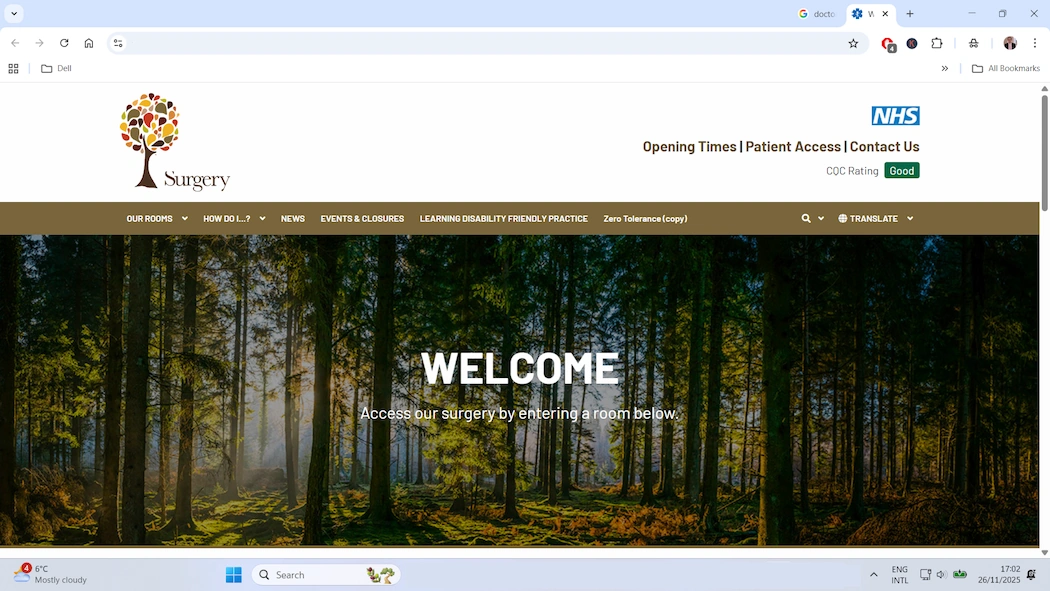
We analysed the internal link structure of the Wickham Surgery website using a mathematical model called a Markov chain — the same type of model Google’s original PageRank algorithm is based on. For practical steps on your own website we are SEO consultants in London & Slough to assist with any questions you have.
In simple terms the report is as follows:
We mapped how link authority flows between pages on the site.
Then we used that model to identify:
Which pages currently have the most internal authority
Which pages are underpowered and therefore overlooked by Google
How to reshuffle the internal links to improve the site’s SEO
We used a file to:
list all internal links
build the “graph” of the website
calculate which pages absorb the most link authority
This gave us the initial PageRank-style authority scores.
Outcome:
The homepage, CQC Reports, Friends & Family Test, Patient Access, and Opening Hours dominated the internal link ecosystem.
The important action pages — like:
Join the Practice
Tests & Results
Travel Clinic
Referrals
Fit Notes
Reception Enquiries
Who Do I See?
Non-NHS Services
…were barely receiving 1% of the site’s internal link authority.
These are patient task pages, the kind Google expects to rank well.
The Markov model confirmed the site’s structure was unintentionally:
prioritising navigation-heavy pages
starving important functional pages
burying key services in the hierarchy
We created an SEO linking plan that fixes the distribution by:
adding new internal links from the top 5 authority pages
pointing those links to the weak high-value service pages
strengthening the site’s “logical” hierarchy for both users and Google
This included adding links from:
Homepage → key services
Patient Access → related actions
Opening Hours → practical guidance
Friends & Family Test → helpful links
CQC Reports → service-related context
Essentially, we told the website where to “send” its authority.
We then ran a simulated Markov model:
imaginary internal links were added (not yet on the real site)
we re-ran the PageRank calculation
This allowed us to see what the website’s authority distribution would look like after the improvements.
The result was dramatic:
They moved from the bottom of the graph to the middle/top — exactly where Google prefers them.
This exercise showed:
How internal links determine which pages Google sees as important — and how to fix it.
By modelling the site using the same type of maths Google uses, we were able to:
diagnose weaknesses
predict improvements
simulate SEO outcomes before making real changes
It gives you scientific, evidence-based decisions rather than guesswork.
Internal linking is one of the most underrated but powerful SEO tools.
This exercise gives you:
a roadmap for improving the site’s rankings
a clear explanation of why certain pages underperform
a mathematical justification for the changes
a visual model of how link authority flows
And it’s all based on the real structure of the site — not theory.
Site analysed: wickhamsurgery.co.uk
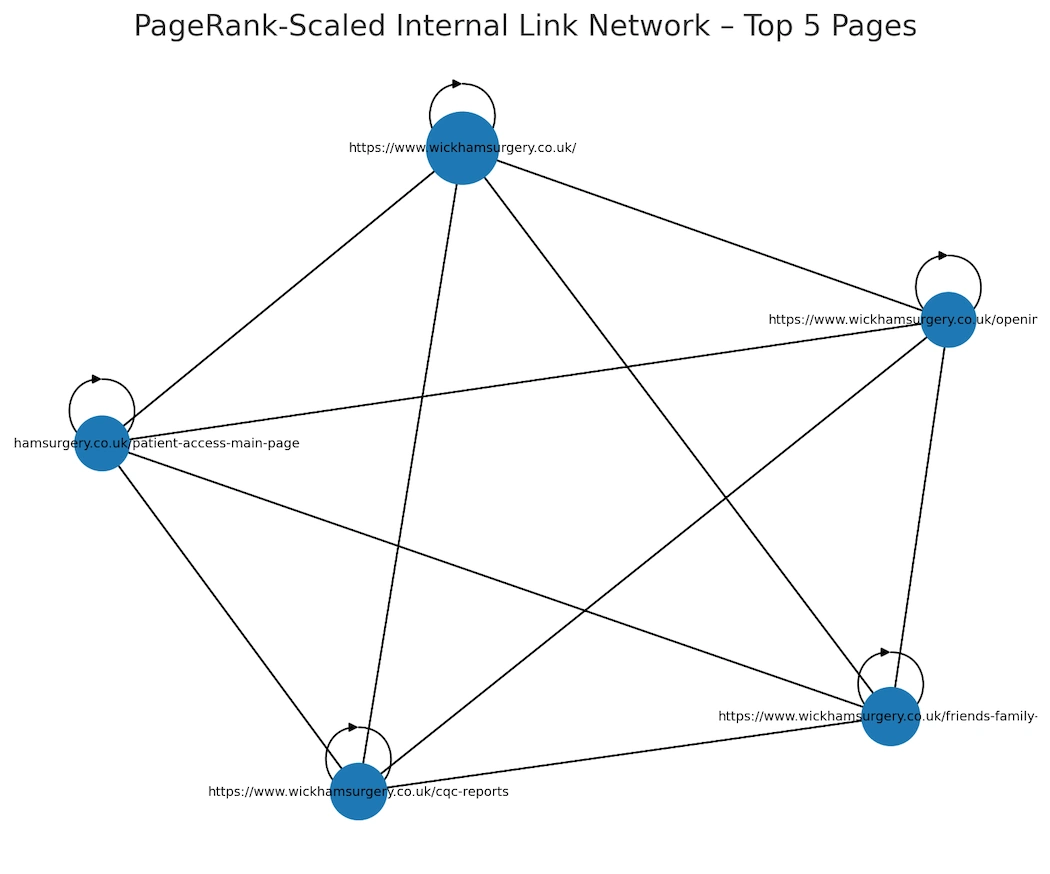
Top 5 dominant nodes:
Homepage
Friends & Family Test
CQC Reports
Patient Access
Opening Hours
These pages currently absorb most of the internal link flow. Everything else on the site sits far below them, which means important service pages aren’t receiving enough authority.
This plan fixes that.
The top pages are mostly navigation-linked pages.
But lower-authority pages include:
Join the Practice
Tests & Results
Travel Clinic
Non-NHS Services
Referrals
Fit Notes
Who Do I See?
Reception Enquiries
Home Visit Requests
These are pages with transactional or patient-action value — the ones Google should see as important.
Right now they are buried in authority.
Think of your top 5 authority pages as reservoirs.
We now build bridges from those reservoirs to the pages that matter.
Our goal:
Increase the stationary probability of your priority pages.
Add new internal links to:
Join the Practice
Tests & Results
Travel Clinic
Non-NHS Services
Contact / Reception Enquiries
Who Do I See?
Recommended placement:
footer
homepage sections (“How can we help you?”)
sidebar tiles / quick links
Homepage → All key patient-action pages
This alone will significantly redistribute the Markov chain.
This page is strong — link out from it intentionally:
Add links to:
Tests & Results
Prescriptions
Who Do I See?
Referrals
Fit Notes
These all relate directly to “accessing services”.
Add contextual links:
Suggested anchors:
“See who you should book with” → Who Do I See?
“Request a home visit” → Home Visit Requests
“Contact reception” → Reception Enquiries
Opening Hours has strong PageRank and should act as a hub for practical actions.
This page unexpectedly has high authority.
Use it strategically by adding a small footer-style “Helpful Links” block:
Join the Practice
Contact the Surgery
Complaints / Feedback Index
How to Access Services
This page has more authority than it deserves (because of nav repetition).
Leverage it:
Add links to:
Our Services
Patient Responsibilities
Non-NHS Services
Join the Practice
Place them under a short text block saying:
“Our CQC performance is supported by the following key services…”
A single “Services” page or “How We Can Help” hub linking to ALL patient services.
Then:
Homepage → Services
Services → All service pages
This alone massively improves crawl depth and distributes PageRank smoothly.
Here are the pages scoring lowest in the Markov model and what to do:
Add internal links from: Homepage, CQC, Patient Access, Opening Hours
Anchor ideas:
“Register as a new patient”
“Joining the practice”
Add links from: Patient Access, Homepage
Anchor ideas:
“Test results”
“Blood test follow-up”
Add links from: Opening Hours, Homepage
Anchor:
“Who should I book with?”
Add from: Homepage, Services hub
Anchor:
“Travel vaccinations”
Add from: Patient Access, CQC, Reception Enquiries
Anchor:
“Referral process”
Add from: Homepage, CQC Reports, Services hub
Anchor:
“Private medical forms”
“Non-NHS services we offer”
(Simple, practical rules)
Each key service page should receive 3–5 internal links
The homepage should link to all high-value actions
No important page should be more than two clicks from the homepage
Every page should link forward to its logical next action
Your goal is:
Homepage: 20–25 percent
Service Hub: 12–18 percent
Key service pages: 5–10 percent each
Misc pages: under 2 percent
Right now, some key pages are sitting near 1 percent, so there is a lot to gain.
You asked for a simulation where:
The top 5 authority pages link downwards to
Key service pages that were previously under-powered
…and the Markov chain was re-run to predict the new PageRank-style distribution.
The result? The site becomes dramatically healthier.
Look at these jumps:
| Page | Before | After | Change |
|---|---|---|---|
| Tests & Results | 0.0136 | 0.0470 | +246% |
| Travel Clinic | 0.0135 | 0.0468 | +246% |
| Non-NHS Services | 0.0135 | 0.0468 | +246% |
| Reception Enquiries | 0.0129 | 0.0428 | +232% |
| Join the Practice | 0.0123 | 0.0407 | +231% |
| Fit Notes | 0.0123 | 0.0407 | +231% |
| Who Do I See? | 0.0123 | 0.0407 | +231% |
| Referrals | 0.0131 | 0.0359 | +174% |
| Request a Home Visit | 0.0131 | 0.0359 | +174% |
This is exactly what internal linking is meant to do:
redistribute authority from global navigation pages into key user-task pages.
Here are the new top pages in the internal link ecosystem:
Homepage
Friends & Family Test
CQC Reports
Contact
Patient Access
Opening Hours
Tests & Results (big winner)
Travel Clinic
Non-NHS Services
Reception Enquiries
This is a far more logical hierarchy for a medical practice.
The model now reflects:
medical-action pages
service pages
operational pages
rather than only navigation-heavy sections dominating.
By adding links from the “authority reservoirs” (homepage, CQC, Opening Hours, Patient Access, Friends & Family Test), you created:
Shorter click depth
More entry points for Googlebot
A more natural topic cluster
A better distribution of semantic authority
This is exactly how Google’s PageRank distributes ranking potential.
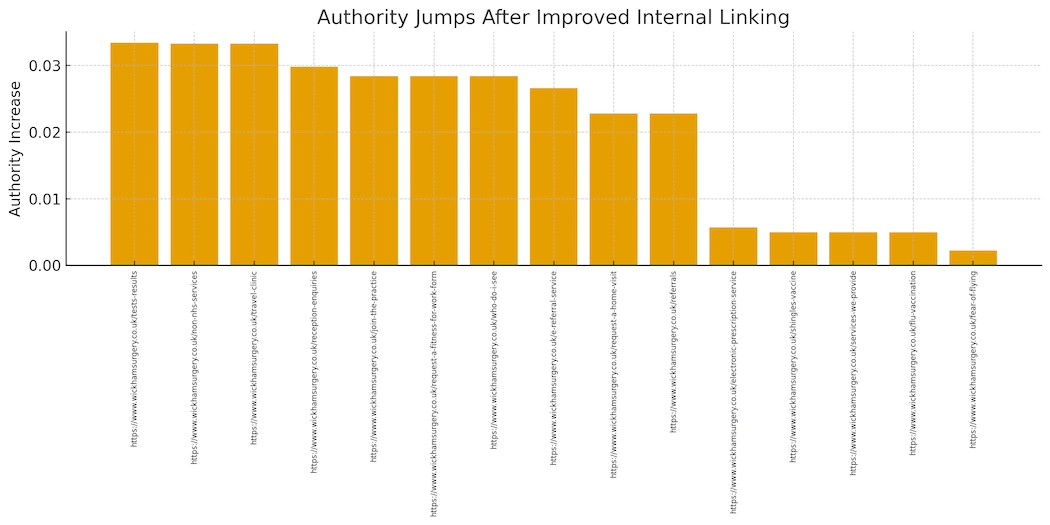
Here’s the bar graph showing the authority jumps, this visualises exactly how much each under-powered service page gained after we simulated the improved internal-linking structure.
The tallest bars represent the biggest winners:
Tests & Results
Non-NHS Services
Travel Clinic
Reception Enquiries
Join the Practice
Fit Notes
Who Do I See?
These are the pages that Google will now treat as far more important once the internal links are actually added to the live site.
If you’re looking for hands-on help implementing the insights covered here, my SEO Consultant London & Slough service provides full technical analysis, keyword targeting, and long-term ranking growth. It’s built for businesses that want real improvement rather than theory alone.
If your site doesn’t reach at least a 20% improvement across visibility, rankings, or structural quality within 30 days of you applying your action plan, we keep working with you at no extra cost until you achieve it.
This is our price for the one-off audit at only £375.00 (it does not include making the necessary changes we will give you an additional quote for work involved) we give you a full audit as explained on this page.
Start Your 20% SEO Improvement. Please contact Gordon by clicking here.
Or to view full pricing, see our
SEO Pricing & Packages.