

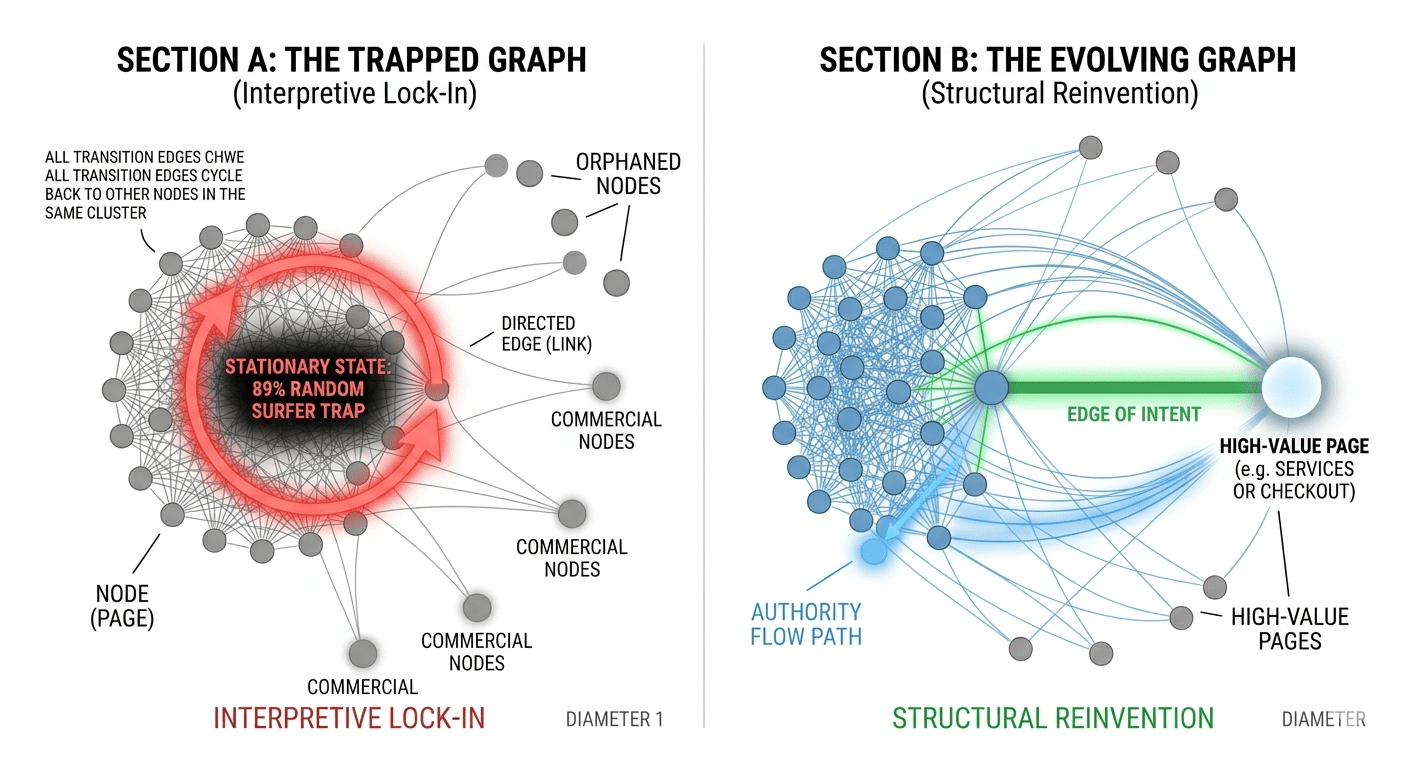
Graph explanation
Authority Flow and the “Random Surfer”
To understand how Google evaluates these nodes, we have to look at the Markov Chain. A Markov Chain is a mathematical system that undergoes transitions from one state to another. Google uses this to create the Random Surfer Model.
As seen in Section A (The Trapped Graph) of the diagram, when your links (edges) aren’t structured with intent, your website creates a Recursive Loop. All authority flows into the same cluster, reaching what the diagram calls a Stationary State—a state of equilibrium where 89% of the ‘random surfer’ trap is confined to a non-commercial part of your site. This visualizes exactly why a 10-page pillar site can outrank a 1,000-page blog: the former consolidates authority flow, while the latter creates a mathematical sink.
Before you start to optimise anything
To most people, SEO still feels like a game of words. Find a keyword, use it often enough, publish the page, and wait. In that mental model, Google behaves like a filing system. If your page is labelled correctly and contains enough content, it gets stored and retrieved. But that model is wrong.
Understand what Google already thinks your website is.
If you want to understand why websites rank where they do — and more importantly, why they stop moving — you have to step away from content as “pages” and start seeing structure. Because that is what Google evaluates. Not pages, not effort, not output. Structure.
If you want the clearest starting point for this, begin with how search systems actually evaluate websites: how Google evaluates websites. Everything else sits on top of that foundation.
The Death of the Page
A webpage is not a destination. In Google’s model, it is simply a node. A node only has meaning when it is connected to other nodes, and the connection itself — the link — is what defines its role. When you link from one page to another, you are not helping navigation; you are defining a relationship. That relationship is measurable, directional, and feeds directly into how your website is interpreted as a system.
This is why large websites often fail to rank. Not because they lack content, but because they lack structure. A small, tightly connected website will outperform a large, disconnected one almost every time. Because Google is not counting pages — it is evaluating how they relate to each other.
The Hidden System: Markov Chains and Movement
At the core of this sits a mathematical model. Not theory, not analogy — a real model. Google uses a variation of a Markov process to understand how users and crawlers move through your website. Each page represents a state, and each link represents a probability of moving to another state.
From any given page, there are multiple possible next steps. Some are more likely than others, and some are effectively dead ends. Google simulates this movement continuously. If your important pages sit on paths that are rarely reached, their probability remains low. If your site creates loops around low-value content, those loops become dominant.
This is not about keywords. It is about movement. And if you want to understand how that movement translates into ranking outcomes, it is worth stepping into the structural layer itself: structural authority flow. Because this is where most SEO work quietly fails.
Authority Is Not a Score — It Is a Distribution
PageRank is often simplified into a number, but in reality it is a distribution. Over time, the system reaches a point where it understands where attention — and therefore authority — settles across your site. Some pages naturally accumulate it, while others receive almost none. This is not random; it is the outcome of your structure.
If a page cannot be reached easily, it effectively does not exist in the system. If a page sits at the centre of multiple strong paths, it becomes dominant. This is why internal linking is not a secondary task — it is the mechanism that defines where authority ends up.
Why Websites Plateau
This is the part most people feel but cannot explain. You add content, refine titles, continue investing — and nothing moves. That is not because Google has stopped evaluating your site. It is because it has already reached a stable interpretation of it.
At a certain point, the system becomes confident in what your website represents. Once that happens, additional activity tends to reinforce that position rather than change it. This is where most SEO efforts quietly stall.
If you want to understand that interpretive layer — how your organisation is actually seen as a system — this sits behind it: how search systems see your organisation. Because until that view changes, rankings rarely do.
Crawl Efficiency and Structural Distance
There is also a practical constraint. Google cannot crawl everything endlessly. Every additional step between pages introduces friction, and the further a page sits from your core structure, the weaker its signal becomes. This is not just about crawl depth — it is about structural distance.
Pages that are close to the centre are evaluated more frequently and with greater weight, while pages buried deep within the site lose visibility — not because they lack content, but because they are structurally distant. A well-structured site reduces that distance, allows authority to circulate, and keeps important pages within reach.
The Shift Toward Entity-Level Understanding
The system is evolving. It is no longer just evaluating how pages link; it is evaluating how ideas connect. Your website is no longer just a collection of URLs — it is a network of concepts.
If those concepts align, reinforce each other, and connect logically, the system sees coherence. If they do not, it sees noise. This is where topical authority actually comes from — not from covering more topics, but from connecting the right ones properly.
Stop Writing for Pages. Start Designing Systems
Most SEO advice still focuses on output — more content, more optimisation, more activity. But search systems do not reward volume. They reward clarity of structure.
The words on your pages matter, but they are not the deciding factor. They describe the nodes, while the structure defines the outcome. Once you understand that Google is not reading your website in the way you think, everything changes.
You stop chasing tactics, you stop repeating effort, and you start working on the only layer that actually moves rankings — the way your website is understood.