

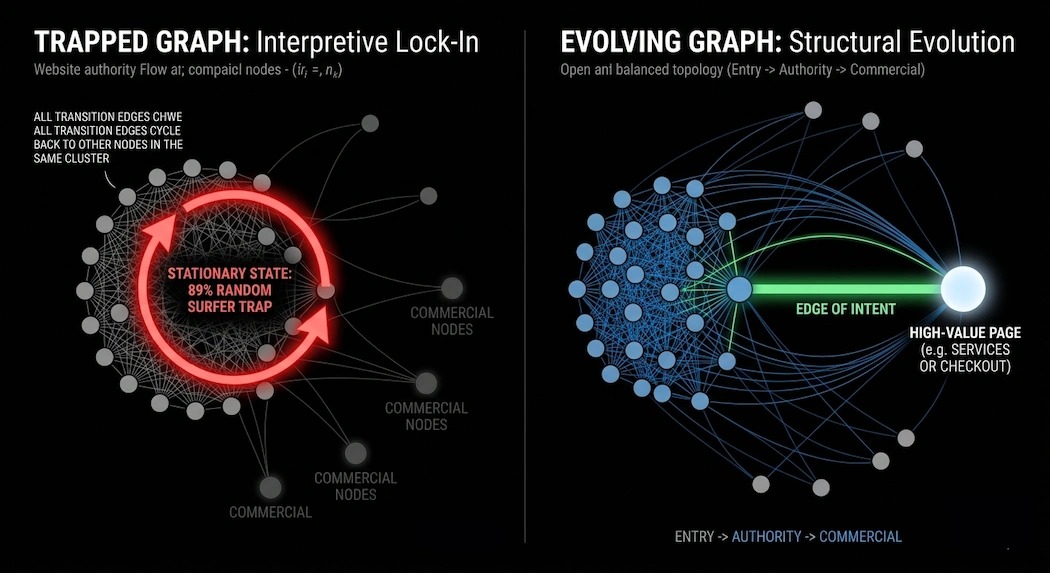
Visualizing Interpretive Lock-In: The Anatomy of a Ranking Plateau
This diagram is a visualization of a website’s internal architecture, viewed through the lens of Directed Graph Theory. It illustrates why traditional “more output” SEO efforts often fail to disrupt established rankings.
Panel A (The Trapped Graph): This depicts Interpretive Lock-In. A dense, intricate cluster of content (e.g., your blog or a specific topic) has become an Authority Sink. The dominant red loop indicates that 89% of all internal transition probability is trapped within these pages. To Google’s ‘Random Surfer’ model, this cluster is the entire website. The high-value commercial pages on the periphery are dim and disconnected, meaning they receive virtually no authority flow and cannot rank effectively for competitive commercial terms.
Panel B (The Evolving Graph): This shows a state of Structural Evolution. By strategically re-engineering the internal link topology, the mathematical trap is broken. The red loop is gone, replaced by a thick Directed Edge of Authority that channels the accumulated topical flow directly to a newly defined Center of Gravity (your Services or High-Value Page). This new gradient of authority forces the search engine to form a different, more powerful model of the website, enabling movement that was previously impossible.
If you feel like your Google rankings have stalled, you aren’t alone. Most website owners believe that SEO progress is a linear path—that more content and more links will eventually force a move in position. However, in practice, many sites hit a ranking plateau that no amount of traditional optimization can break. This happens because of a phenomenon called Interpretive Lock-In. To understand why your position hasn’t changed, you have to understand how Google evaluates websites not as a list of pages, but as a mathematical system. There is a specific moment when the search engine stops “testing” your visibility and reaches a stable conclusion about your site’s authority. If you want to move again, you don’t need more activity; you need to change the system Google has already decided on.
Quick Summary: Why do rankings stay the same? Google evaluates websites by building a mathematical model of their structure and authority flow. Once this model reaches a “Stable Conclusion”—a state of equilibrium in a Markov Chain—rankings often plateau. To break this “Interpretive Lock-In,” you must change the site’s underlying graph structure rather than simply adding more content.
Most website owners believe rankings are constantly moving in the search engine. That with enough effort—more content, more optimisation, more links—their position will eventually improve. But in practice, something very different happens. There is a point where movement slows. Then stops. Not because the work has stopped, but because the search engine system evaluating the website has reached a stable conclusion. This is the moment most people never see.
“Google does not make a single decision. It constructs a model. And once that model becomes stable, new data tends to confirm rather than challenge it. That is the moment your position is decided.”
This is the moment Google decides your position in the search engine index.
How Long It Takes for Google to Decide Your Position
It is natural to assume that rankings are continuously decided in real time. That with enough effort, position will steadily improve.
In reality, the process is more defined. There is no single moment where Google makes a final decision. But there is a period where its interpretation of a website becomes consistent enough that rankings begin to stabilise.
In most cases, this happens within the first few months of a page or website being actively crawled and evaluated.
In the early stages, movement can be rapid. Pages appear, disappear, and reappear across different queries as the system tests where they belong. This phase can last days or weeks. Then, gradually, the volatility reduces.
Internal structure is understood. External signals are absorbed. Content relationships become clearer. At this point, the system no longer needs to test as aggressively, because it has formed a working model of what the website represents.
This is the closest thing to the moment your position is decided.
From here, rankings tend to settle into a range. They may move slightly, but they often return to the same position over time—not because evaluation has stopped, but because it keeps reaching the same conclusion.
This is why websites can remain in similar positions for extended periods, despite continued effort. The system is still active. But its interpretation is now stable.
Understanding this changes the question entirely.
It is no longer about how long it takes to rank, but about how long it takes for an interpretation to form—and what is required to change it once it has.
The Misunderstanding That Drives Endless SEO Activity
The assumption behind most SEO work is simple: more input creates more output. More pages lead to more visibility. More optimisation leads to higher rankings. This assumption only holds true while the system is still forming its understanding. Once that understanding stabilises, additional activity rarely changes direction. It reinforces what is already believed.
This is why many websites continue investing in SEO for months or years without meaningful progress. The effort is real. The output is limited. The position remains largely unchanged.
Not because nothing is happening, but because everything is being interpreted in the same way.
The Moment Google “Decides”
Google does not make a single decision in the way humans do. There is no fixed point where a switch is flipped. Instead, a model forms. Through crawling, linking, content relationships, and user signals, Google constructs an internal representation of your website. This representation includes what your site is about, how authoritative it appears, how it connects to other entities, and where it fits within the wider web. At a certain point, this model becomes consistent. Not perfect. Not final. But stable enough that new data tends to confirm rather than challenge it.
That is the moment your position is effectively decided.
Why Positions Then Stay the Same
Once a stable interpretation exists, rankings become less responsive to incremental change. This is not because Google has stopped evaluating your site. It is because the evaluation keeps reaching the same conclusion.
Every new page is interpreted through the existing model. Every link is absorbed into the same structure. Every optimisation is filtered through what Google already believes your website represents. In effect, your website enters a state of equilibrium.
Movement is still possible, but it requires something more than activity. It requires a shift in how the system understands the site itself.
The Role of Structural Signals
What drives this stability is not individual pages, but structure. Google does not rank pages in isolation. It evaluates how those pages connect. How authority flows. How topics reinforce each other. How internal linking distributes importance. This is where most websites begin to lock into place.
If the structure consistently signals a certain level of authority, a certain topical focus, and a certain hierarchy, that signal becomes dominant. And once dominant, it becomes difficult to change without restructuring the system itself.
To understand this properly, it helps to first understand how Google evaluates websites as a whole, rather than as individual pages.
Why More Content Often Changes Nothing
One of the most common responses to stagnation is to produce more content. More articles. More keywords. More variations of the same idea. This can create the illusion of progress. Activity increases. Pages grow. The website feels more complete. But if the underlying interpretation does not change, the additional content simply fits into the existing model. It strengthens the current position rather than moving it.
This is why some websites can publish hundreds of pages and remain in exactly the same ranking range.
Why Links Don’t Always Move the Needle
Links are often seen as the solution. More authority, more movement. And in early stages, this is often true. But once a site reaches a stable state, links behave differently. They are not evaluated in isolation. They are absorbed into the existing structure. If that structure does not redistribute or reinterpret the authority effectively, the impact is limited.
This is why link building campaigns can produce little visible change despite significant effort and cost.
The Concept of Interpretive Lock-In
What is happening here can be thought of as interpretive lock-in. Google has formed a consistent view of your website. That view is reinforced by structure, content, and external signals.
Each new signal is not judged independently. It is judged in context. And context, once established, is powerful. It defines how everything else is understood.
This is the hidden reason behind ranking plateaus.
What Actually Changes Positions
If rankings are not primarily driven by activity once stability is reached, what changes them? The answer is simple, but not easy. The interpretation must change.
This can happen through structural shifts, changes in authority distribution, clearer semantic alignment, or repositioning within a topic space. But in all cases, the goal is the same. To give the system a reason to reconsider what it believes your website is.
Without that, movement is limited.
How to Disrupt the Graph — So a New Result Becomes Possible
If rankings stabilise because the system has formed a consistent interpretation, then movement requires something very specific.
Not more activity, but a change in the structure that created that interpretation in the first place.
This is where most approaches fall short. They add to the system without altering it. New pages are published. Links are built. Content expands. But the underlying structure remains the same, so the outcome remains the same.
To change position, the graph itself must change.
This does not mean making random adjustments. It means introducing signals that force a different interpretation to become more likely than the current one.
In practical terms, this happens in a small number of ways.
First, authority flow must be redirected. Not simply increased, but redistributed. When internal linking patterns change in a meaningful way, the relative importance of pages shifts. This alters how the system navigates and evaluates the site.
Second, new structural relationships must be created. A single new page rarely changes anything. But a group of pages that reinforce each other and connect into the existing structure can introduce a new centre of gravity within the site.
Third, external signals must enter the system in a way that changes distribution, not just volume. Authority introduced into the wrong place is often absorbed without impact. Authority introduced into a structurally significant position can alter how the entire site is interpreted. What matters in all cases is not the addition of signals, but their effect on the overall model.
The goal is simple. To give the system a reason to reconsider what it believes your website is, and where it belongs. Until that happens, change is unlikely. Once it happens, movement becomes possible again.
Why Most SEO Approaches Miss This Entirely
Most SEO strategies are built around tasks. Fix this. Add that. Optimise here. Build links there. These actions are not wrong. But they are often disconnected from how Google actually evaluates websites. If the underlying interpretation is already stable, task-based activity rarely changes it. This is why SEO can feel like hard work with little return.
The effort is being applied at the wrong level.
A Different Starting Point
Instead of asking what to do next, the more useful question is: How is the website currently being understood?
Not what has been done. Not what could be added. But what the system already believes. Because that belief is what determines the outcome. This is the foundation of the Strategic Search Authority Review, where the focus is not on activity, but on interpretation.
If You Stop Reading Here
Your rankings are not constantly being decided from scratch. They are the result of a model that has already formed.
And once that model stabilises, your position tends to remain consistent—not because nothing is happening, but because everything is being understood in the same way. If you want movement, the task is not to do more. It is to change what the system believes.
Where This Leaves Most Websites
Most websites are not failing. They are simply fixed in place. They operate within a stable range of visibility, occasionally shifting slightly but rarely breaking out.
This can continue indefinitely.
Not because growth is impossible, but because the conditions required for change have not been created. Understanding this is the first step. Because once you see it, the problem is no longer invisible. And when the problem becomes visible, it can finally be addressed.