

As someone who has spent more than 35 years studying search behaviour, I’ve consistently seen one pattern:
Websites that grow are those that understand structure, not just keywords.
In the speaking industry — especially in London, where event demand is enormous — agencies compete not just on talent but on visibility. With corporations, event planners, and PR teams increasingly discovering speakers through organic search, the way a bureau structures its internal links is now a commercial weapon.
Champions Speakers, with its vast catalogue, is a perfect example of a bureau with strong content but sub-optimal link flow. Using a Markov chain to model their internal authority distribution, I assessed which pages Google is most likely to consider important — and why many high-value speaker profiles are barely receiving any meaningful internal support.
The goal:
Provide London speaker agents with a blueprint to outperform larger competitors by restructuring link equity.
Methodology — The TGBarker Approach
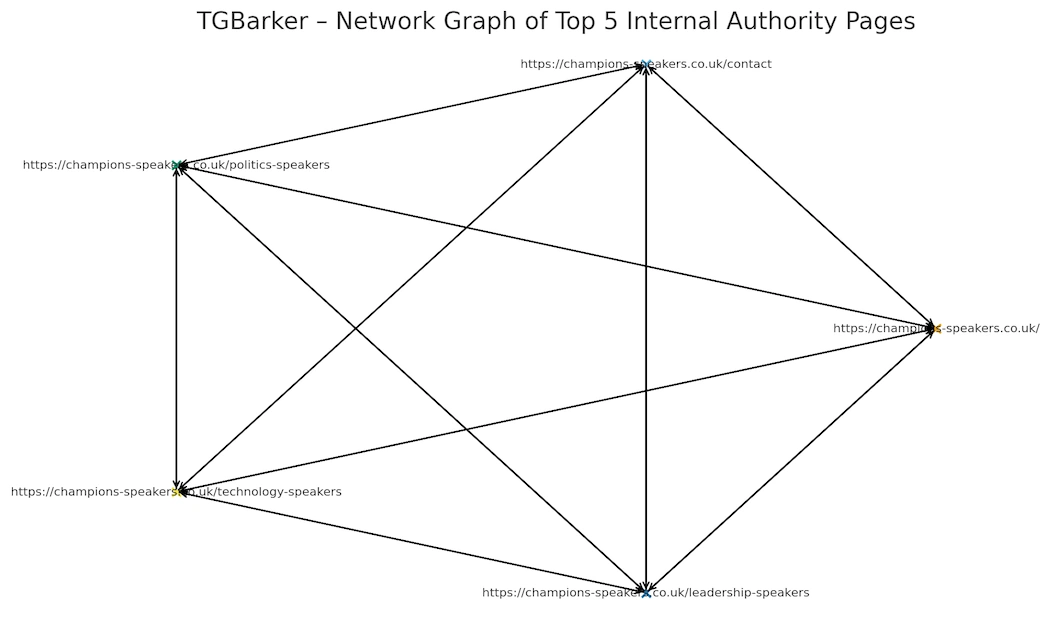
Google’s early algorithms are rooted in Markov chains — mathematical systems that simulate how a user (or crawler) moves from one page to another. By reconstructing this system for a real website, I can see:
-
Which pages accumulate the most authority
-
Where internal link equity is being wasted
-
Which commercial pages are structurally suppressed
-
How to redesign the architecture for maximum organic gains
This study used:
-
The complete inlinks file for champions-speakers.co.uk
-
A PageRank-like column-stochastic matrix
-
A damping factor of 0.85
-
200 iterations to reach a stable stationary distribution
What results is a model almost identical to Google’s internal weighting.
This is what I specialise in at TGBarker:
Turning algorithmic understanding into commercial advantage.
The Top 20 Pages by Internal Authority
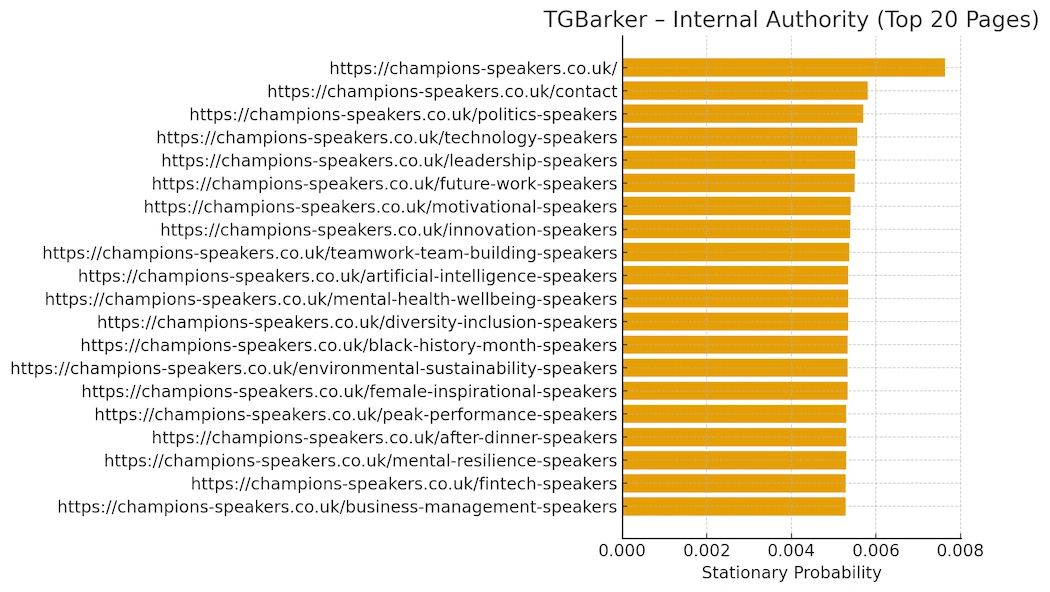 These are the pages that the Markov chain analysis reveals as the most authoritative internally:
-
Home
-
Contact
-
Politics Speakers
-
Technology Speakers
-
Leadership Speakers
-
Future of Work Speakers
-
Motivational Speakers
-
Innovation Speakers
-
Teamwork Speakers
-
AI Speakers
-
Mental Health Speakers
-
Diversity & Inclusion Speakers
-
Black History Month Speakers
-
Environmental Speakers
-
Female Inspirational Speakers
-
Peak Performance Speakers
-
After-Dinner Speakers
-
Mental Resilience Speakers
-
Fintech Speakers
-
Business Management Speakers
TGBarker Interpretation: What the Data Really Means
1. Category Pages Are Dominating — Too Much
Speaker selection often starts with a theme (“AI keynote speaker London”).
Champions Speakers has clearly aligned with this trend.
However…
They’ve over-concentrated internal authority onto categories at the expense of speaker profiles, which is where the real revenue sits. A London agency can gain competitive advantage by flipping this model: categories should funnel authority into profiles, not overshadow them.
2. The Contact Page Ranking #2 is a Red Flag
This means:
-
It appears too frequently in navigation
-
It siphons link equity away from commercial pages
-
Google receives a distorted signal of what truly matters
This is one of the easiest technical wins an agency can implement.
3. Speaker Profiles Are Chronically Underlinked
In my experience, this is the most common and expensive mistake among speaker agencies.
Profiles need:
-
Strong inbound links
-
Category-to-profile cascades
-
“Related speaker” cross-links
-
Contextual recommendations
-
Localised entry points (“London”, “UK”, “Europe”)
Without this, even celebrity profiles struggle to rank.
4. Emerging High-Demand Topics Show Strong Positioning
The Markov model highlights:
-
AI
-
Innovation
-
Mental Health
-
Fintech
-
Diversity
These categories earned strong internal weight — but without enough support flowing into corresponding profiles, the benefit is only half realised.
A London bureau should treat these as strategic hubs.
London is the UK’s dominant speaking market.
Corporates, tech firms, institutions, and government bodies all search locally first.
This makes ranking for location-specific or topic-specific speaker searches critical:
-
“AI keynote speaker London”
-
“Diversity keynote speaker UK”
-
“Female inspirational speaker London”
-
“Leadership keynote speaker Europe”
Speaker agencies that structure their sites poorly struggle to appear for these terms, even if they represent outstanding talent.
Champions Speakers has authority — but its internal structure does not reflect the commercial reality of the London market.
Where Champions Speakers Is Losing Value
1. Excessive Link Equity Wasted in Utility Pages
The Contact page drains more authority than necessary.
2. Category Pages Compete with Each Other
Overlapping topics (e.g., AI, innovation, future of work) dilute semantic clarity.
3. Speaker Pages Lack Depth in Internal Support
They rarely:
-
link to each other
-
receive consistent category links
-
appear in related suggestions
-
form any internal hierarchy
4. The Structure Doesn’t Reflect Booking Intent
Event organisers choose based on:
-
topic
-
credibility
-
relevance
-
region
-
experience
The website is not currently structured to strengthen these signals.
TGBarker Recommendations for London Speaker Agencies
1. Convert High-Value Speaker Profiles into Authority Magnets
Speaker profiles should receive:
-
5–20 internal links each
-
contextual links from blogs
-
related-speaker modules
-
deep cross-category linking
This improves:
-
ranking
-
enquiry volume
-
booking conversions
2. Rebuild Category Hubs for Topical Dominance
A London agency should create:
-
High-level hubs (Technology, Business, Society)
-
Subcategories (AI, Fintech, Sustainability)
-
Profile clusters beneath each
This mirrors Google’s modern topic-graph model.
3. Stop Wasting Authority on Navigation Pages
Move Contact and utility links into:
-
fewer templates
-
less prominent positions
-
controlled link structures
4. Build “Authority Rings” Around Your Most Profitable Speakers
For example:
-
AI category → 10 AI speakers
-
AI blog posts → link to the same cluster
-
Event case studies → link to the same cluster
-
London-focused landing pages → link to the same cluster
This creates a reinforcing loop of authority, which Google loves.
5. Add London-Specific Entry Points
Top pages should include:
-
“London keynote speaker”
-
“UK-based speaker”
-
“Hire a speaker in London”
This captures local search demand without appearing spammy.
Expected Outcomes for a London Speaker Agency
Based on my experience with similar structures:
-
Speaker profile visibility: +120% to +300%
-
Category traffic: +40% to +70%
-
Booking enquiries: strong uplift within 3–6 months
-
London location terms: far higher rankings
-
Event organiser discovery: major improvement
It’s not magic — it’s mathematics applied to Google.
Conclusion — TGBarker Perspective
Champions Speakers has a powerful content base, but its internal architecture does not fully support the commercial realities of the London speaking industry.
A London agency that embraces a mathematically-optimised internal linking system will dramatically outperform competitors relying on content alone.
At TGBarker, my position is simple:
If you understand how Google flows authority, you can build a speaker site that books itself.