

The Hidden Model Behind Your Website’s Rankings
Search systems do not just rank pages. They construct models — and rankings are the visible outcome of that model.
Search systems do not just rank pages. They construct models — and rankings are the visible outcome of that model.
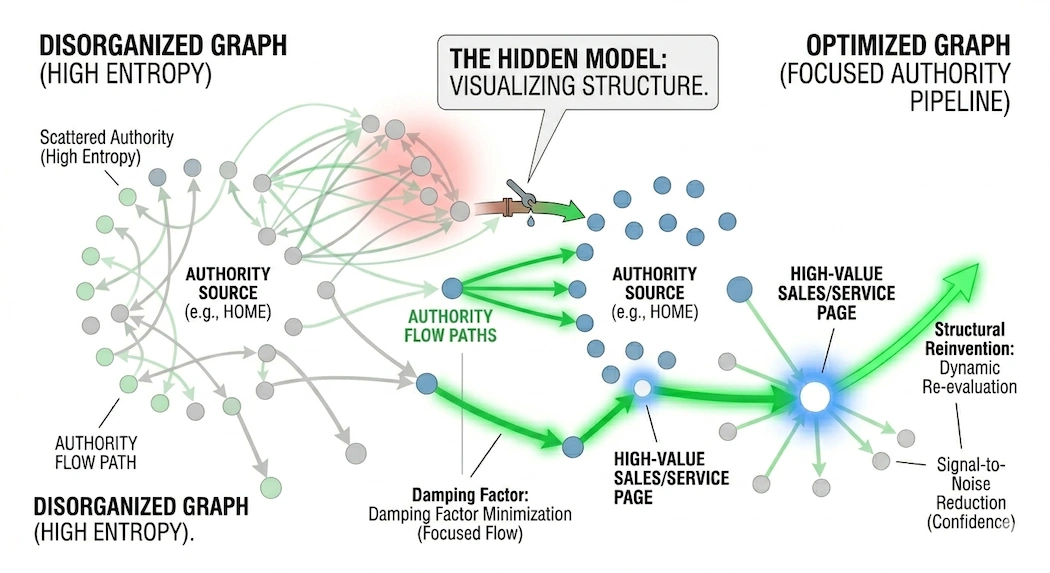
To understand why rankings plateau, we must look past the “Library” metaphor. Search systems evaluate websites using Graph Theory. They do not see a collection of files; they see a network of Nodes (pages) connected by Edges (links).
The value of a page is not just in its words, but in its mathematical position within your site’s network.
Links are the pipes. They determine the volume and direction of authority flow across your domain.
From this network, Google constructs an internal model that represents what your website is about and how much Confidence it has in each area. This determines How Search Systems See Your Organisation before a single visitor ever clicks a link.
These structural imbalances are often hidden. We frequently see Authority Misalignment, where a business aims to rank for a commercial term like “Used Cars”, but their Privacy Policy or About Us page carries more structural weight. The issue isn’t the quality of the content; it’s that the “Roadmap” is leading Google to the wrong destination.
In another scenario, a company operating as a Talent Agency may struggle to rank for its core term because the structure of the site places emphasis on individual talent profiles rather than the agency itself. The keyword “Talent Agency” becomes diluted across multiple pages, while the central identity of the business is not reinforced strongly enough. As a result, search systems do not clearly associate the domain with that primary concept, even though it is the organisation’s core offering.
In competitive sectors like travel or professional services, websites fail when authority and intent are diluted across too many nodes. To break a plateau, you must shift from reactive optimisation to deliberate structural positioning.
In property development, construction never begins without architectural plans. These plans define the structure and function before the first brick is laid. Without them, the outcome is random, regardless of effort.
Websites are rarely approached this way. They are built to meet objectives like traffic, but without a clear understanding of how the graph will be interpreted. By applying models similar to Markov Chains, we reveal where authority accumulates, where it dissipates, and where the “leakage” is occurring.
My review reveals how search systems currently interpret your website by making that hidden graph visible. We provide the architectural plans for a site that has already been built. Discover specifically how the Strategic Search Authority Review Works to provide clarity before you invest another pound in content.
Most SEO strategies are built around activity: More effort, more output. But search visibility is constrained by Structure. If the underlying interpretation of your site does not change, your results will not change.
To break a plateau, you must step away from pages and start seeing the network. Because that is what search systems evaluate. Not effort. Not output. Structure.