

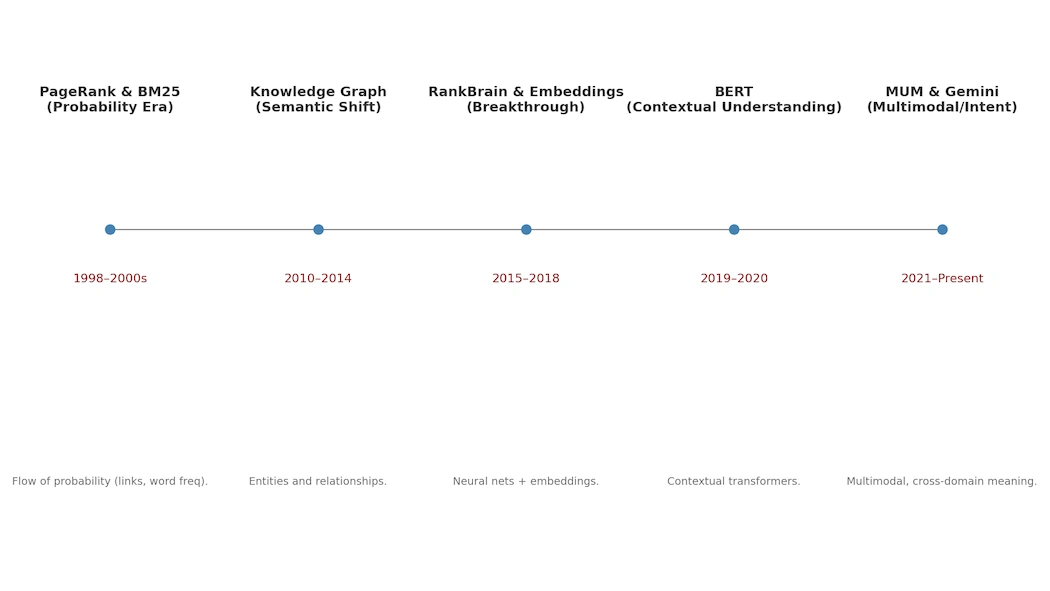
So as we at TGBarker understands it in short: Markov models explained the flow of probability, but embeddings explained the flow of meaning.
The Probability Era: PageRank & BM25
When Google launched in 1998, PageRank applied a Markov chain to the web’s link graph:
the “random surfer” model distributed authority based on how pages linked to each other.
In parallel, TF-IDF and later BM25 weighted words by frequency and rarity to score document relevance.
- Strength: mathematically rigorous ranking of likelihood and authority.
- Limitation: little semantic understanding—“apple” (fruit) vs “Apple” (company) remained ambiguous.
The Semantic Shift: Knowledge Graph
In 2012, Google’s Knowledge Graph began treating queries as entities and relationships.
It enabled direct answers (e.g., “capital of France”) using a graph of people, places, and things.
Powerful—but largely rule-based and brittle.
Neural Nets & Embeddings: RankBrain
The 2015 introduction of RankBrain brought neural networks and embeddings
into core search. Words and phrases moved into dense vector spaces where geometry encodes meaning
(think “king − man + woman ≈ queen”). Google could now generalise to unseen or ambiguous queries.
Contextual Understanding with BERT
With BERT (2019), transformers read words in both directions, capturing nuance and intent.
Queries like “can you get medicine for someone at a pharmacy?” are interpreted differently from
superficially similar strings. This shifted SEO from keyword presence toward intent satisfaction.
Multimodal & Intent Models: MUM & Gemini
Today’s MUM and Gemini connect meaning across text, images, code, and video.
Search is now about cross-modal understanding and knowledge transfer, not just matching tokens in text.
What This Means for SEO
understanding, coverage, and usefulness for the searcher’s task.
- Think in topics & entities: structure content around themes and relationships, not isolated keywords.
- Cover intent thoroughly: incorporate comparisons, steps, alternatives, pitfalls, and FAQs the user expects.
- Build an internal link graph: flow authority with hub-and-spoke structures from pillar pages to in-depth articles.
- Demonstrate expertise: cite sources, use data/diagrams, and add author bios where appropriate.