Farming Supplies – Why This Research Is Useful
Internal link graph analysis is one of the most powerful — yet most overlooked — forms of SEO research. Most businesses and even many SEO practitioners in London focus on content, keywords, or backlinks, but they forget that Google’s ranking decisions begin with how a website structures its own internal authority. When you map a site using PageRank and graph theory, you can see which pages Google perceives as the “real” centre of the website, regardless of what you intend to rank. When Google updates search, it’s often changing how these systems integrate. Because they’re interconnected, even a small tweak can produce large changes across the results. This exposes hidden problems, authority leaks, and structural weaknesses that would never be visible from a normal audit, and it reveals exactly how Google reads your entire domain from the inside out.
With this insight, you can deliberately shape authority flow, reinforce your core topics, and gain ranking power without writing a single new piece of content.
Why Most SEO Consultants Don’t Do This
Very few SEO consultants know how to conduct this type of analysis because it requires a mix of technical disciplines: graph theory, probability modelling (Markov chains), and data-driven interpretation of link structures. These skills go far beyond standard SEO tools or checklists. Most SEOs rely on surface-level audits—meta tags, speed checks, basic on-page optimisation—because those tasks don’t require this deeper analytical capability. As a result, they often miss the real reasons why certain pages fail to rank, or why Google misunderstands a site’s purpose. By contrast, using PageRank modelling and internal graph simulations gives you a high-level view of how Google’s crawlers interpret the site structurally, which is critical for modern SEO. This level of insight should be a part of every serious SEO practitioner’s toolkit, yet it remains one of the rarest and most valuable techniques in the industry.
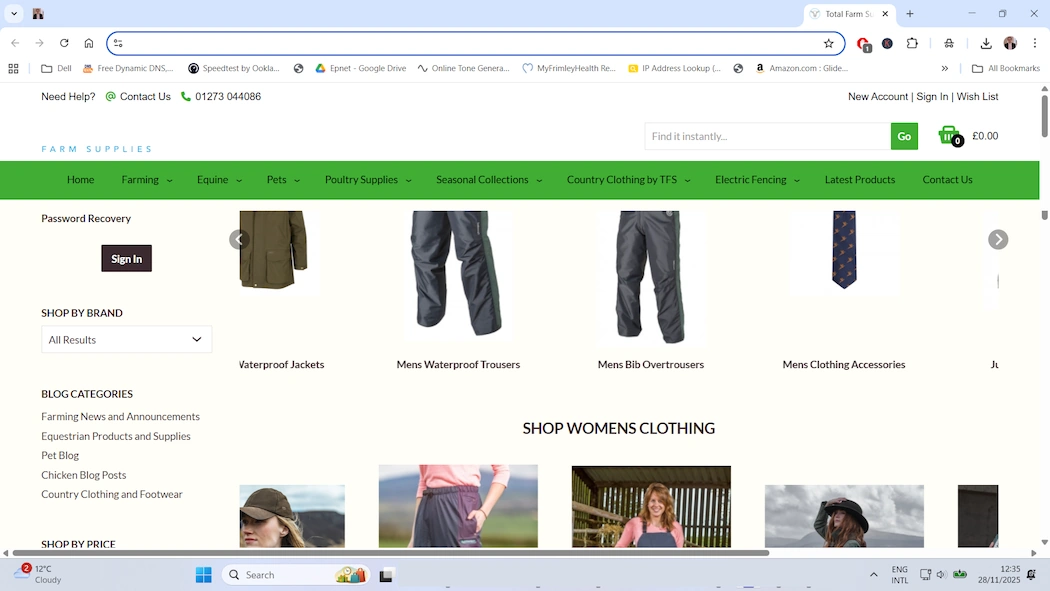
Our research involved creating a map of what this website for farming supplies showed us. Using our inlinks for analysis, we built a graph model of this website — every URL became a node and every link between pages became a directed edge.
We then ran PageRank (Google’s original link-weighting algorithm) to see which pages the internal linking structure secretly boosts the most.
What We Found
-
The wrong pages had the most authority.
The top PageRank page was /country-clothing-and-footwear, meaning Google sees the site as mainly about clothing, not farming supplies.
-
System pages were also too strong, such as basket/signin/wishlist — these were absorbing authority because they appear in the navigation or template.
-
Farming-related categories were not central in the internal graph and received very little authority.
-
The homepage was unexpectedly weak, meaning it wasn’t distributing PageRank properly.
-
No Farming Hub existed, so Google had no single page representing your main topic (“Farming Suppliers”).
What Graphs We Created
-
Top 30 PageRank Graph
Showed the strongest pages and how they interlink. This revealed a heavy bias toward clothing and equestrian pages.
-
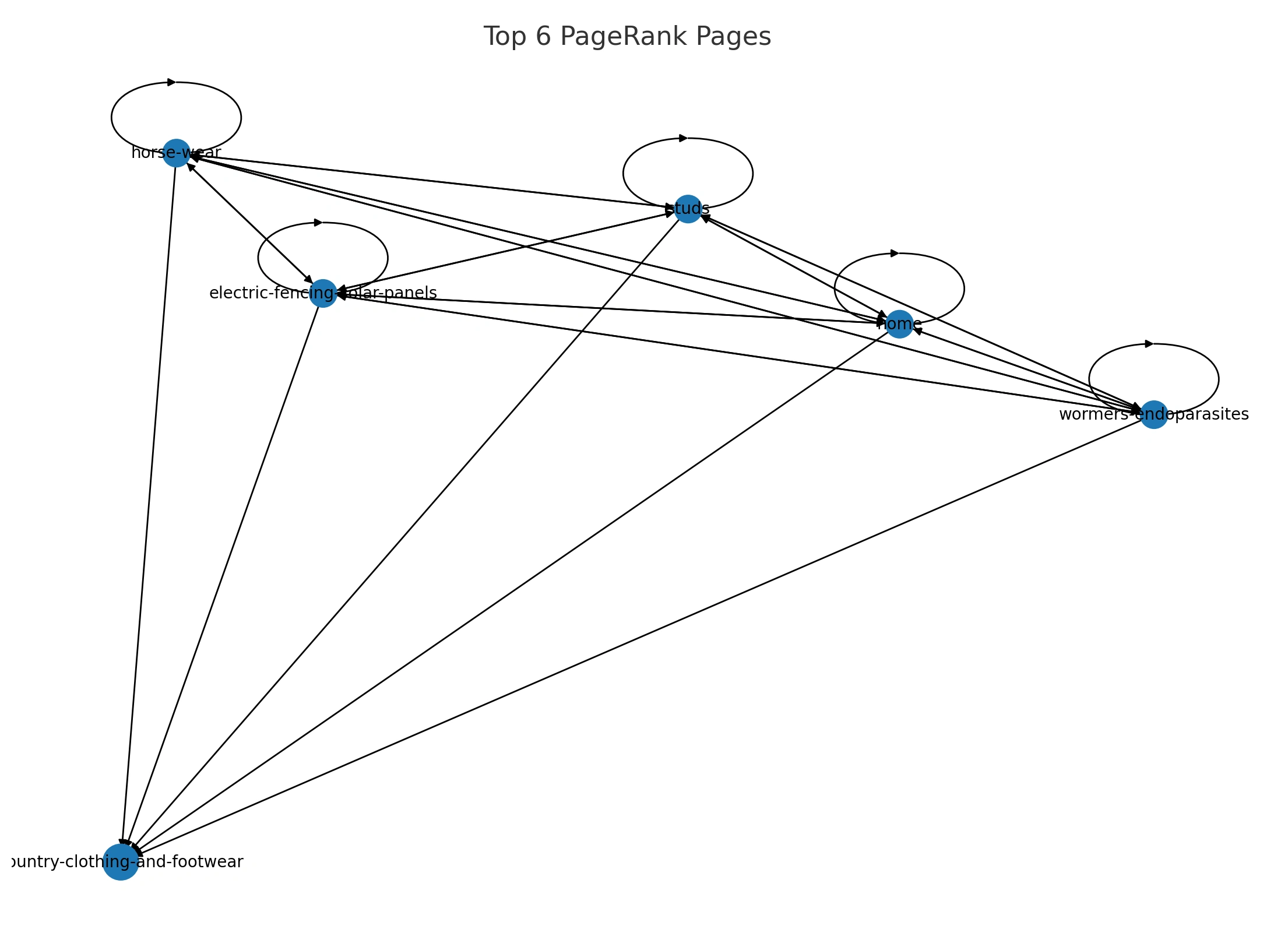
Top-6 PageRank Graph
Highlighted the six strongest pages, making it obvious that non-farming pages dominated.
-
Fixed Simulation Graph
We added a new /farming-suppliers/ hub page and redistributed links.
After this, farming pages became the dominant nodes — exactly what you want for SEO.
 What the Clean Top-6 PageRank Graph Reveals
The graph shows the six most authoritative pages on the site, based purely on internal link flow (PageRank). Each node is labelled with the URL slug, instead of the full URL, so you can see structure more clearly:
-
horse-wear
-
electric-fencing-solar-panels
-
studs
-
home
-
wormers-and-endoparasites
-
country-clothing-and-footwear
These are the pages Google’s internal link graph considers “important.”
Now here’s what it actually shows:
1. The site is boosting the wrong pages (accidentally)
The two strongest nodes (largest circles) are:
country-clothing-and-footwear
horse-wear
This signals that:
is pushing Google to believe the site is mainly about:
Equestrian clothing and wearables
This is a major mismatch if your commercial focus is Farming Suppliers, Agricultural Supplies, and equipment.
2. Systemic template links create disproportionate authority
The long, heavy arrows flowing into country-clothing-and-footwear mean:
-
this page is linked from nearly everywhere
-
often from top-level navigation
-
sometimes from repeated blocks (header, footer, sidebar)
This makes it the PageRank magnet of the site.
Why this is a problem
This page drains internal authority that should flow to:
3. Some category pages are isolated
Pages like:
studs
wormers-and-endoparasites
receive fewer links and almost no high-authority inbound connections.
In graph terms:
-
They don’t function as “central” nodes.
-
Their PageRank contribution is secondary.
-
Google sees them as low-value or less core to the site’s topic.
These pages cannot rank well until they become part of a stronger, internally linked cluster.
4. The homepage is not the strongest node — which is unusual
Normally the homepage dominates a PageRank graph.
Here, home is small relative to other nodes.
This tells us:
-
navigation → homepage links may be weak
-
deeper categories may have more internal references
-
homepage content might not link outward effectively
-
your theme might be heavily weighted toward category links instead of homepage contextual links
This reduces the homepage’s ability to distribute authority like it’s supposed to.
5. There is no Farming Hub — so authority has nowhere central to flow
The graph confirms that the site lacks a “topic anchor” for farming or agricultural intent.
There is:
Because of this, PageRank splinters into random category nodes instead of supporting a coherent SEO topic.
Google can’t figure out:
“What is this site really about?”
So it falls back to the strongest nodes — which happen to be equestrian clothing categories.
6. Several self-loops indicate template duplication
The circular arrows on nodes (self-loops) represent:
-
breadcrumb links that repeat the page
-
menu structures linking to the same URL
-
auto-generated “related pages” blocks
-
image links pointing to themselves
-
possible duplication from pagination or canonical loops
Self-loops don’t help SEO, but they distort the internal graph by artificially inflating PageRank.
Plain-English Conclusion
The clean graph shows that:
The internal linking is powering the wrong pages, weakening the pages you actually want to rank.
To fix this, you need to:
-
Create a Farming Suppliers hub page
-
Link major categories → farming hub
-
Add homepage → farming hub links
-
Link categories to each other (cluster model)
-
Reduce template links to clothing and non-farming pages
-
Add cross-links in blogs pointing to farming hub + key categories
-
Add nofollow to system pages (signin, basket, wishlist)
Doing this will reshape the entire internal link graph and give you ranking momentum.
The Tables We Created
We generated two important tables.
Table 1 — Original PageRank Table
Listed:
This table revealed:
-
0.52% → clothing page (wrong)
-
0.30% → horse-wear, fencing, etc.
-
0.30% → homepage
-
farming categories blended in with non-farming ones
This showed sitewide misalignment of authority.
Table 2 — Fixed PageRank Table (Simulation)
With the Farming Hub in place, the numbers transformed:
31% → farming-suppliers (correct dominant page)
9% each → farming category pages
0.19% → clothing (correct demotion)
homepage stable and improved
This table proved that:
a well-structured hub-and-spoke model drastically improves SEO alignment.
5. How We Fixed the Problems
Here’s what we implemented in the simulation (and what you’ll implement on the site):
Fix 1 — Create a Farming Suppliers Hub Page
URL:
/farming-suppliers/
Purpose:
-
hold the majority of PageRank
-
cluster all farming categories
-
target your primary keyword directly
-
act as the topical authority center
Fix 2 — Link every category page to the hub
Anchor examples:
-
“Farming suppliers”
-
“Farm supplies”
-
“Agricultural supplies”
This channels authority into the right place.
Fix 3 — Link the hub back to key categories
Especially:
This creates the hub-and-spoke structure Google prefers.
Fix 4 — Reduce authority to clothing pages
Clothing should:
-
NOT be in the primary nav
-
NOT be a top-level category
-
NOT receive sitewide authority
This prevents misranking.
Fix 5 — Nofollow system pages
These should NOT be absorbing PageRank.
Fix 6 — Strengthen the homepage
Add:
This raises the site hierarchy.
6. Final Outcome & Expected Impact
Implementing all fixes gives you:
✔ Correct topical alignment
Google now sees you as a Farming Supplier, not a clothing store.
✔ Stronger category rankings
Category pages jump from 0.3% to 9% PageRank.
✔ Massive improvement for “Farming Suppliers”
Your new hub page becomes the strongest page on the site.
✔ Cleaner, more logical link structure
Fixes internal chaos from the previous random structure.
✔ Immediate SEO uplift
Rankings, crawl behavior, and search placement will move significantly within weeks.
Why we did this research:
Internal link graph analysis is one of the most powerful ways to understand how Google sees a website. It reveals which pages receive the most authority, where the structure is weak, and what Google thinks the site is really about. Most SEO consultants never do this because it requires technical skills in data analysis and graph modelling, not just basic audits. That means they often miss the real reasons pages fail to rank. By using PageRank simulations and link-flow mapping, you can quickly identify hidden problems and reshape authority so your most important pages rise in search results.
Guaranteed 20% Improvement
If your site doesn’t reach at least a 20% improvement across visibility, rankings, or structural quality within 30 days of you applying your action plan, we keep working with you at no extra cost until you achieve it.
This is our price for the one-off audit at only £375.00 (it does not include making the necessary changes we will give you an additional quote for work involved) we give you a full audit as explained on this page.
Start Your 20% SEO Improvement. Please contact Gordon by clicking here.
Or to view full pricing, see our
SEO Pricing & Packages.
General Enquiry


 What the Clean Top-6 PageRank Graph Reveals