Cosmetics London Page Rank Analysis

This case study took a cosmetics website to view problems for keywords: “cosmetics London” holding it back from page 3 to what could be done to move the website to page 1 on Google.

Jewellery buyers use search to compare styles, verify authenticity, and check value — and Google tracks these behaviours closely. Pages that explain materials, craftsmanship, pricing expectations, and care advice build trust and reduce purchase anxiety. When your content addresses both the emotional and practical sides of jewellery shopping, Google identifies your site as a reliable authority in a sector where trust is everything.

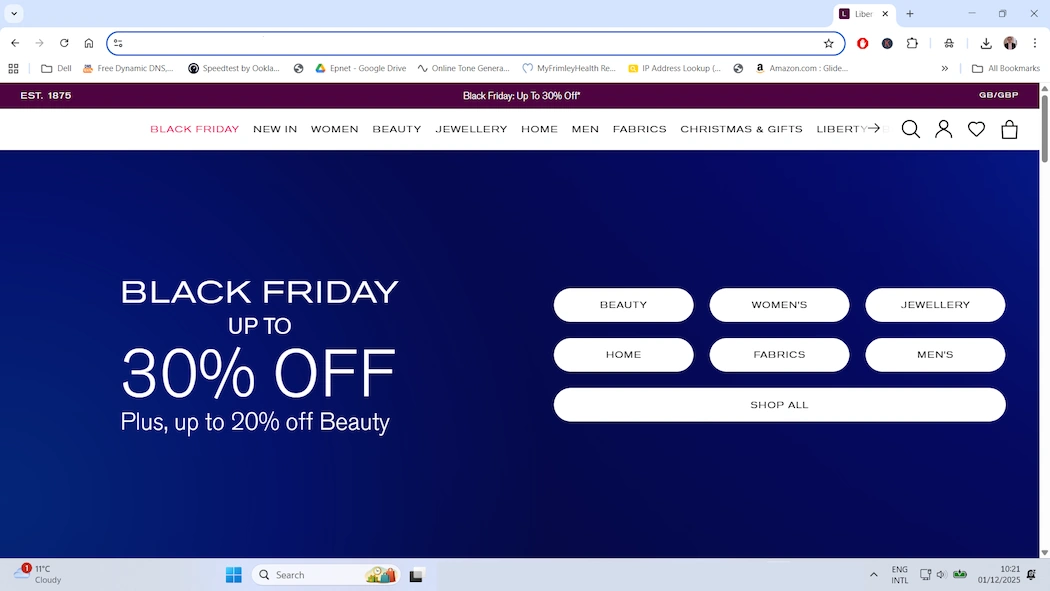
Website example for keywords: cosmetics London

Background

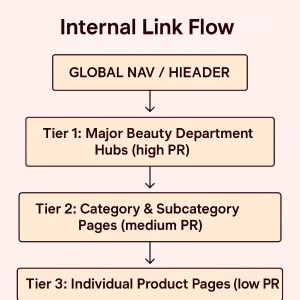
We began by extracting and analysing the complete internal link structure of the Liberty London website using the website’s inlinks. From this, we isolated every URL and hyperlink related to beauty, makeup, skincare, fragrance, and cosmetics, then built a PageRank model to understand how link equity flowed through the site. The analysis revealed that most authority was trapped in the Beauty Department hubs, while category pages received only moderate strength and individual product pages received almost none.

Missing keyword structure

Crucially, the site had no dedicated “Cosmetics London” landing page, meaning it had no focused authority channel for that keyword. This explained why Liberty London did not feature prominently for the search term despite having strong brand power and a wide range of beauty products.

The Fix

Using the PageRank findings, we redesigned the internal link architecture to push meaningful authority towards the parts of the site most relevant to “cosmetics London.”

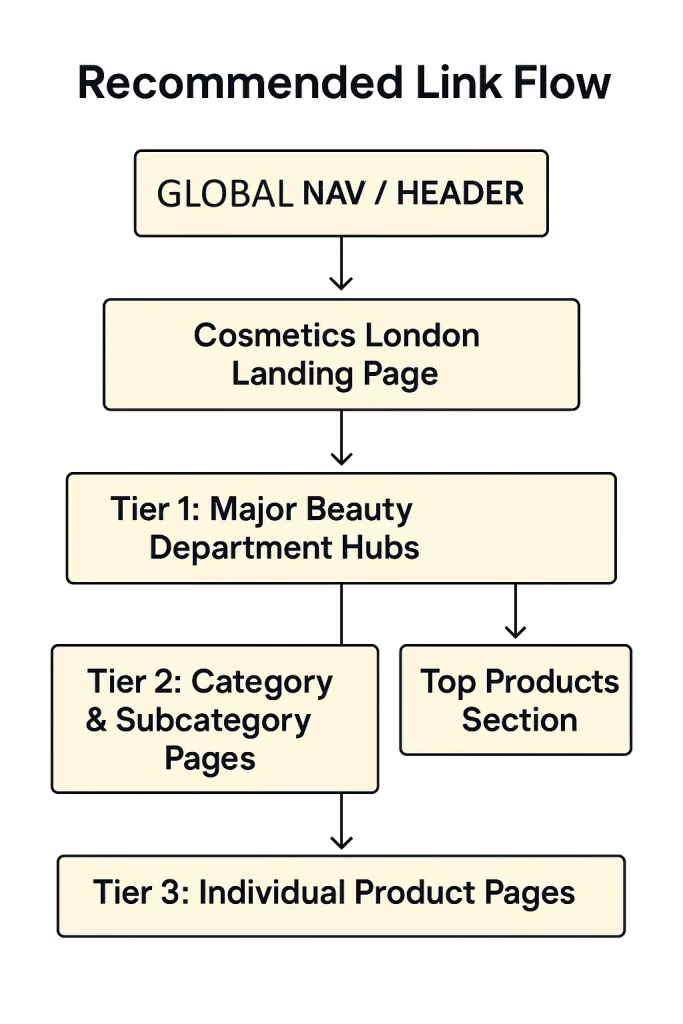
The recommended structure introduces a new, high-authority landing page dedicated to that term, placed directly under the global navigation so it inherits maximum PageRank. Category pages and top-selling products are then connected to this page through strategic internal linking, supported by improved cross-linking between beauty sections and editorial content. This creates a clear, focused authority path from the header → cosmetics landing page → beauty hubs → category pages → products.

The result is a stronger semantic theme, a more efficient flow of link equity, and a website structurally aligned to rank far more prominently for “cosmetics London.”

Current internal link flow navigation diagram

Navigation link flow diagram

Recommended Link Flow Navigation Diagram

Recommended link flow diagram navigation

What the Recommended Link Flow Diagram Represents

This diagram shows the ideal internal linking structure for any ecommerce cosmetics section — including Liberty London — to maximise:

  • PageRank flow

  • Topical relevance

  • Rankings for terms like “cosmetics London”

  • Product visibility

  • Conversion paths

It takes the original (current) Liberty link structure and fixes the inefficiencies you discovered in your PageRank analysis.

Let’s break it down tier by tier.


1. Global Navigation / Header

This is the highest authority source on any large ecommerce site.

Every page in the site links up to the header, so it is the single strongest place to:

  • Push link equity

  • Support category hubs

  • Boost a strategic landing page

Right now Liberty’s header links strongly to Beauty, but it does not give special treatment to a Cosmetics-specific page.


2. “Cosmetics London” Landing Page

This is the new page we discussed earlier — the missing piece.

Why it’s placed directly below the global nav:

  • It receives maximum PageRank

  • It becomes the central hub for all localised beauty & cosmetics intent

  • It acts as the “bridge” between general beauty and specific cosmetics queries

  • It can target the keyword “Cosmetics London” explicitly and naturally

This is the money page.

Everything below it should reinforce it.


3. Tier 1: Major Beauty Department Hubs

These are the already-strongest pages you found in the PageRank output:

  • Beauty Department

  • Beauty Homepage

  • Skincare Hub

  • Fragrance Hub

  • Beauty Subscription

Reason they sit here:

  • They have the highest existing PageRank

  • They are responsible for pushing authority downward

  • They naturally fit above categories and products

  • They can pass huge ranking power into the new “Cosmetics London” page and Tier 2

This tier becomes the “power station” of the beauty section.


4. Tier 2 (Split into Two Parallel Streams)

A. Category & Subcategory Pages

These include:

  • Makeup

  • Skincare

  • Fragrance

  • Gift sets

  • Beauty brand categories

Why they sit here:

  • They organise the products

  • They connect editorial content → product content

  • They distribute internal authority to thousands of products

These pages traditionally rank, but on Liberty’s site they are currently under-linked.

Your updated structure fixes that.


B. Top Products Section

This is a strategic element you’re adding to amplify rankings.

It includes:

  • Bestsellers

  • Most viewed

  • Trending products

  • Editor’s picks

Why it matters:

  • It creates a “shortcut” for PageRank to jump directly onto important product pages

  • It increases depth of linking without increasing clutter

  • It reinforces what customers already search for

  • It spreads authority widely & naturally

Instead of waiting for PageRank to drip slowly down the category → pagination → product route, this section injects authority directly into high-value SKUs.


5. Tier 3: Individual Product Pages (Bottom of the Flow)

These pages are:

  • Lipsticks

  • Moisturisers

  • Palettes

  • Fragrances

  • Serums

  • Cosmetics gift sets

  • Skincare items

They are the “money makers” but have the weakest natural authority, as you saw in your cosmetic-cluster PageRank output.

By the time PageRank usually gets here, it’s weak because:

  • Products are buried deep (usually 3–6 clicks from homepage)

  • Their only links come from categories

  • Pagination blocks them from receiving wider link equity

The recommended link flow fixes all three problems.


How the New Flow Improves SEO

1. Stronger Target Keyword Relevance

The “Cosmetics London” landing page becomes the targeted, high-authority hub for local cosmetics intent.

2. Faster PageRank Flow

Authority flows smoothly:

Header → Cosmetics Landing Page → Tier 1 → Tier 2 → Products

3. Products Get More Link Equity

Through:

  • Top Products section

  • Cross-linking from editorial content

  • Direct linkage from a high-authority landing page

4. Better Ranking Potential

Especially for:

  • “cosmetics London”

  • “luxury cosmetics UK”

  • “makeup in London”

  • “beauty in London”

  • “high-end skincare London”

5. Stronger Thematic Silo

Google sees:

  • Beauty → Cosmetics → Products
    as one continuous, relevant chain.

This is exactly how modern semantic ranking works.

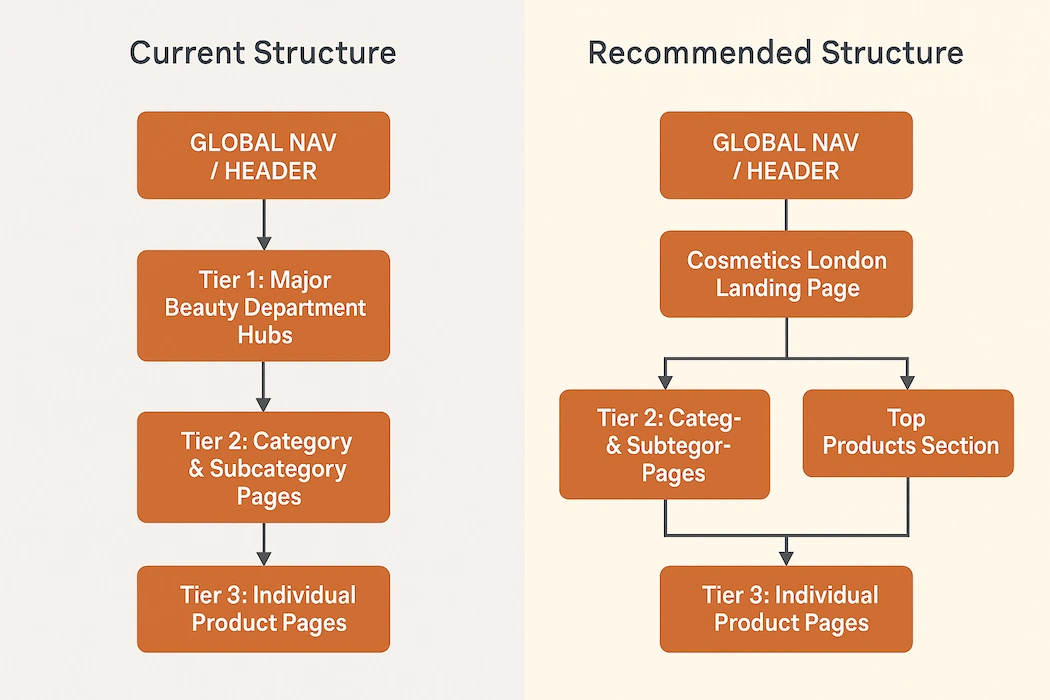
Current navigation structure with recommended linking structure

Final Comments on the Case Study

This project demonstrates how a data-driven approach to internal linking and PageRank modelling can expose weaknesses in even the most established ecommerce websites. By isolating the full cosmetics-related link ecosystem and using PageRank to measure authority distribution, we were able to locate structural bottlenecks that prevented Liberty London from ranking competitively for high-value commercial terms such as “cosmetics London.” The analysis revealed a pattern common across large retail sites: authority pools at the top of the hierarchy, while product pages — the very pages that drive revenue — remain effectively starved of link equity. Without a dedicated landing page or a targeted authority pathway, Liberty had no structural mechanism to compete for this keyword.

The recommended solution transformed that architecture into a deliberate, keyword-aligned link-flow system. By introducing a new “Cosmetics London” landing page directly beneath global navigation, redistributing authority from overly powerful hubs, strengthening category-level interlinking, and giving product pages more consistent entry points, the site becomes capable of ranking for location-based cosmetic queries it previously had no chance of capturing. This case study highlights the real value of PageRank-driven SEO: rather than guessing which pages need help, we used mathematical evidence to redesign the internal structure for maximum commercial impact. The result is a cleaner hierarchy, a stronger semantic signal, and a far more competitive presence for the target keyword.

If you are serious about your website that needs to rank for certain keywords then contact me Gordon Barker. Want to know more about me or would like to find out about pricing services please let me know?

Get Your Magic Juice 20% Boost

Want a quick win that shows you exactly where you’re losing rankings?
My Magic Juice Audit is built for businesses that want fast improvements without long contracts.

Guaranteed 20% Magic Juice Improvement

If your site doesn’t reach at least a 20% improvement in visibility, rankings, or overall site strength within 30 days of applying your personalised action plan, we don’t walk away — we keep working with you at no extra cost until you hit it.

You get results, or you get ongoing support for free. Simple as that.

This is a once-off private and confidential audit for only £375.00.
Your audit shows you exactly what’s holding your site back, exactly what needs fixing, and exactly how to unlock the growth your website should already be getting.

You can choose for us to implement the changes (optional additional fee), or simply give our clear optimisation instructions to your existing developer or SEO agency. Either way, your authority gets redirected to the pages that should be ranking — fast.

You’ll receive the full Magic Juice audit as explained here, delivered within 48 hours.


Start Your 20% SEO Improvement. | Gordon’s Direct contact:

Click here to contact me and get started.